If you want home buyers to get excited about purchasing your home, then it needs to look it’s very best!
Most people don’t want to spend hundreds of thousands of dollars to buy a “fixer upper” that needs fresh paint and flooring…they want “move in ready.”
But most of us don’t live in a home that looks like a builder’s model! The way you live comfortably in your home is not how you should stage your home for sale. 🙂
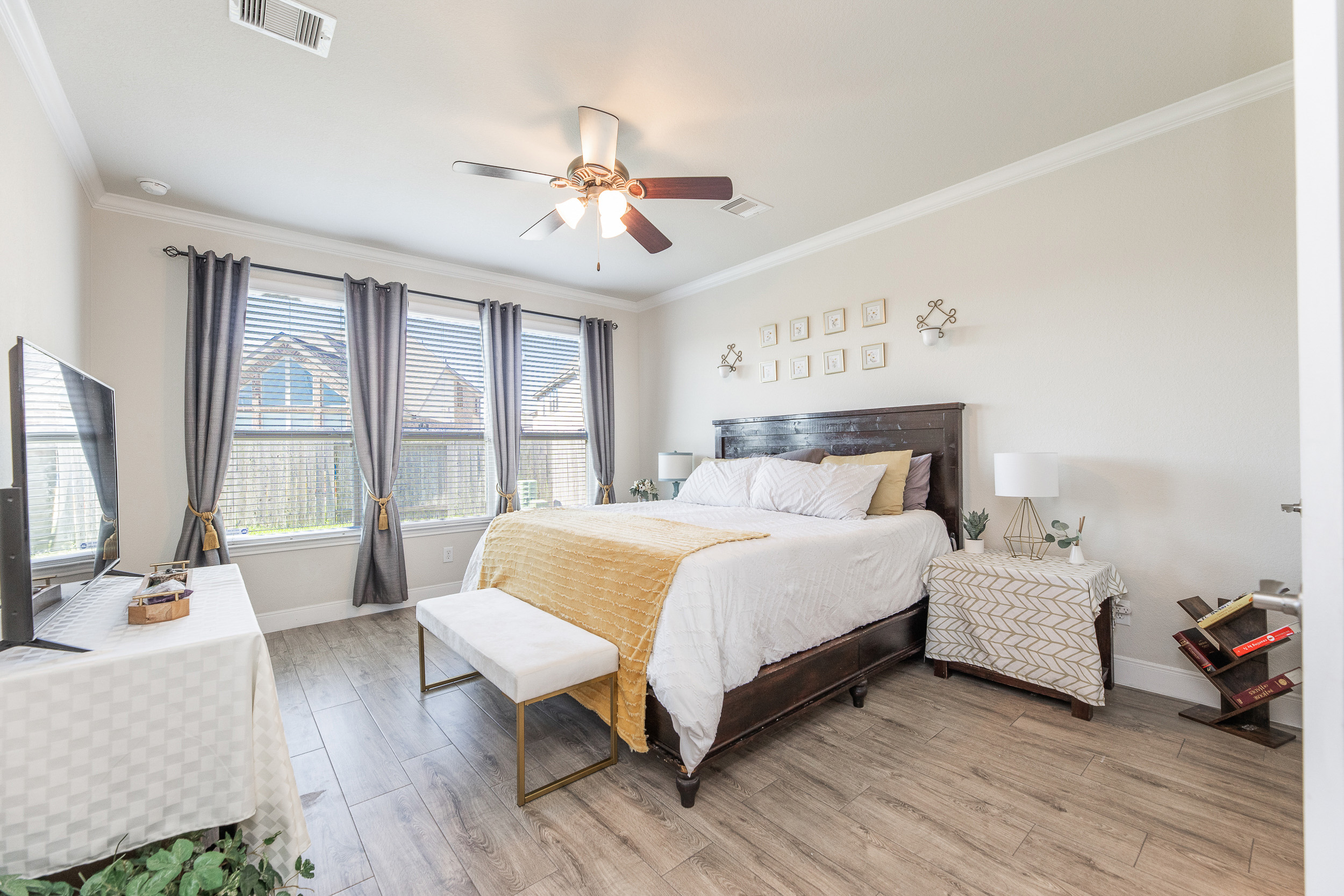
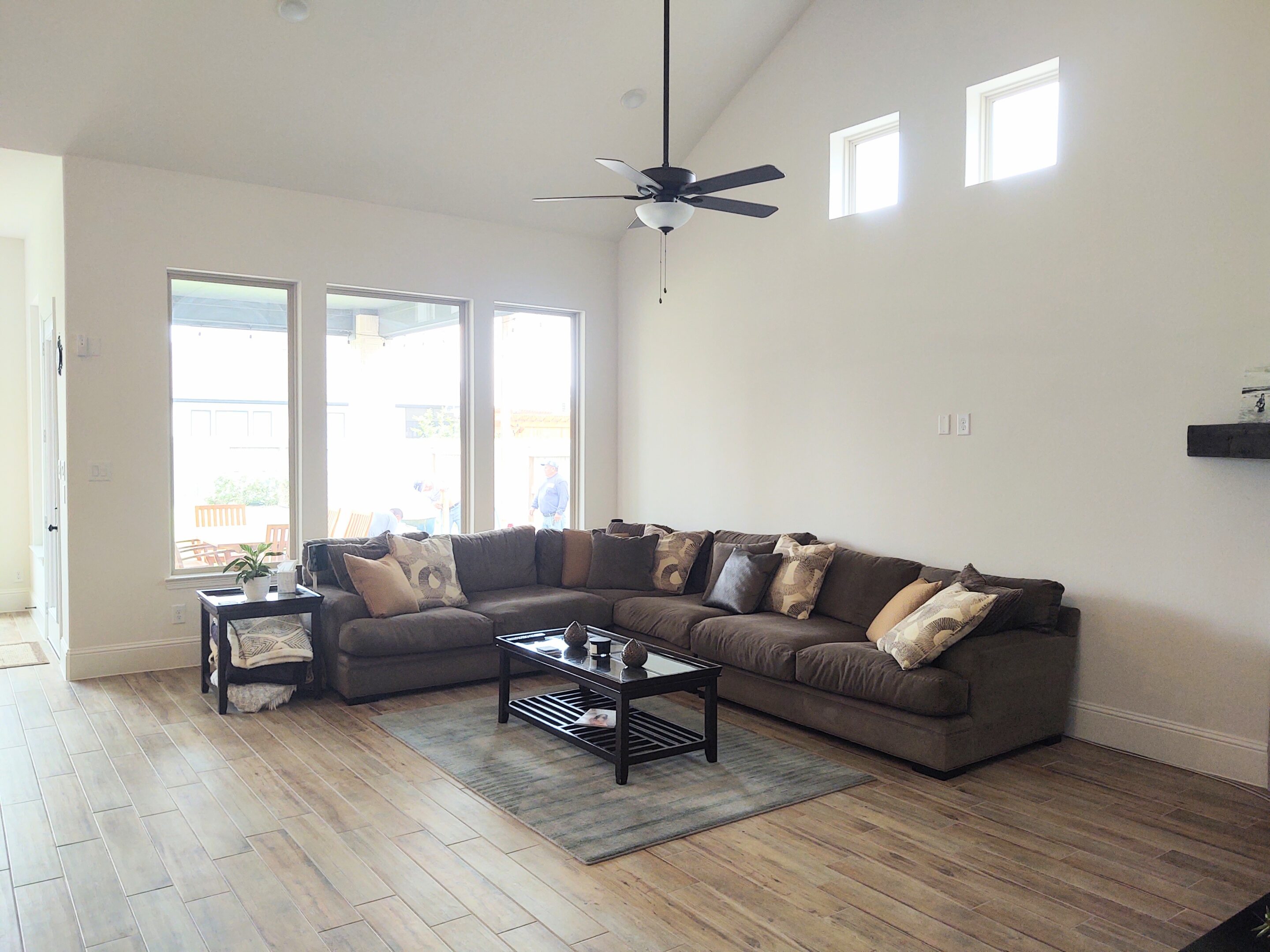
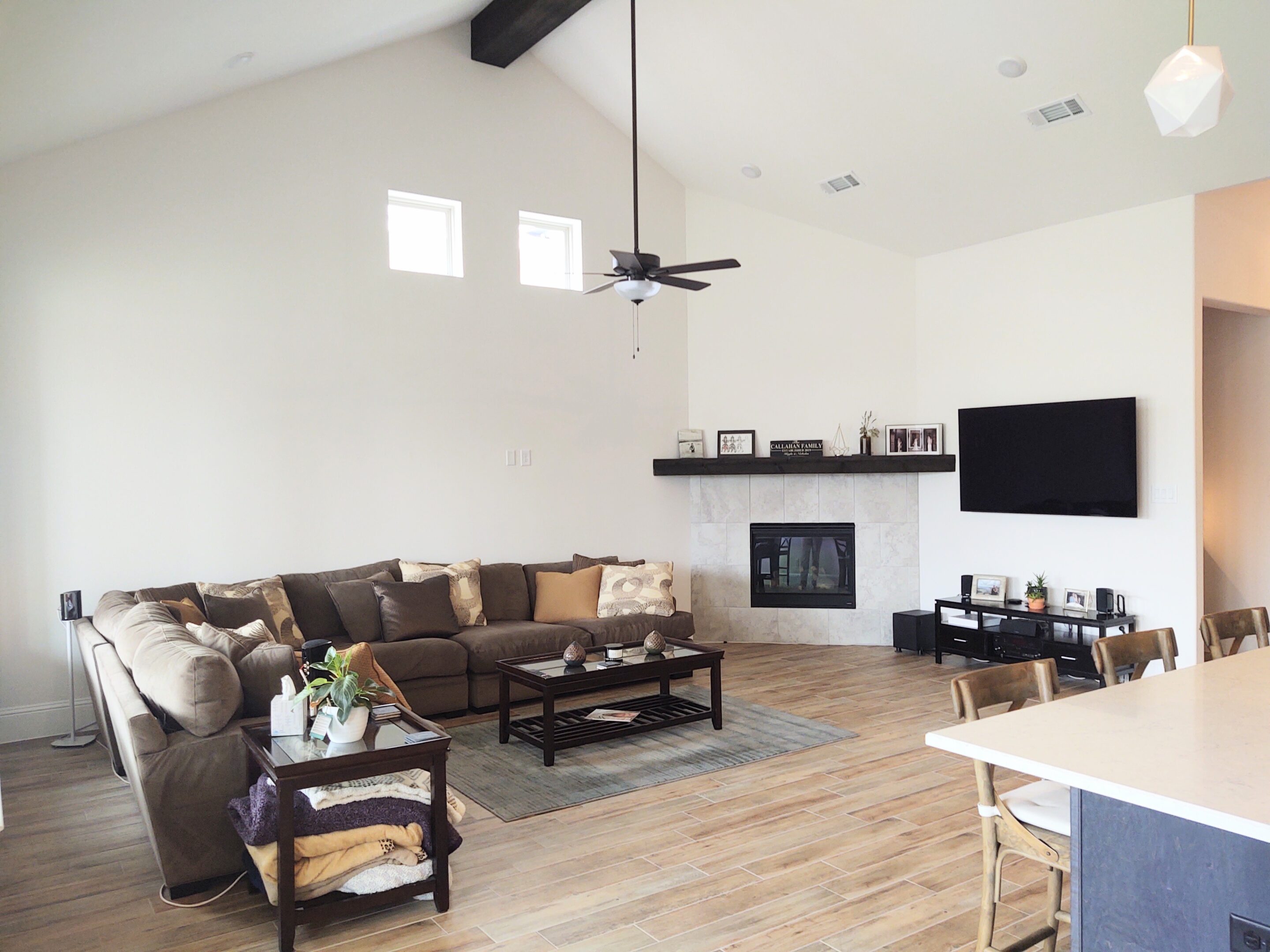
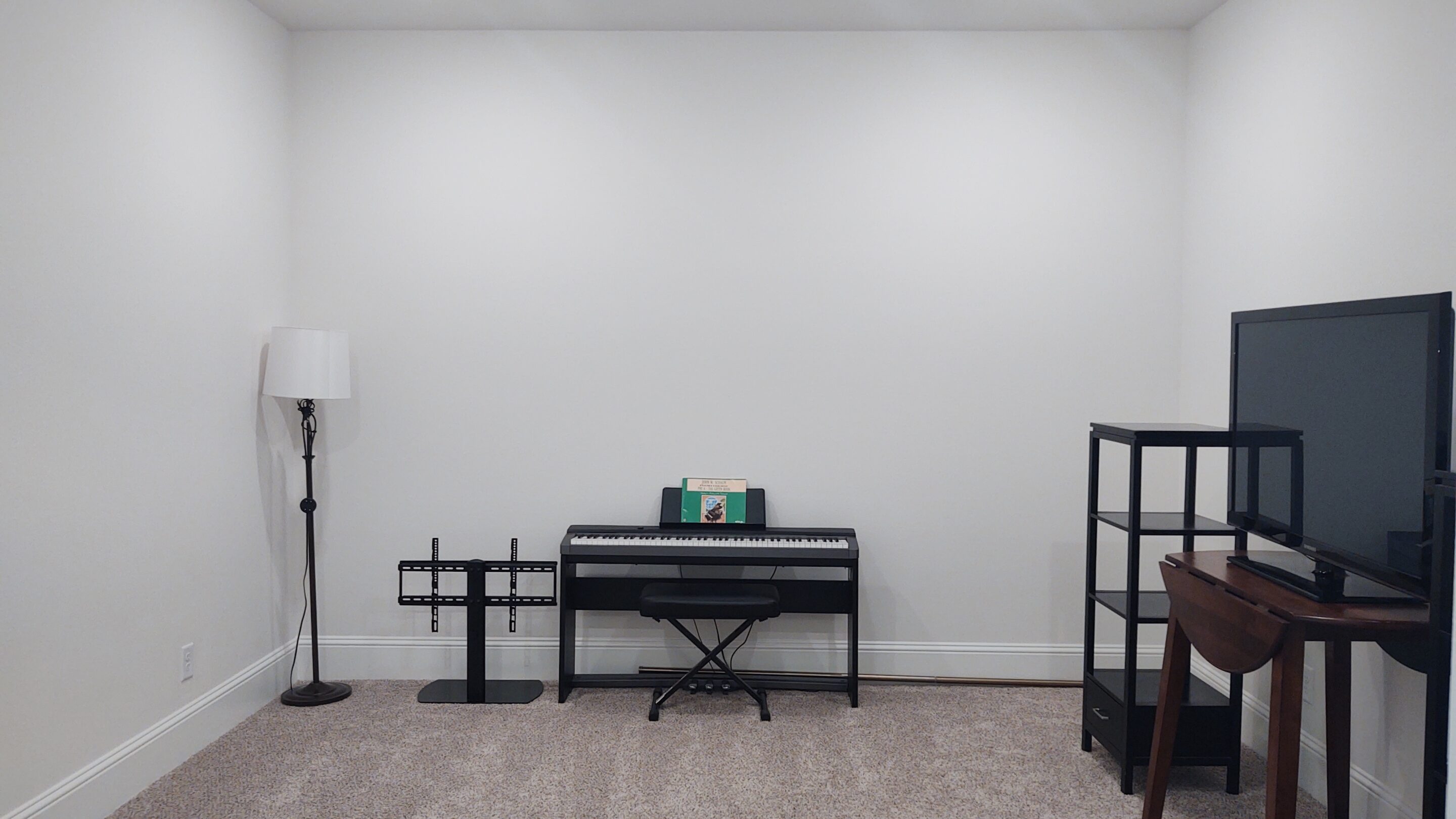
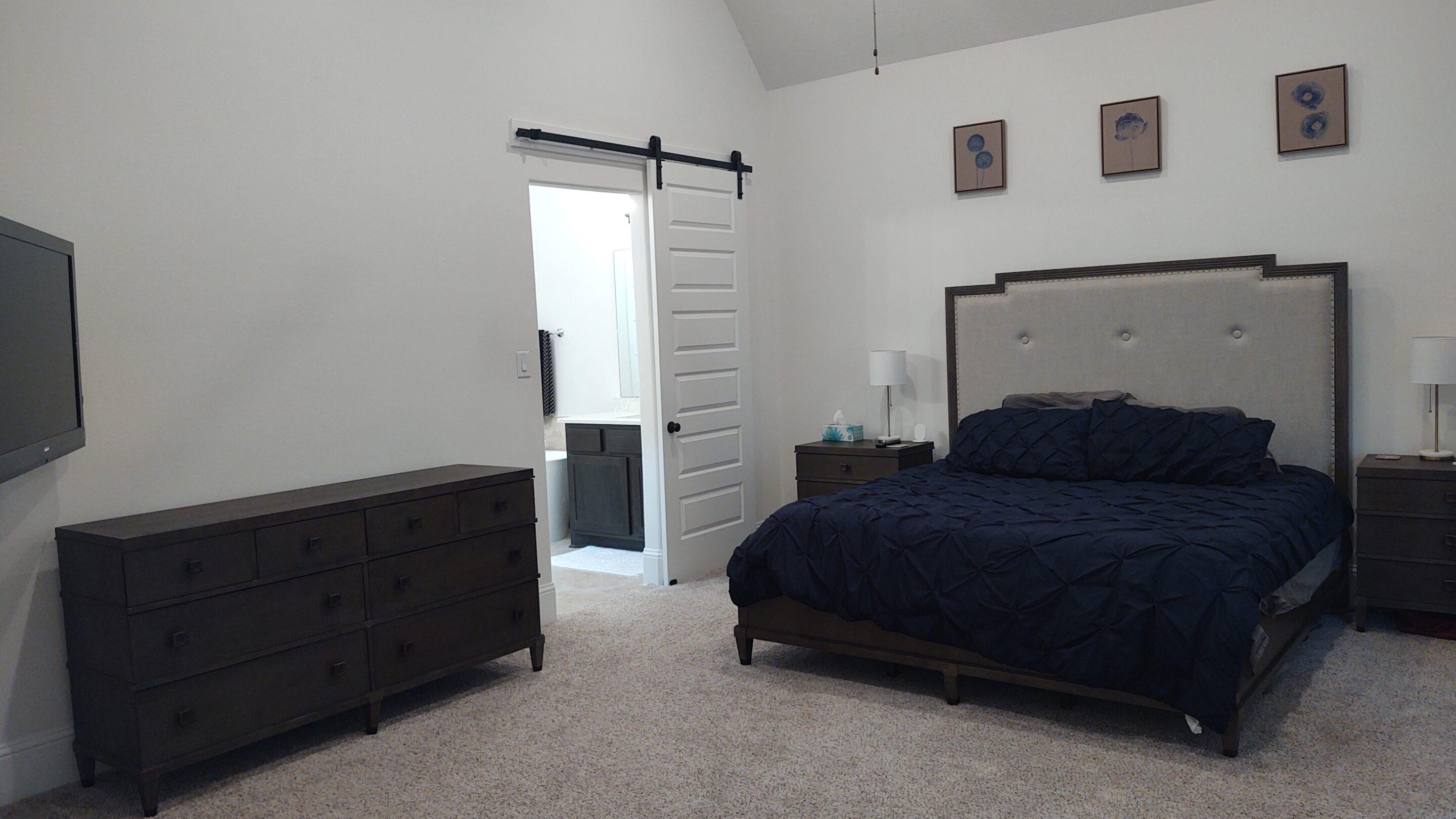
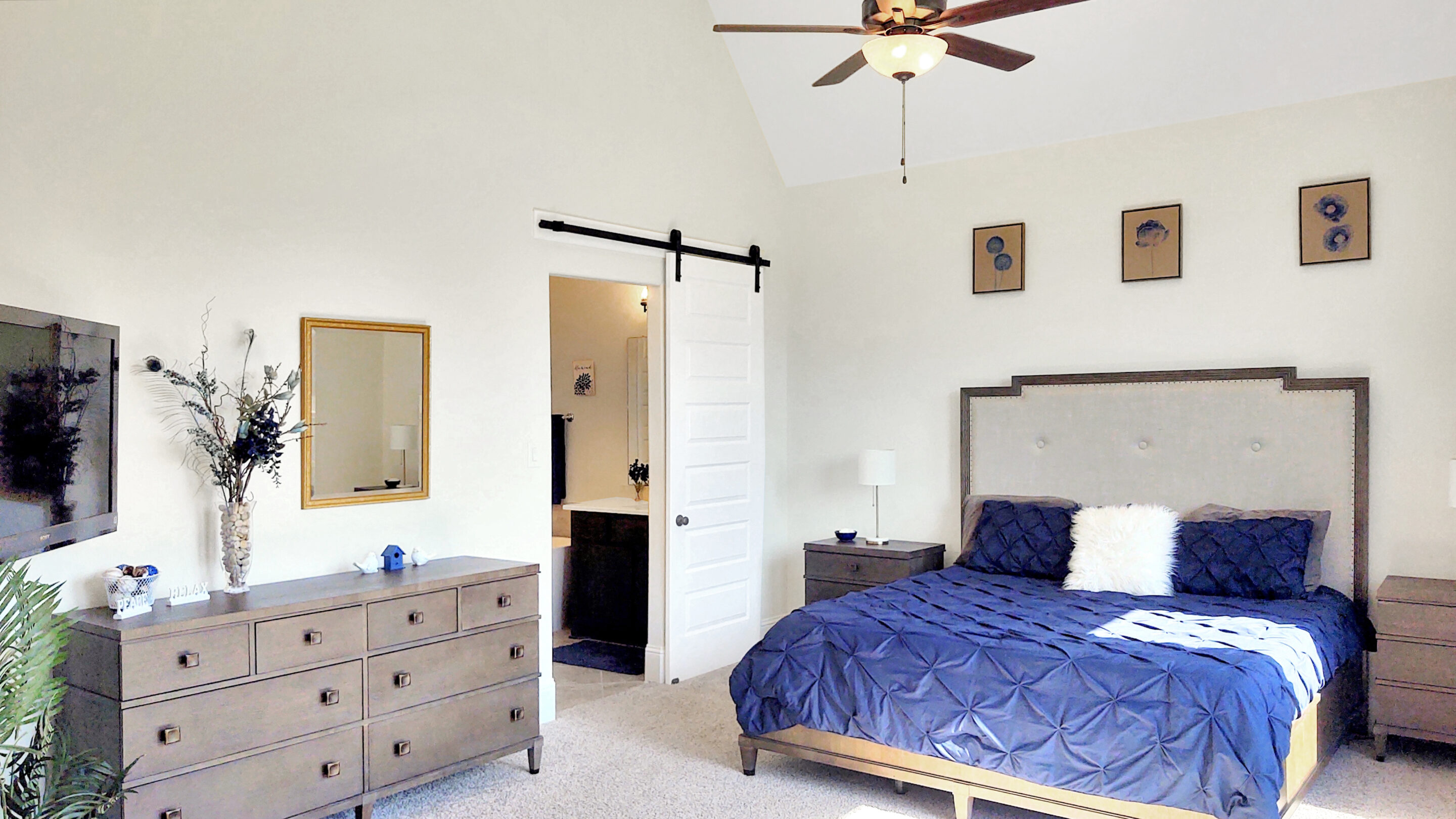
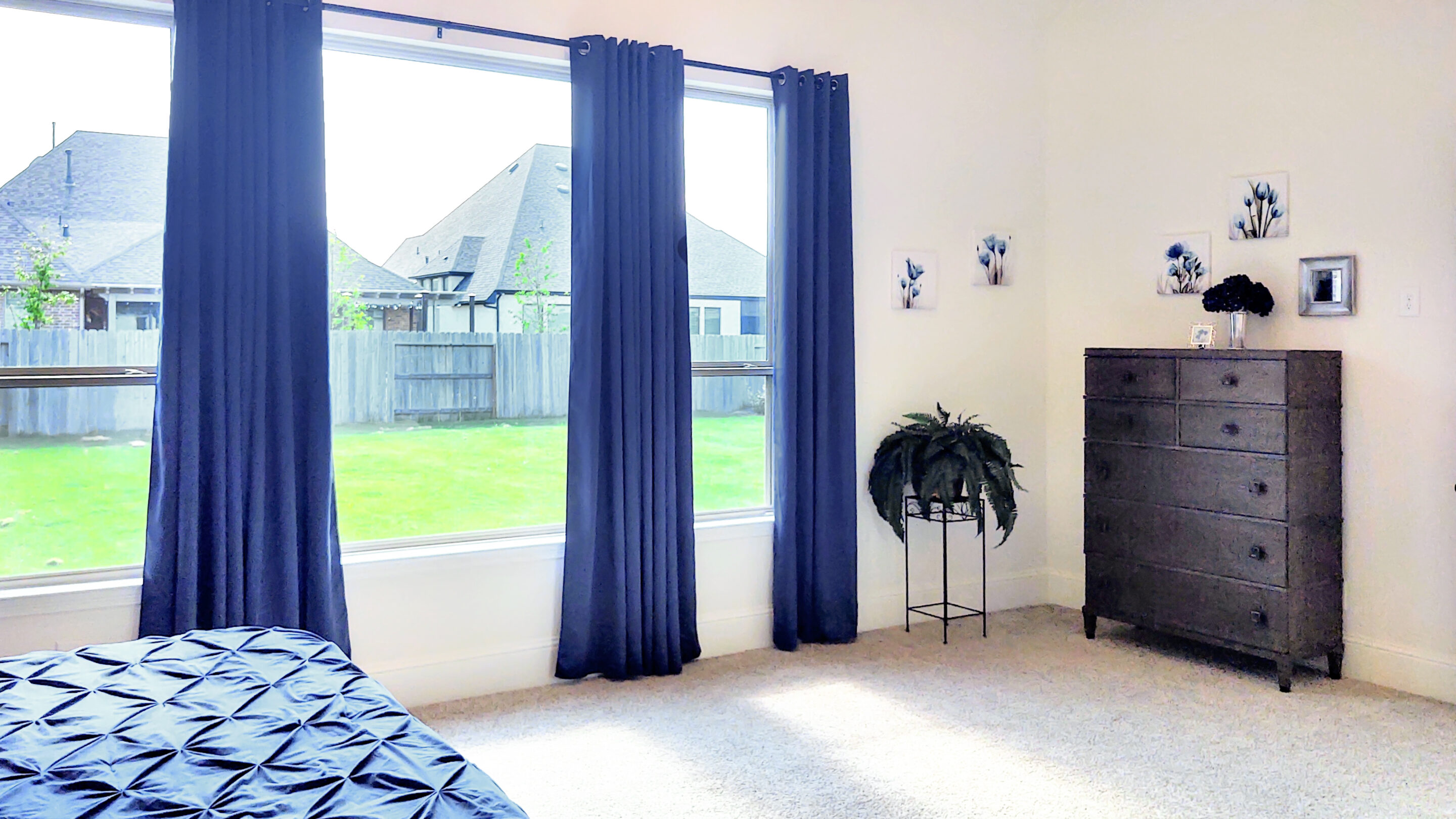
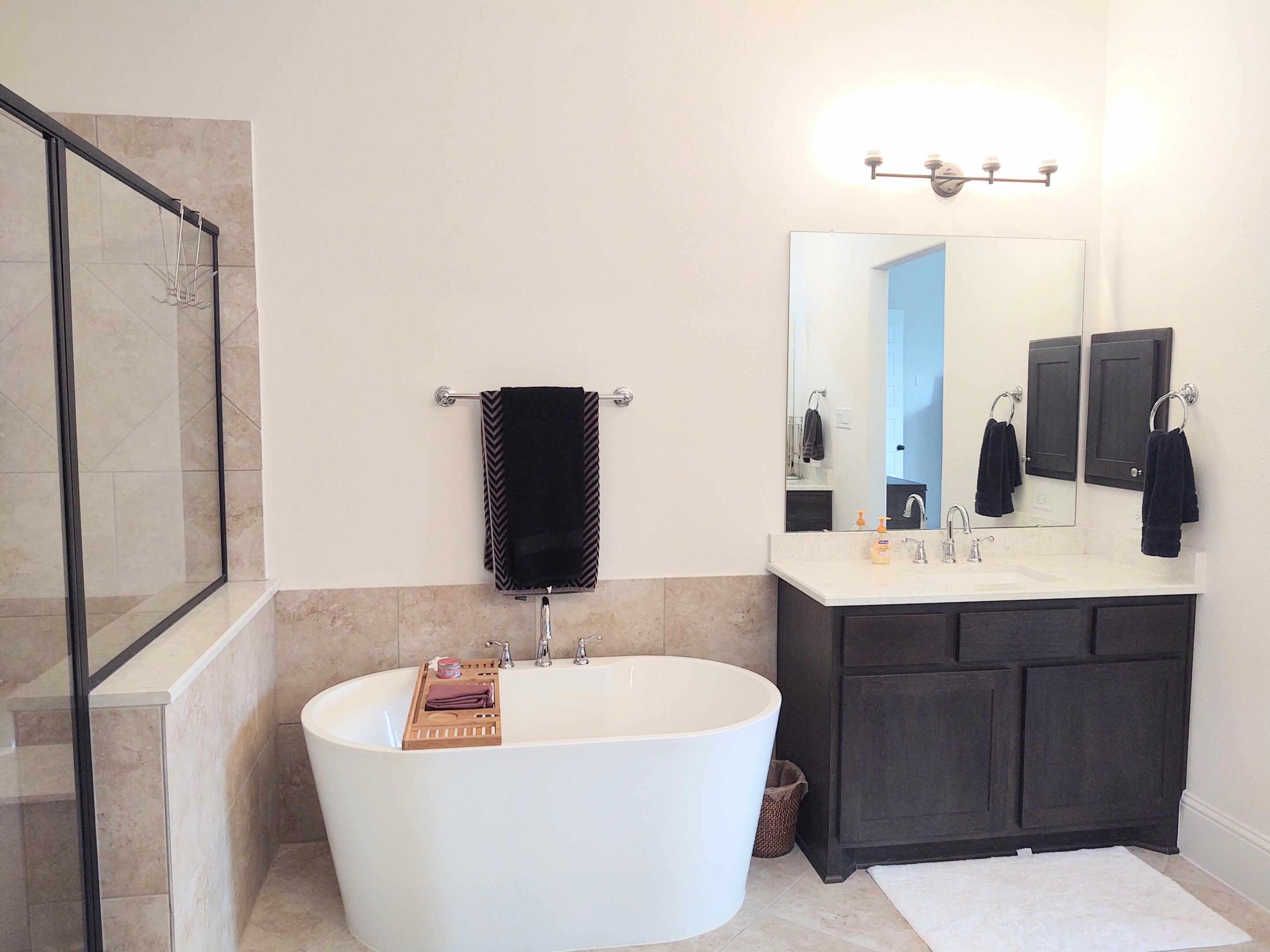
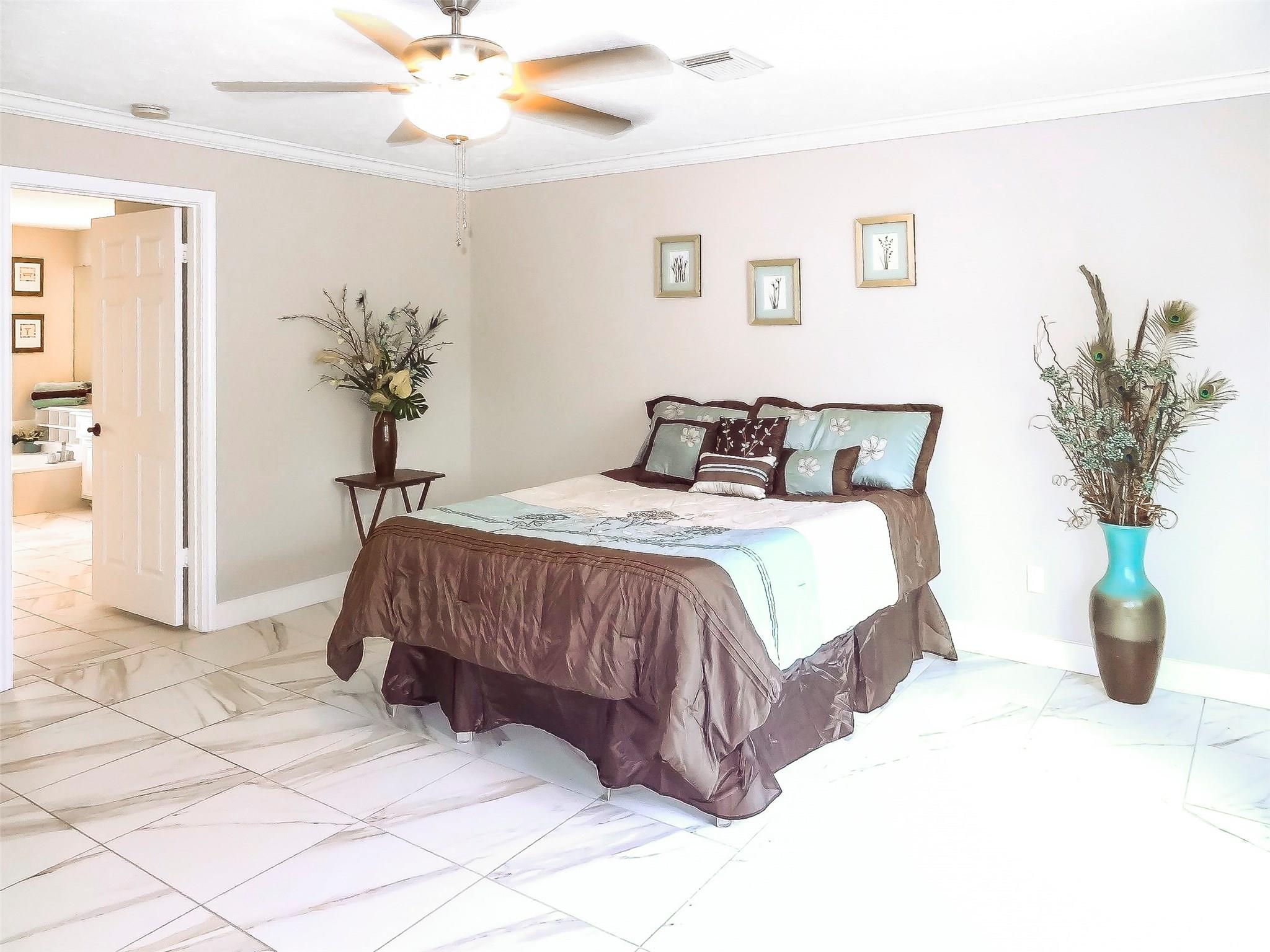
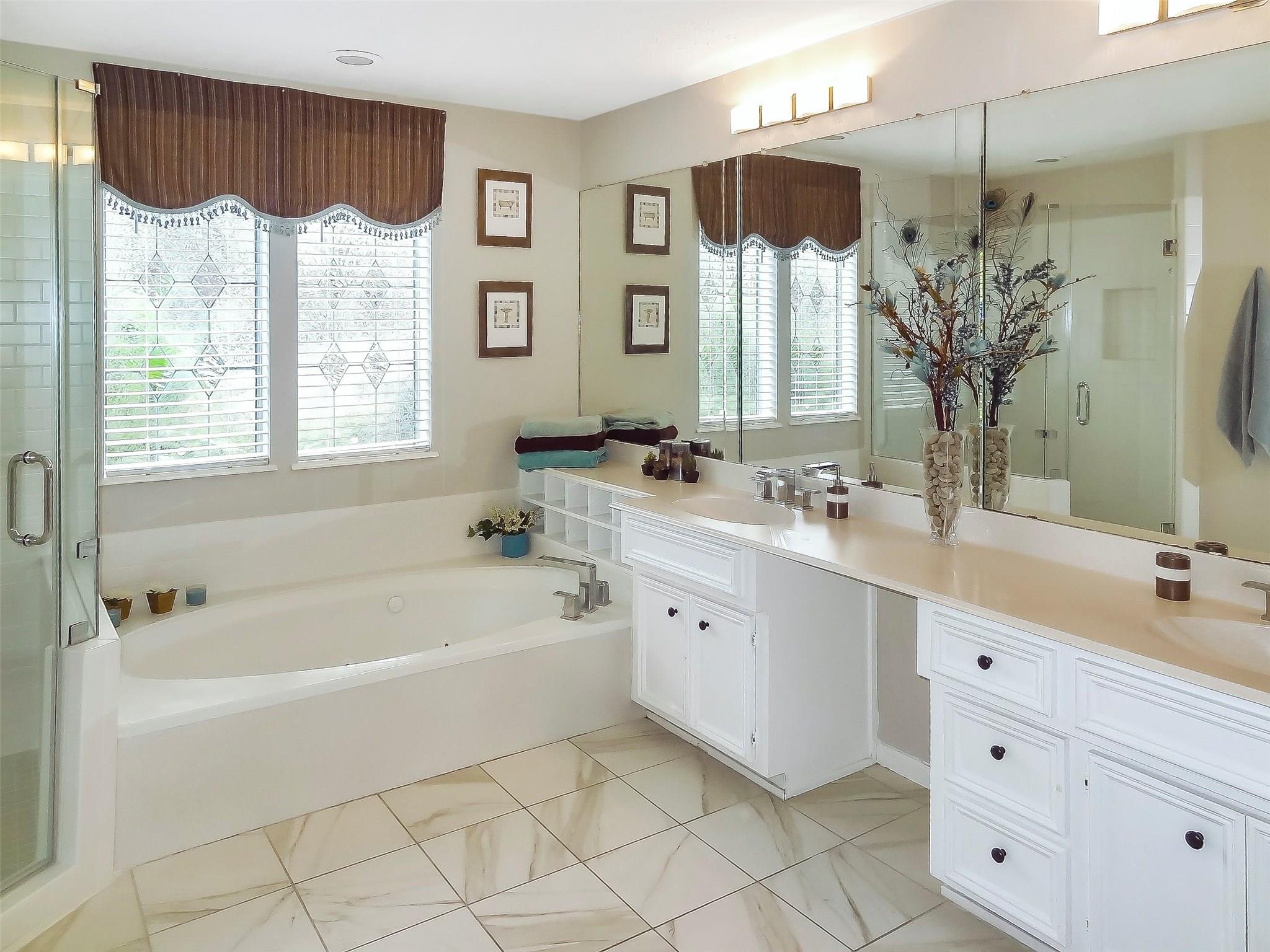
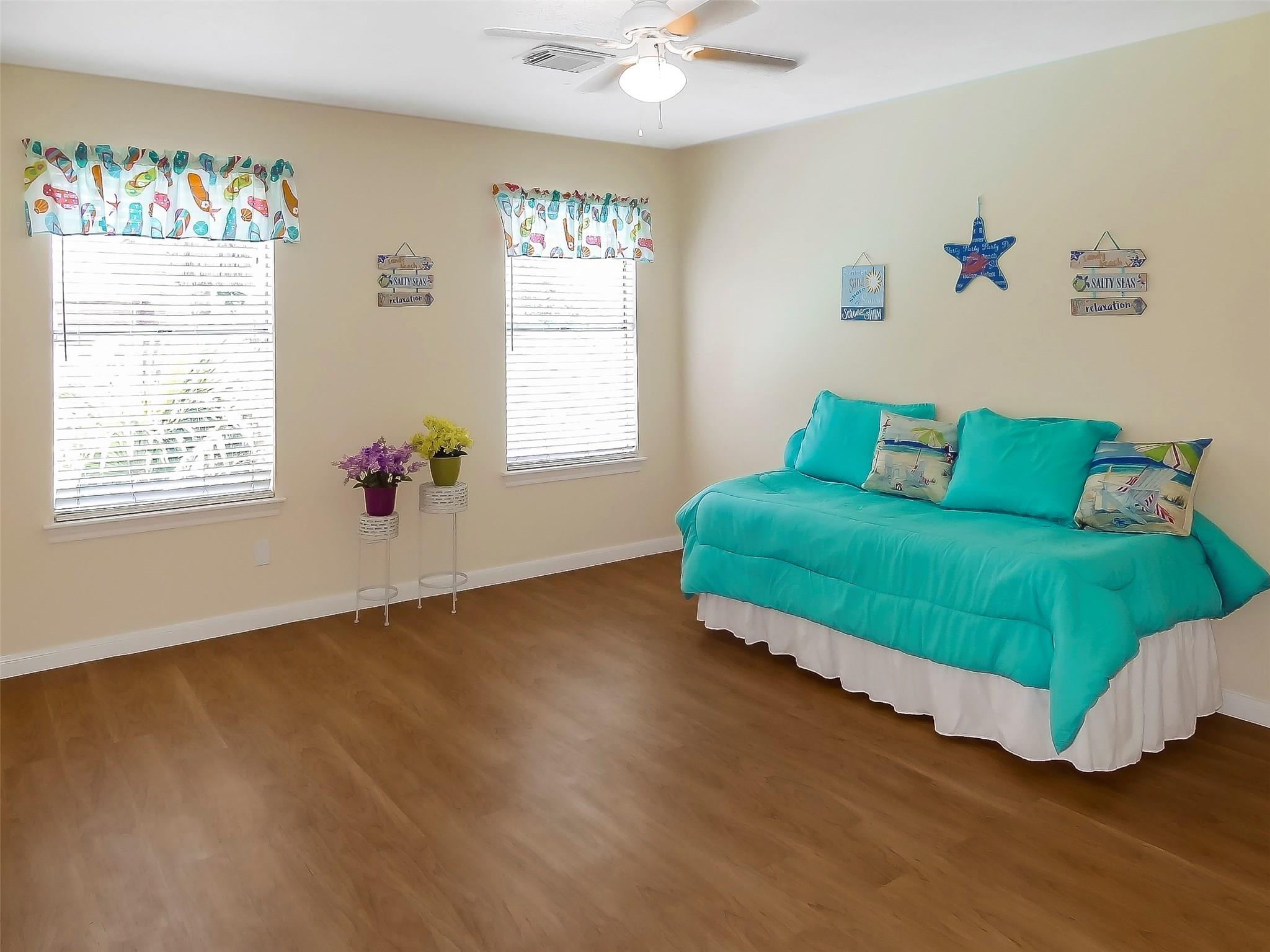
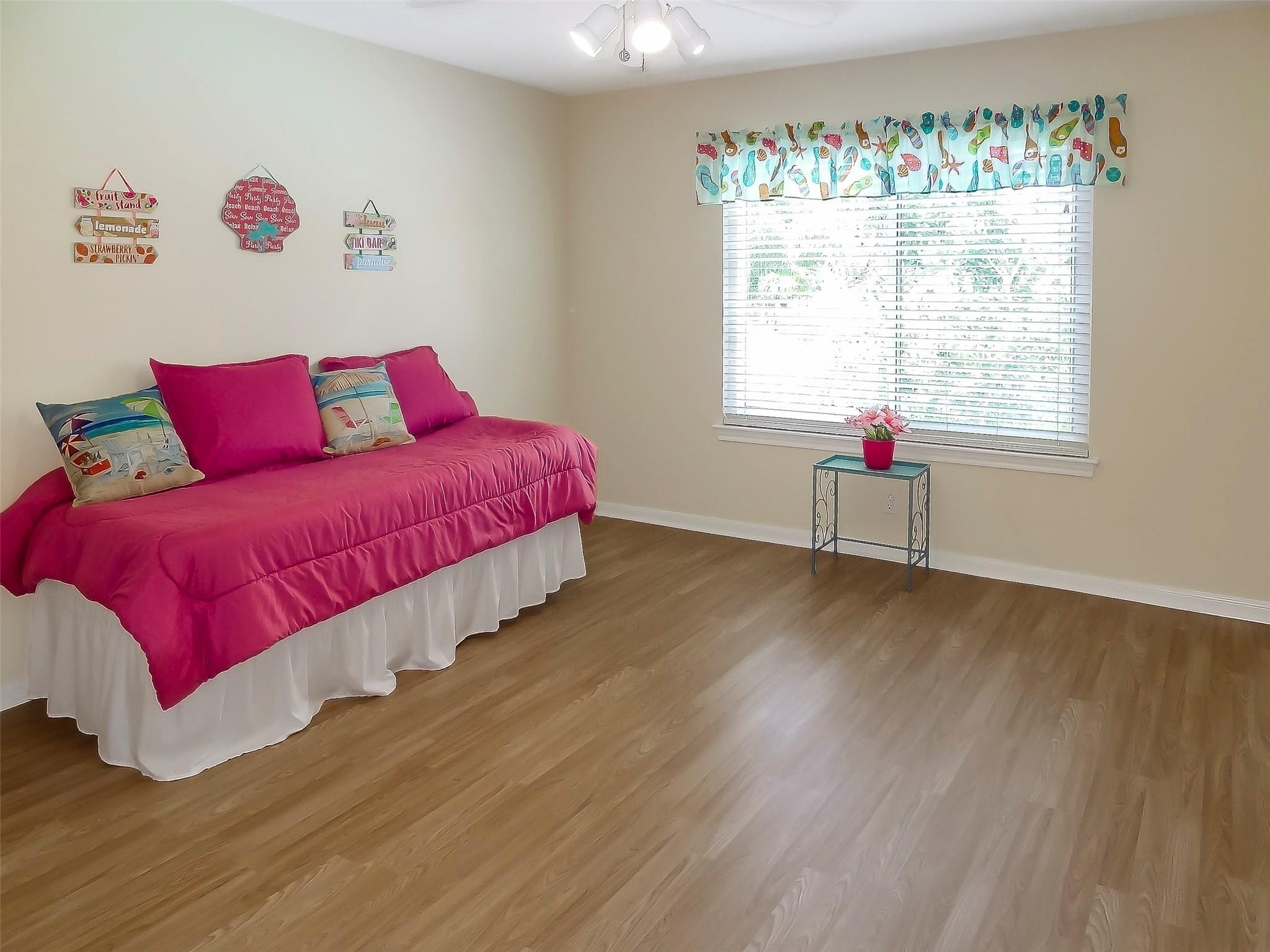
I can provide small-scale staging services for my full-fee clients, as shown in the following examples. If you need premium furniture (for higher-end or luxury homes) then you will probably need to engage a professional home stager.
TRUE Video Tours
To see one of my best video tours (where no staging was necessary) check this out!
Staging Project 1
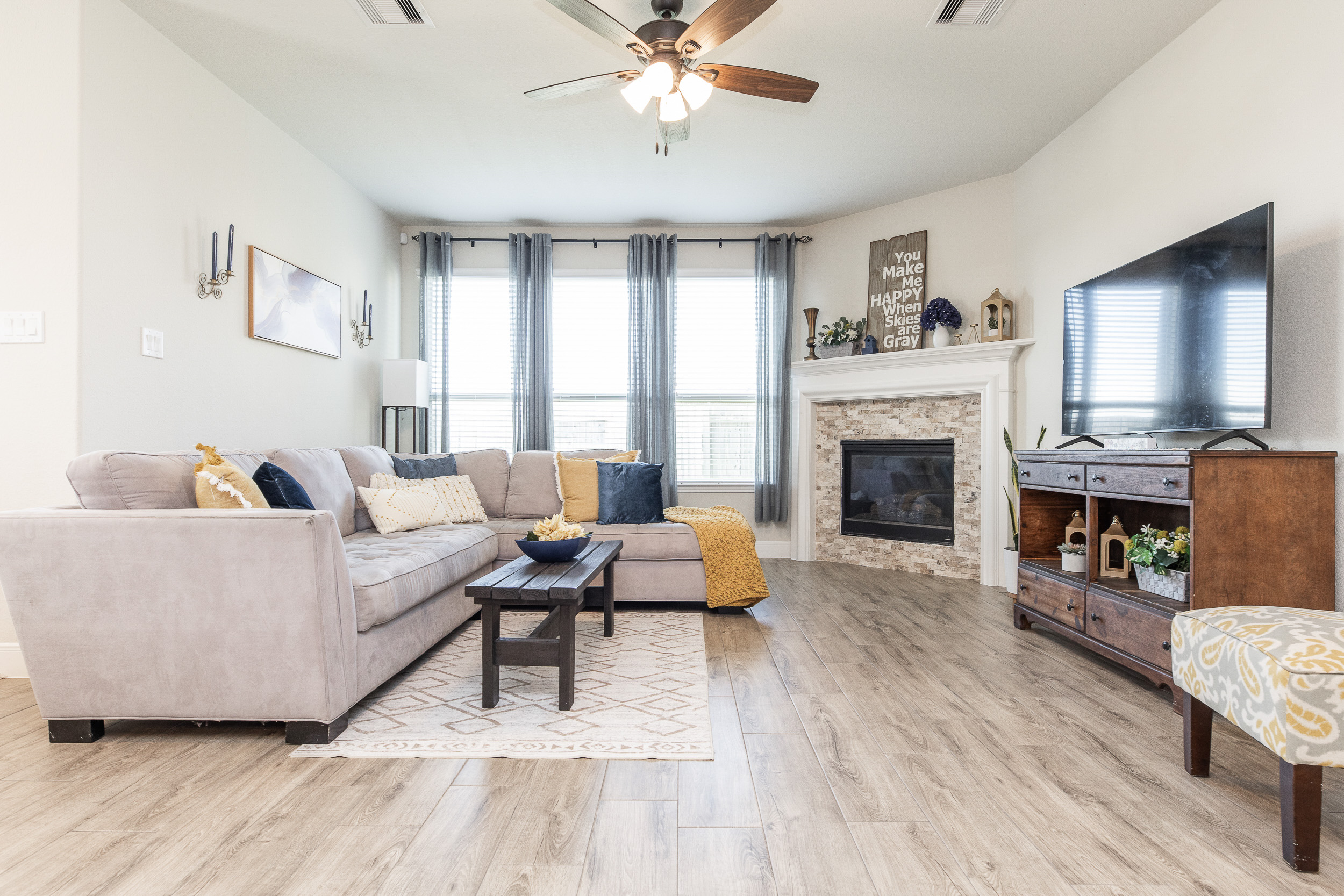
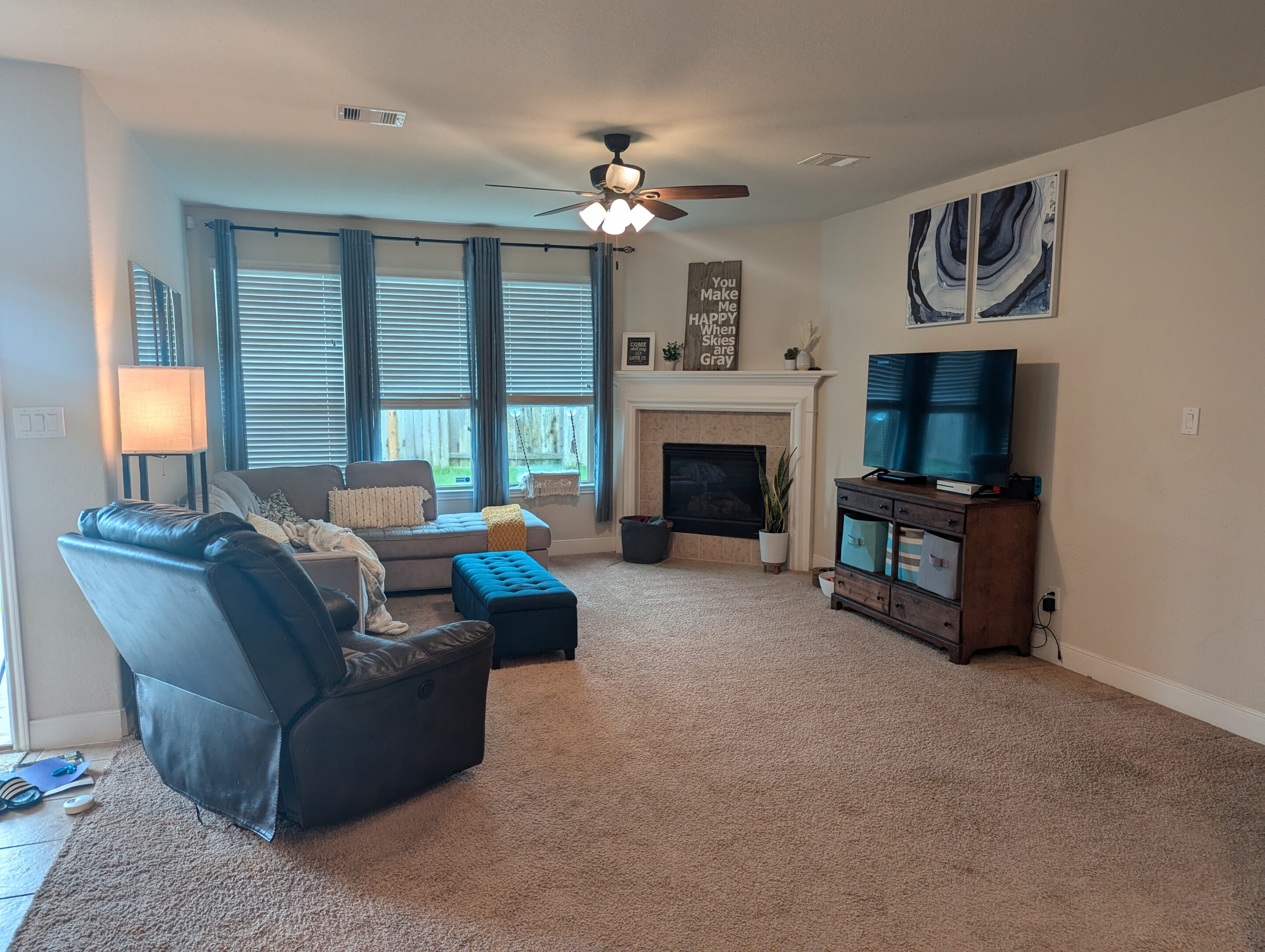
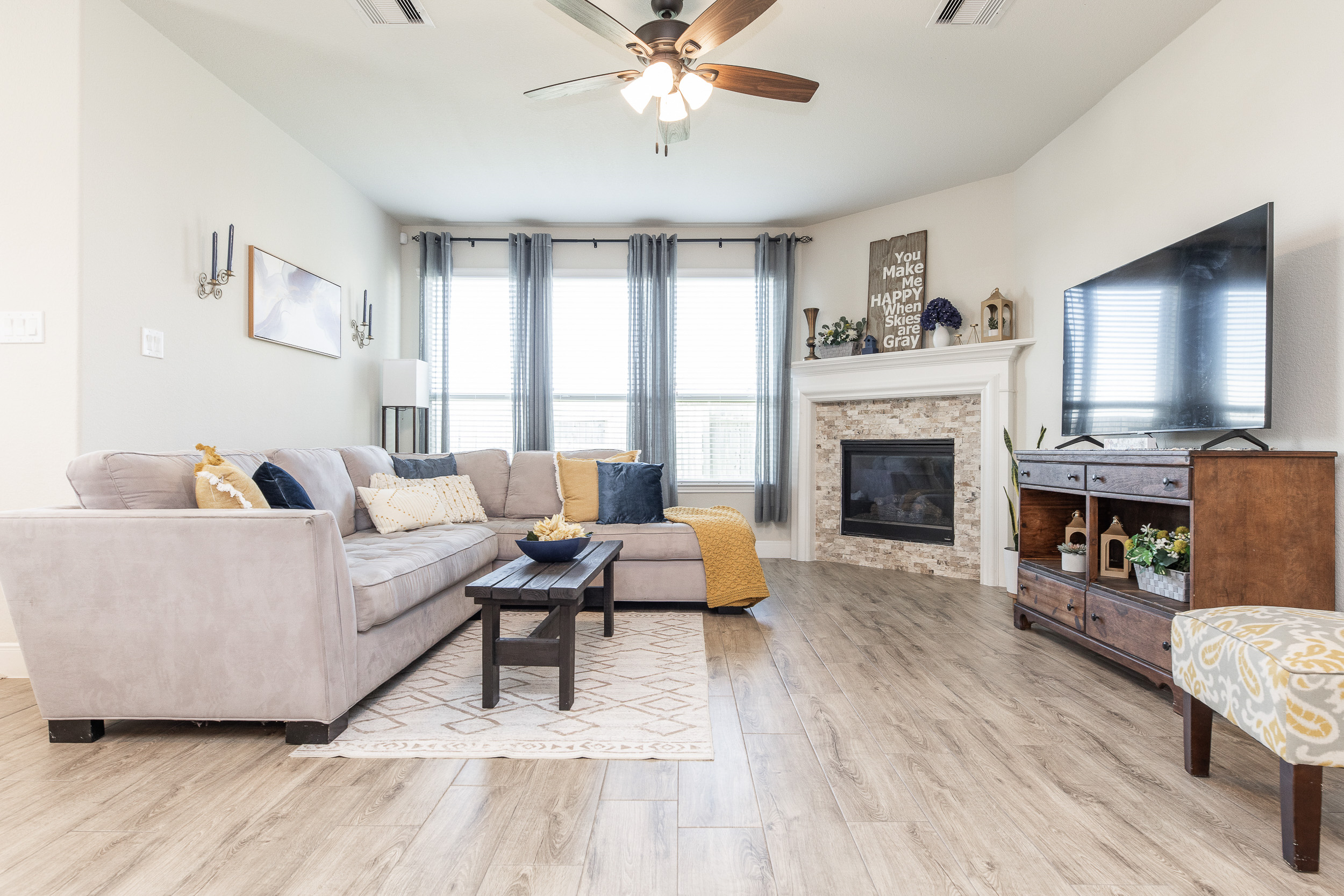
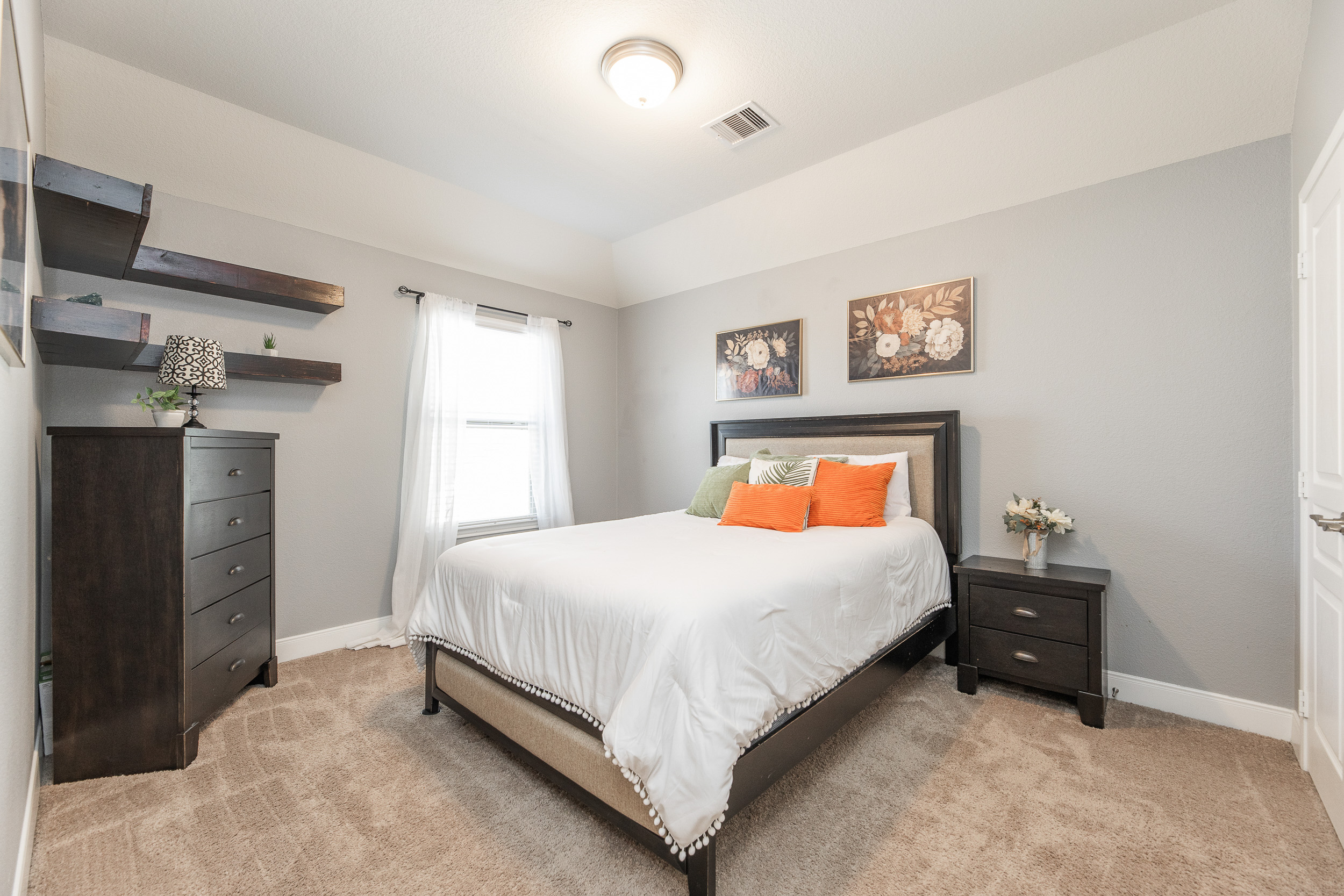
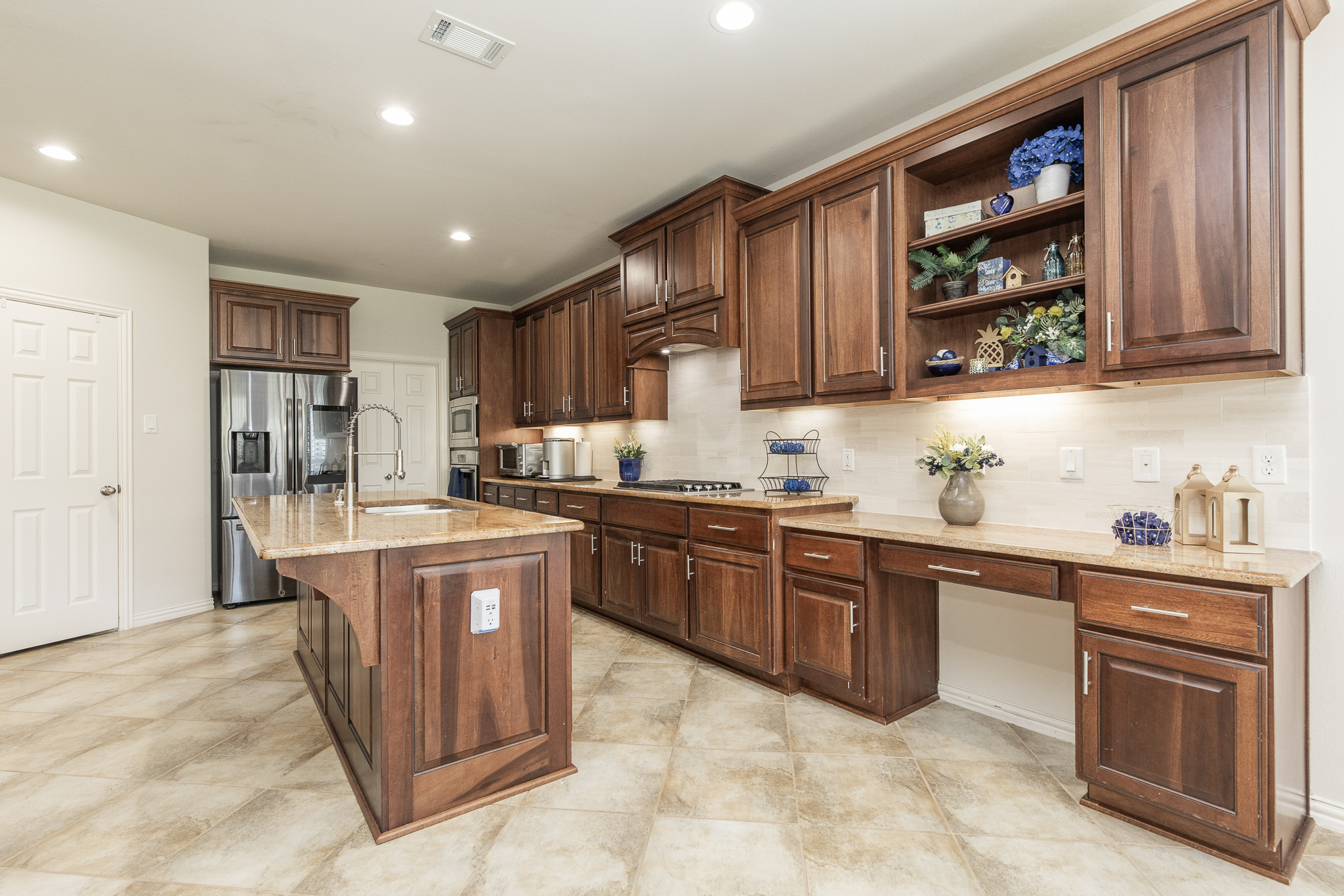
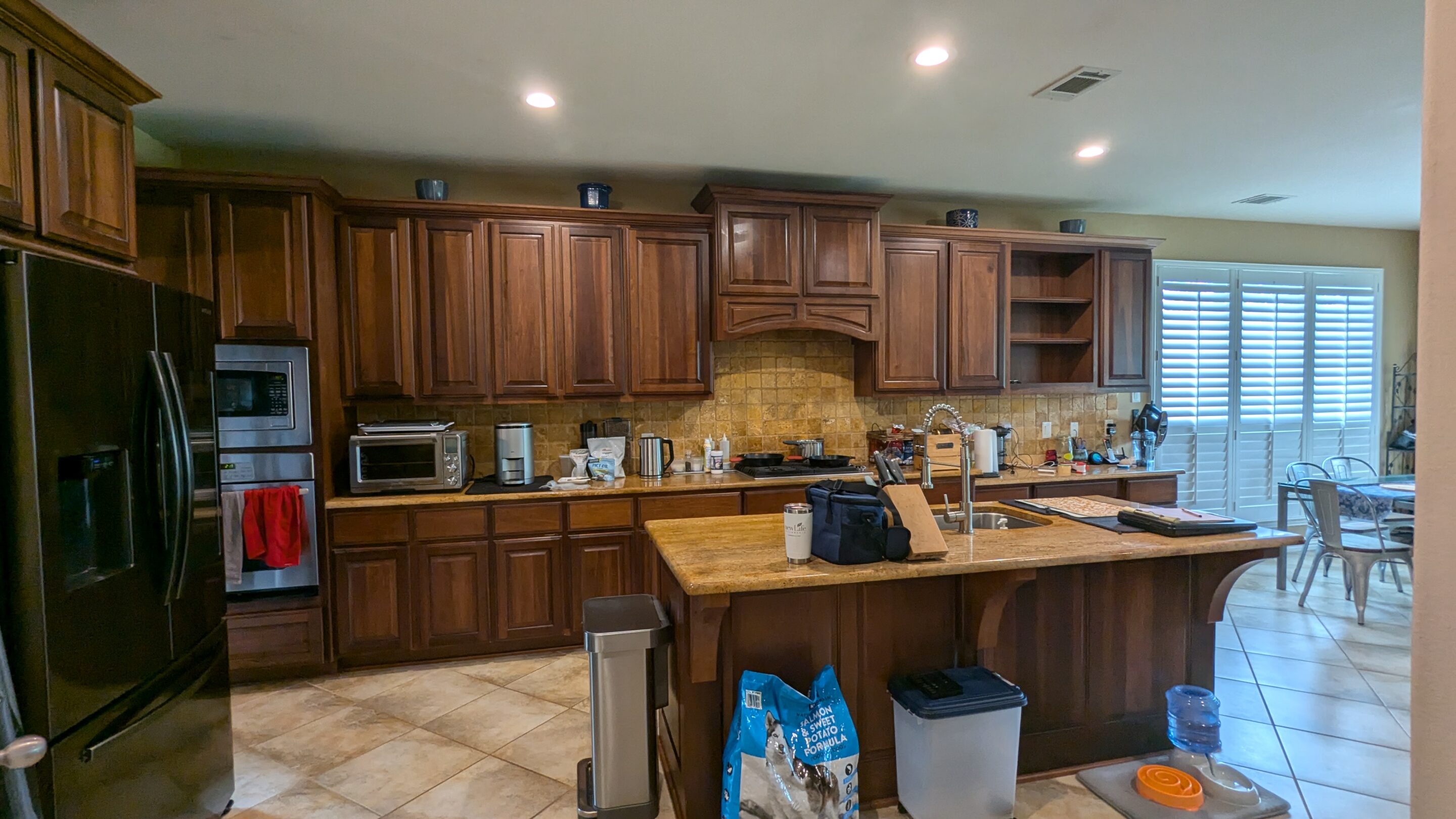
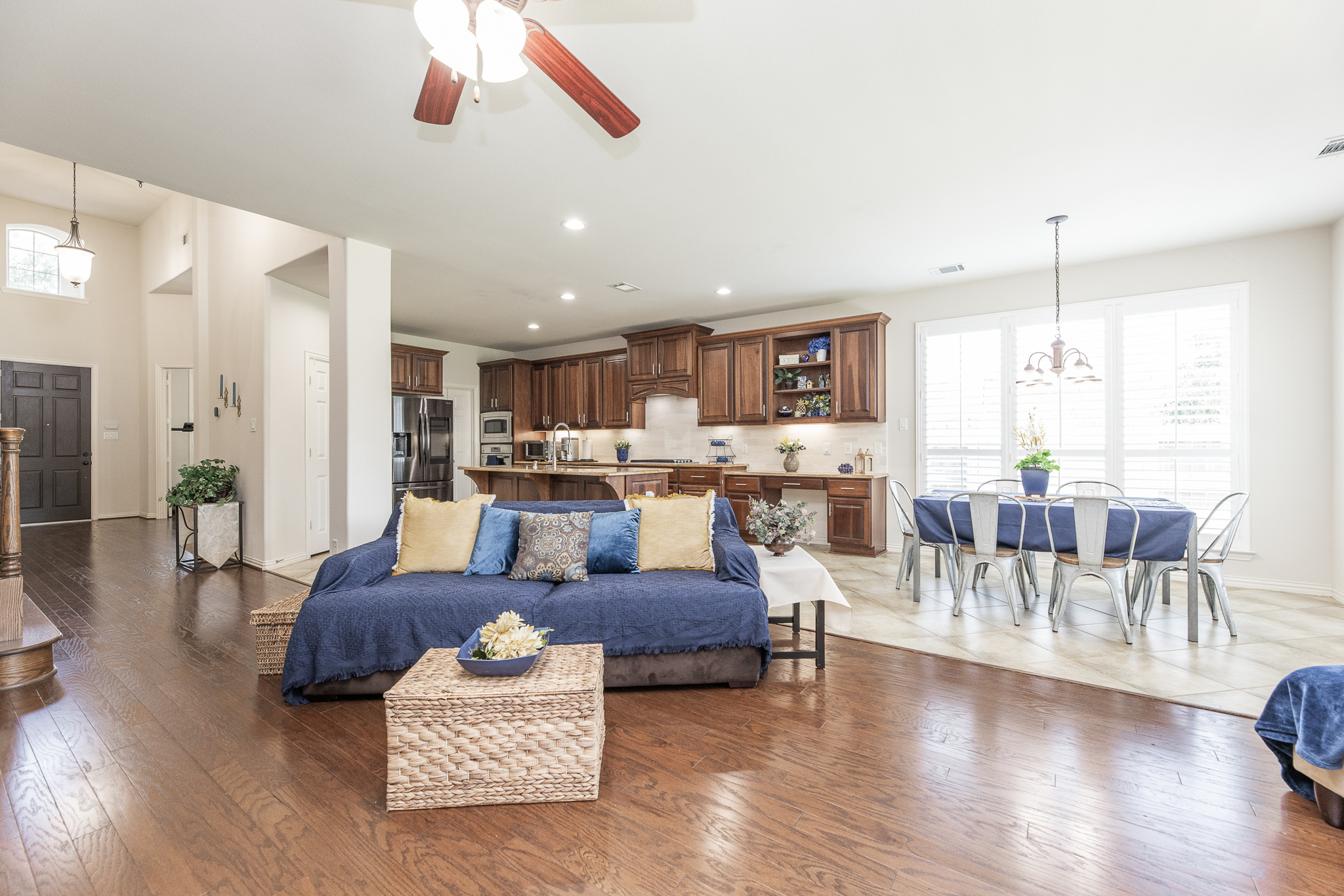
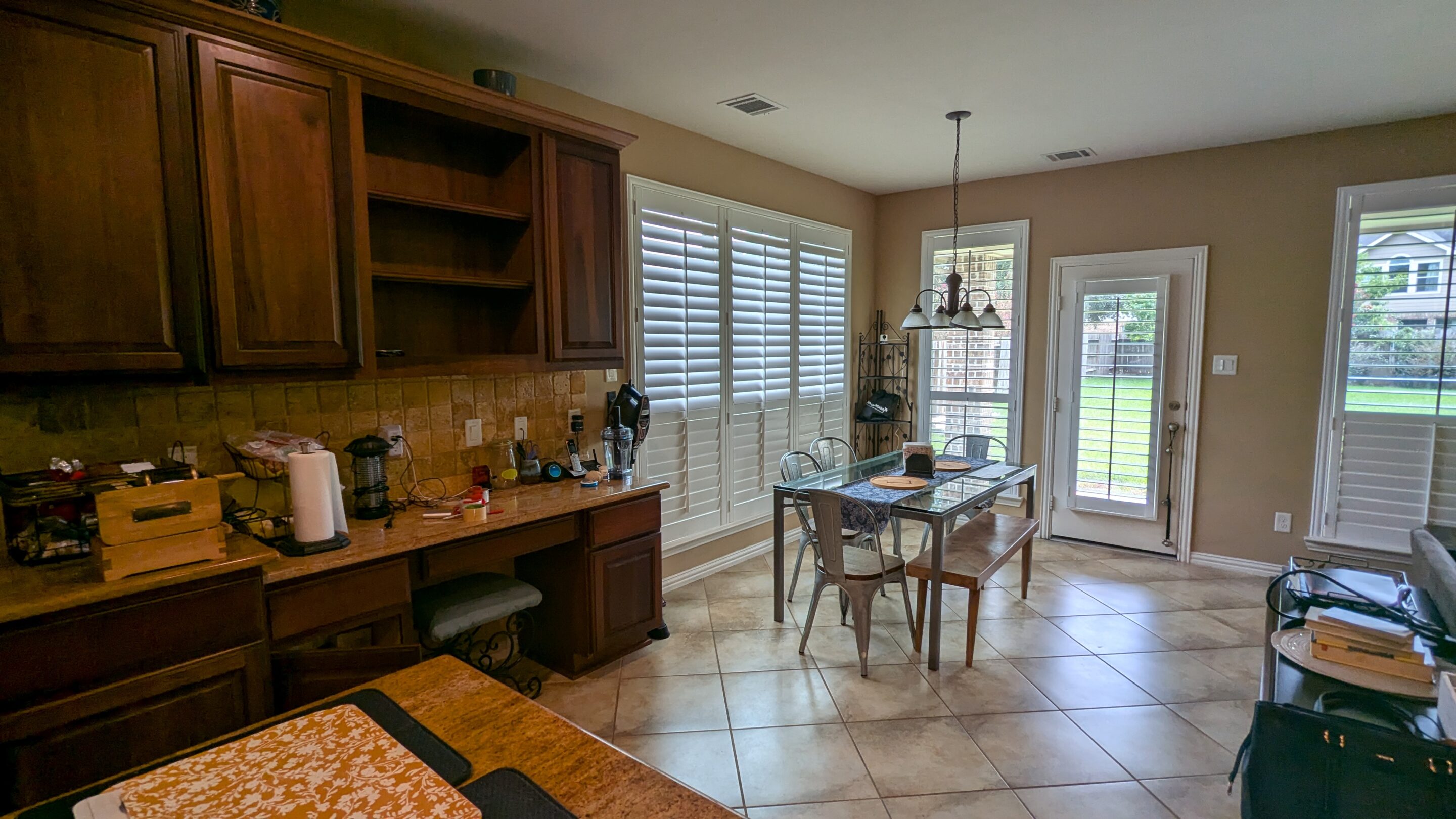
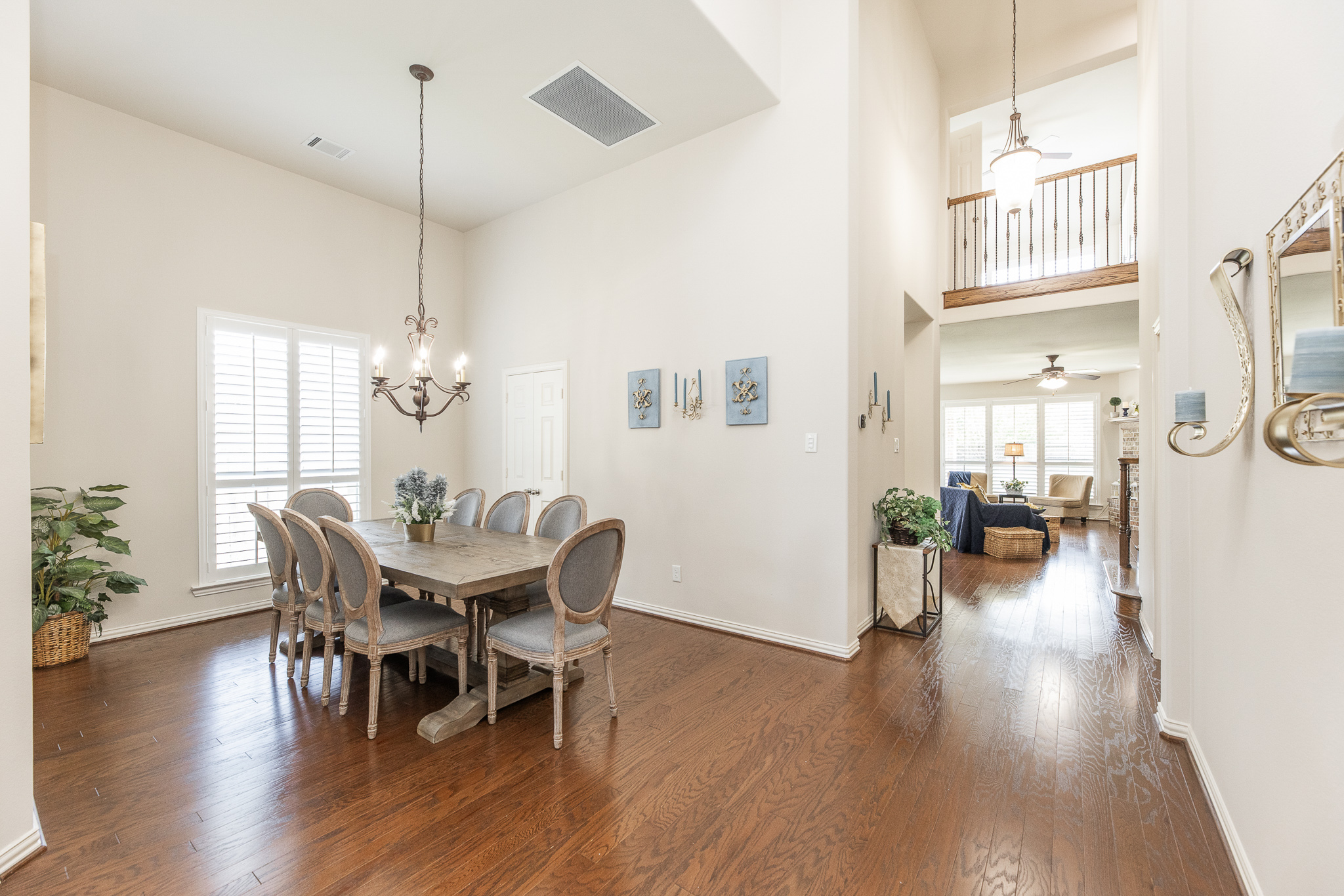
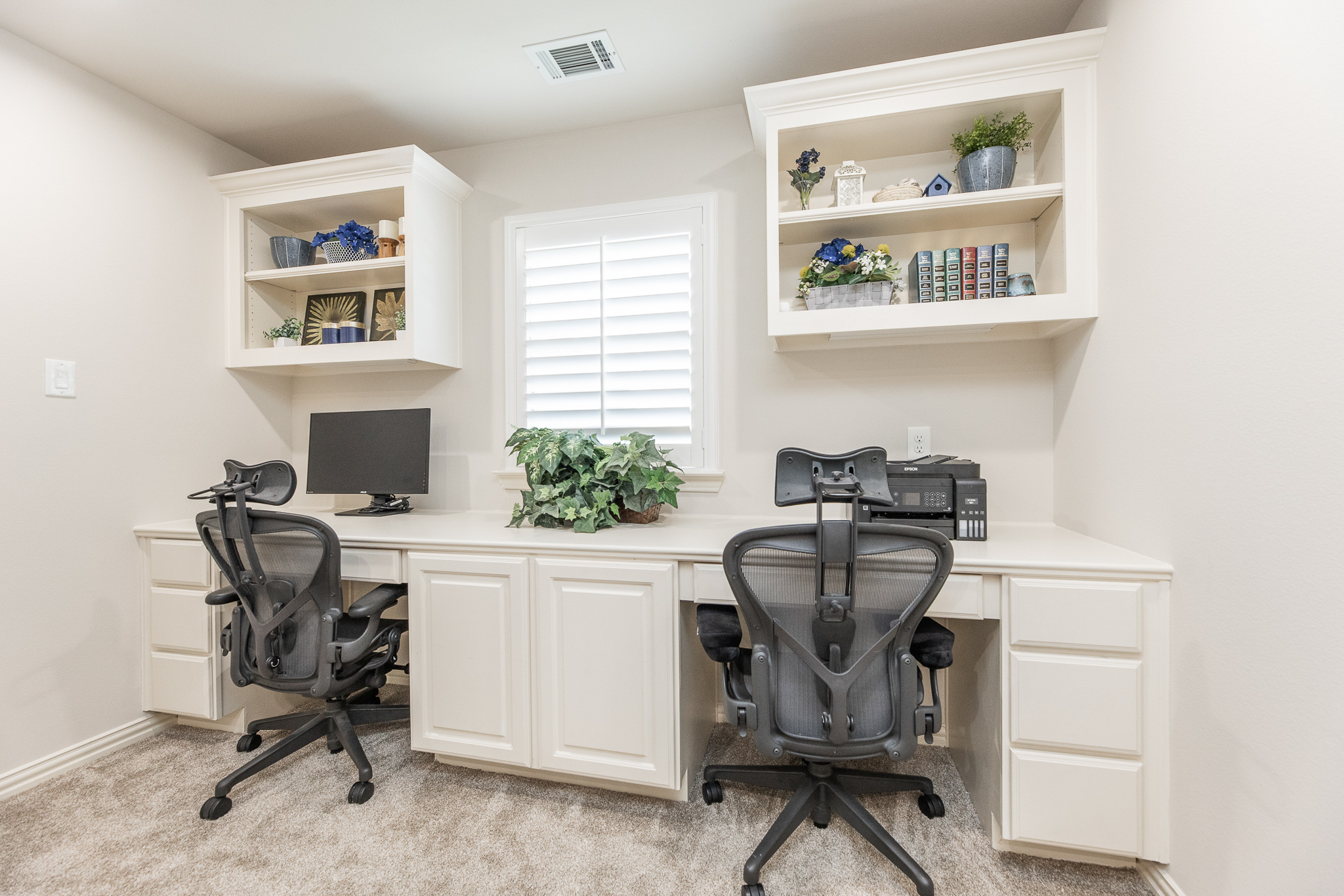
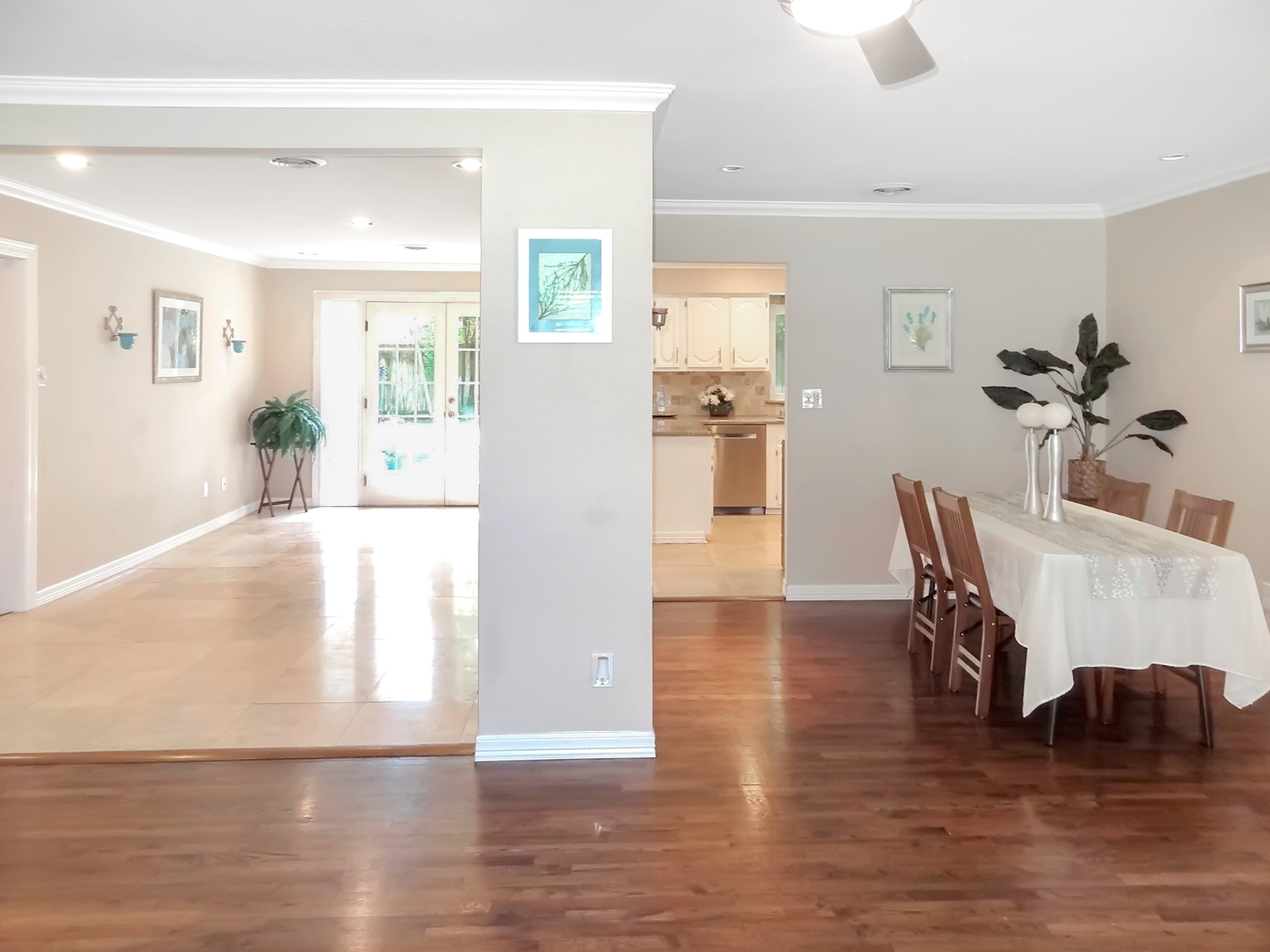
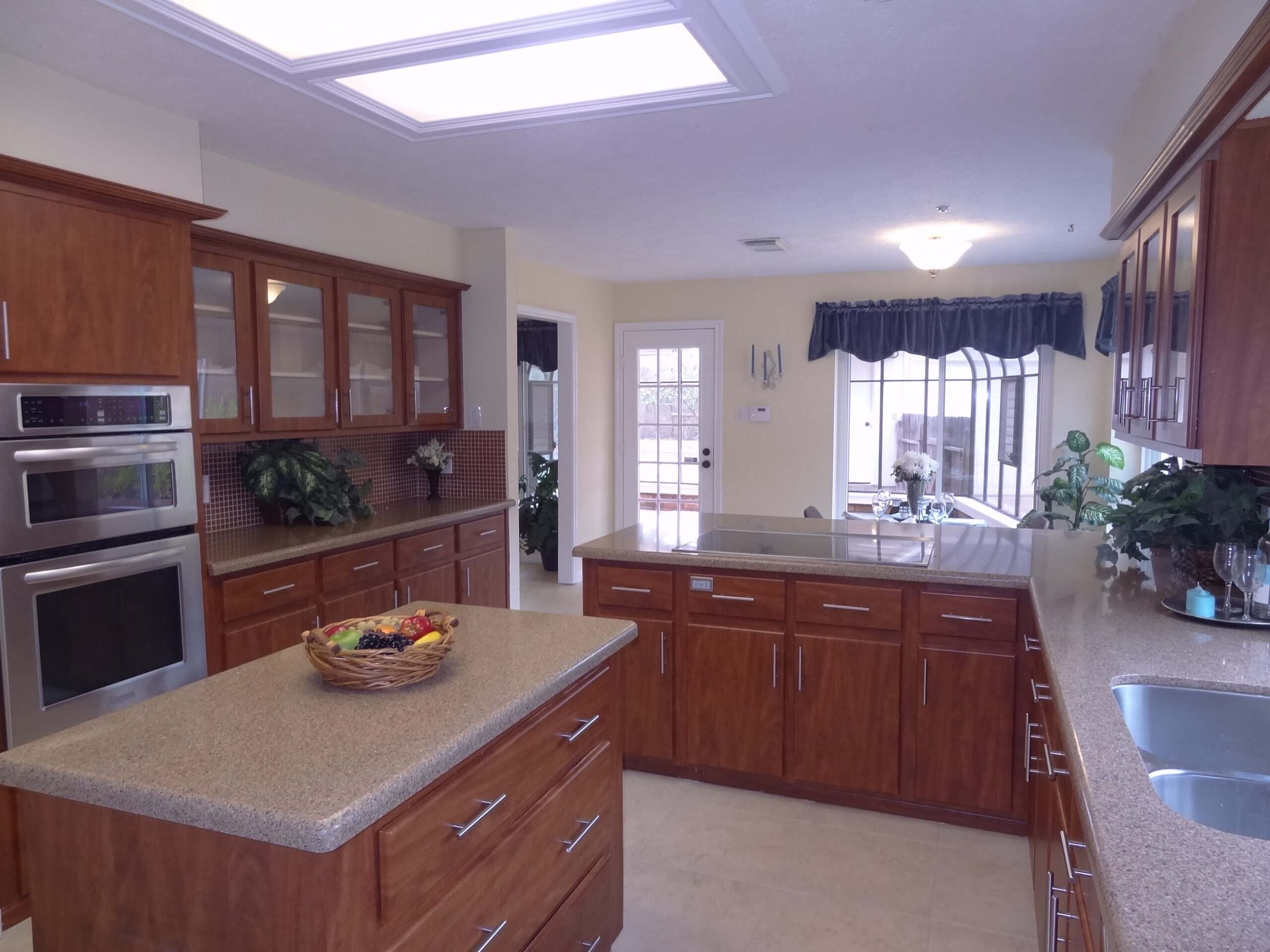
Here’s one example of a home staging project I did for a lovely home owner/client and the professional photography that I arranged. We received multiple offers in 3 days. That’s how you do it! I also helped this home owner save thousands of dollars by using a local flooring company that I recommended ($9000) vs Home Depot or Lowes ($22,000-24,000). This is why you should contact me EARLY…before you spend too much money on your house. 🙂
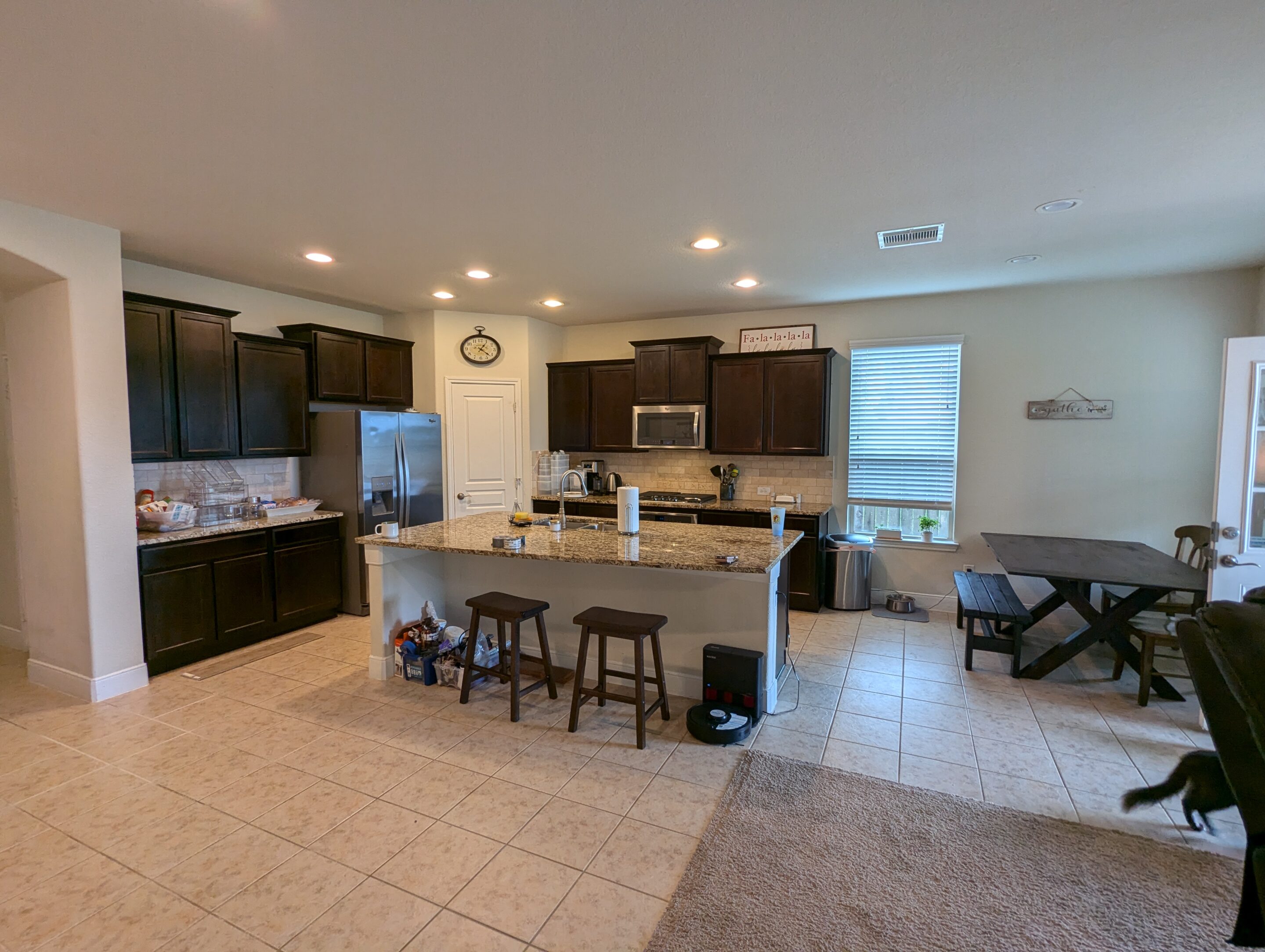
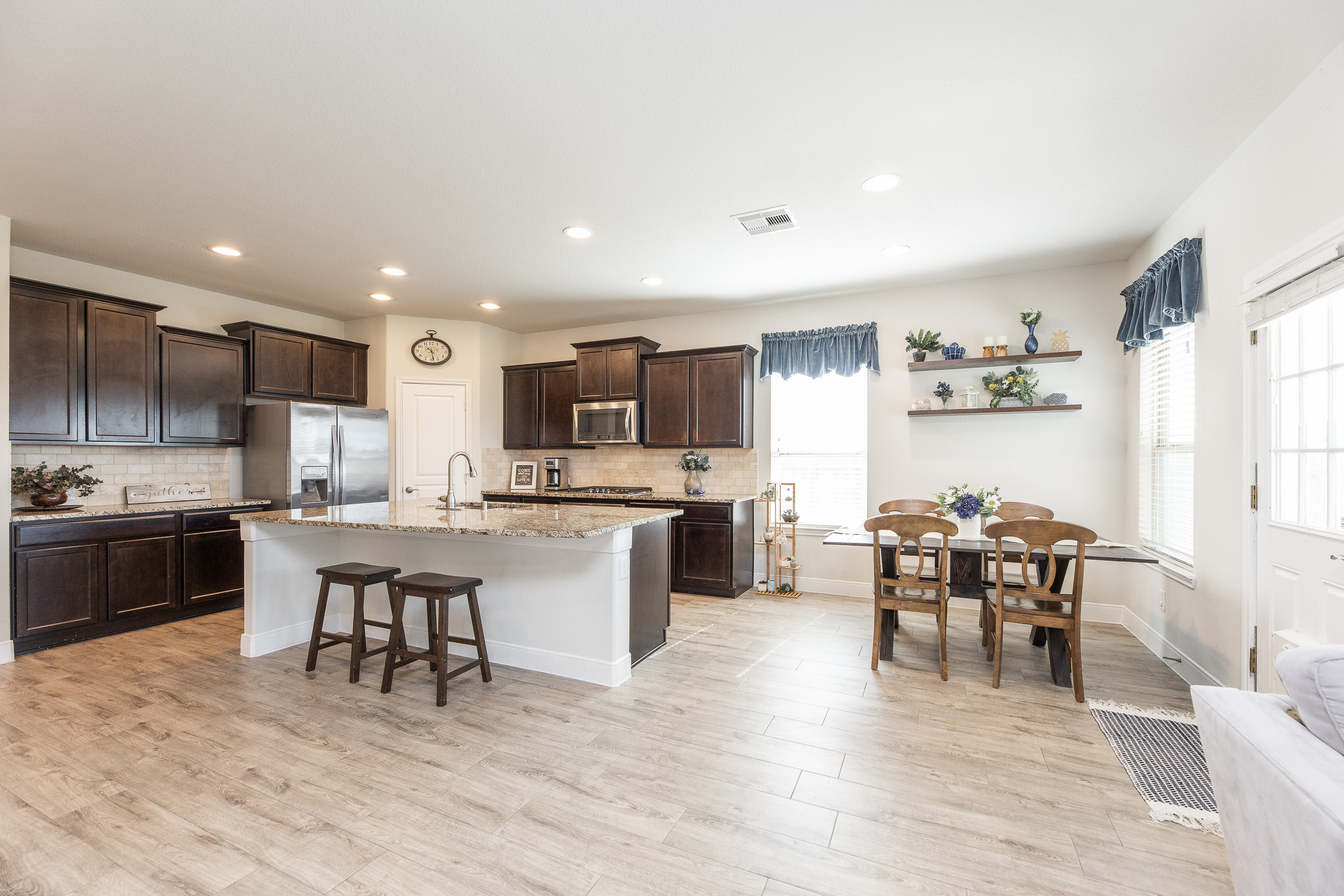
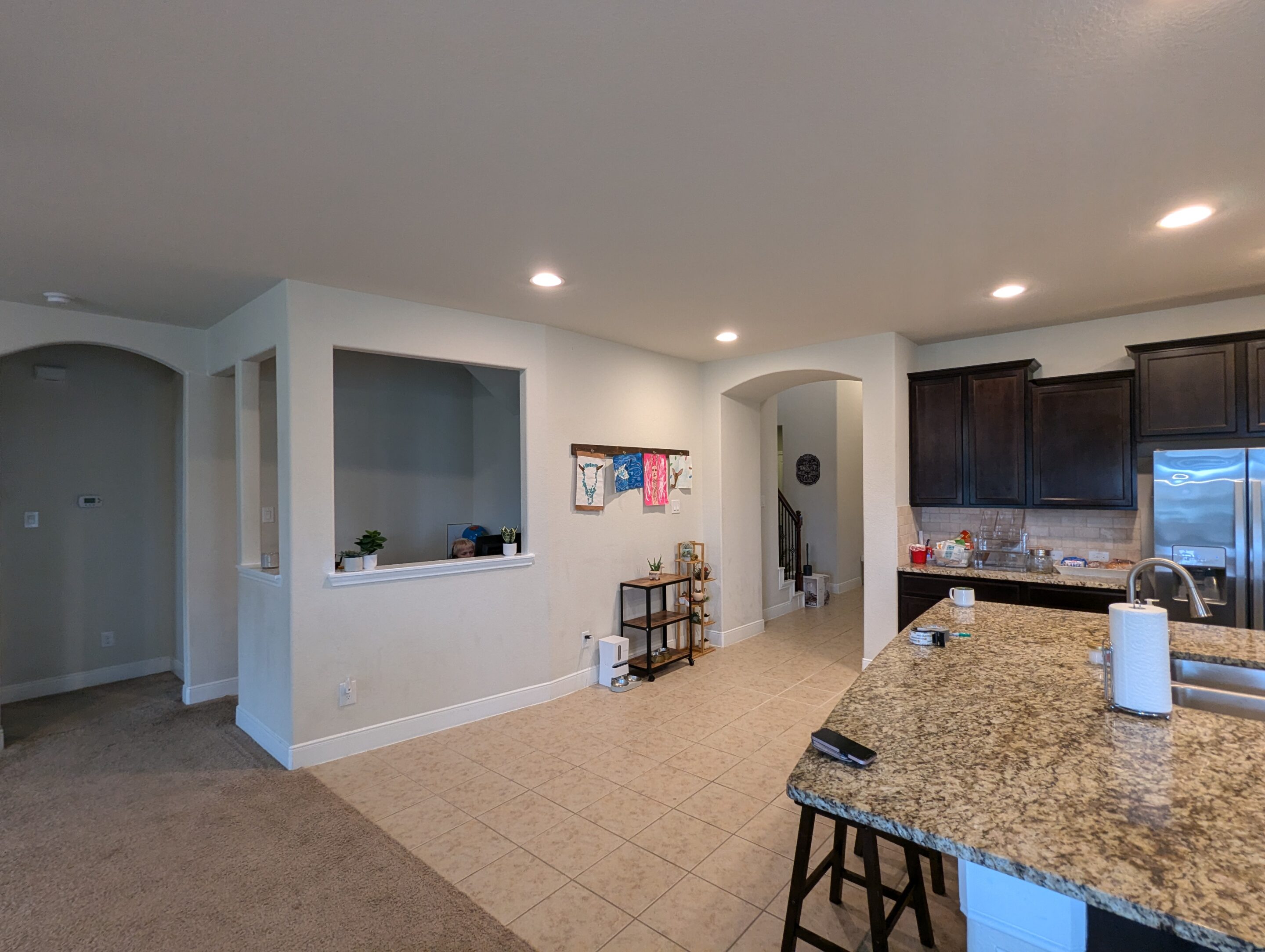
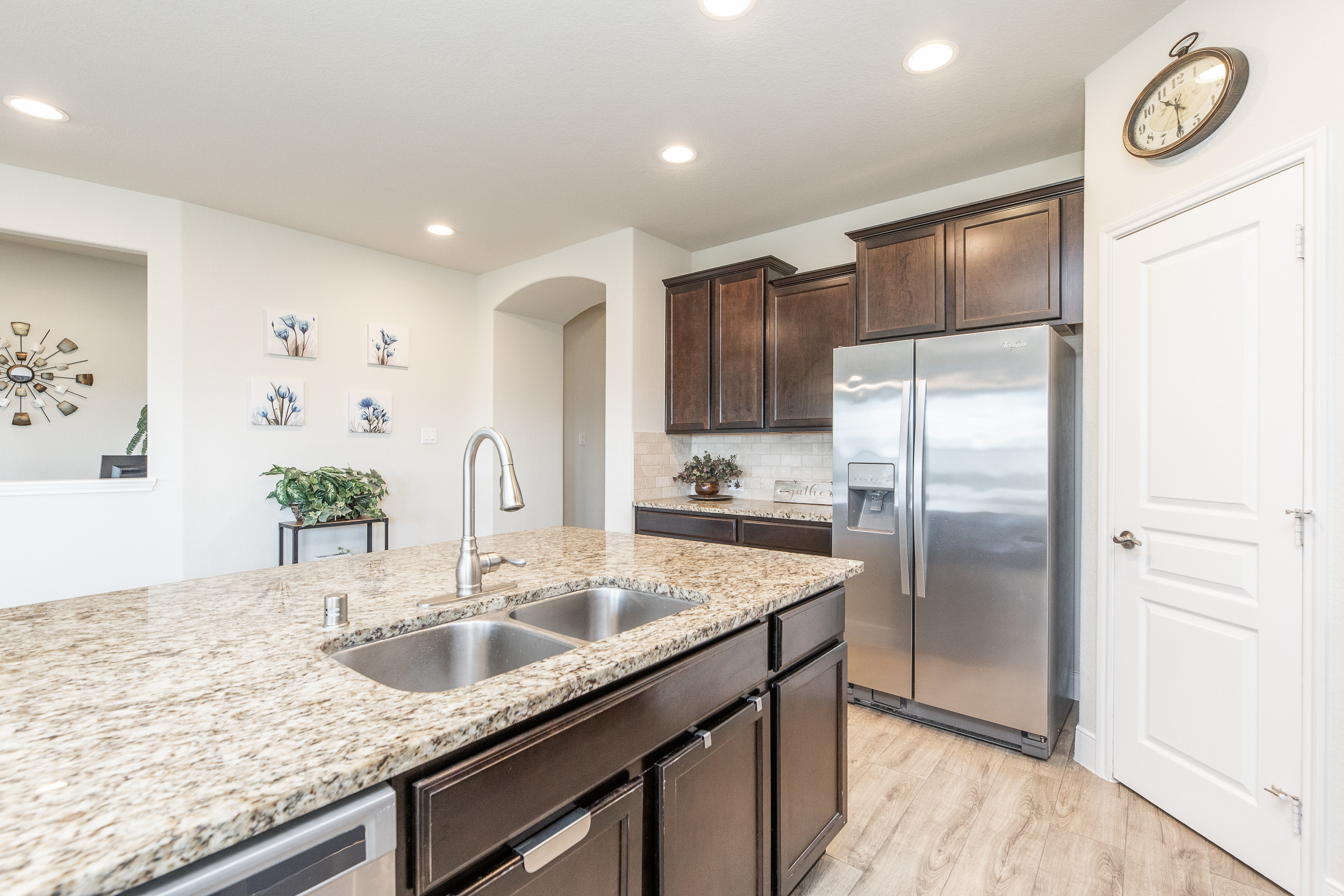
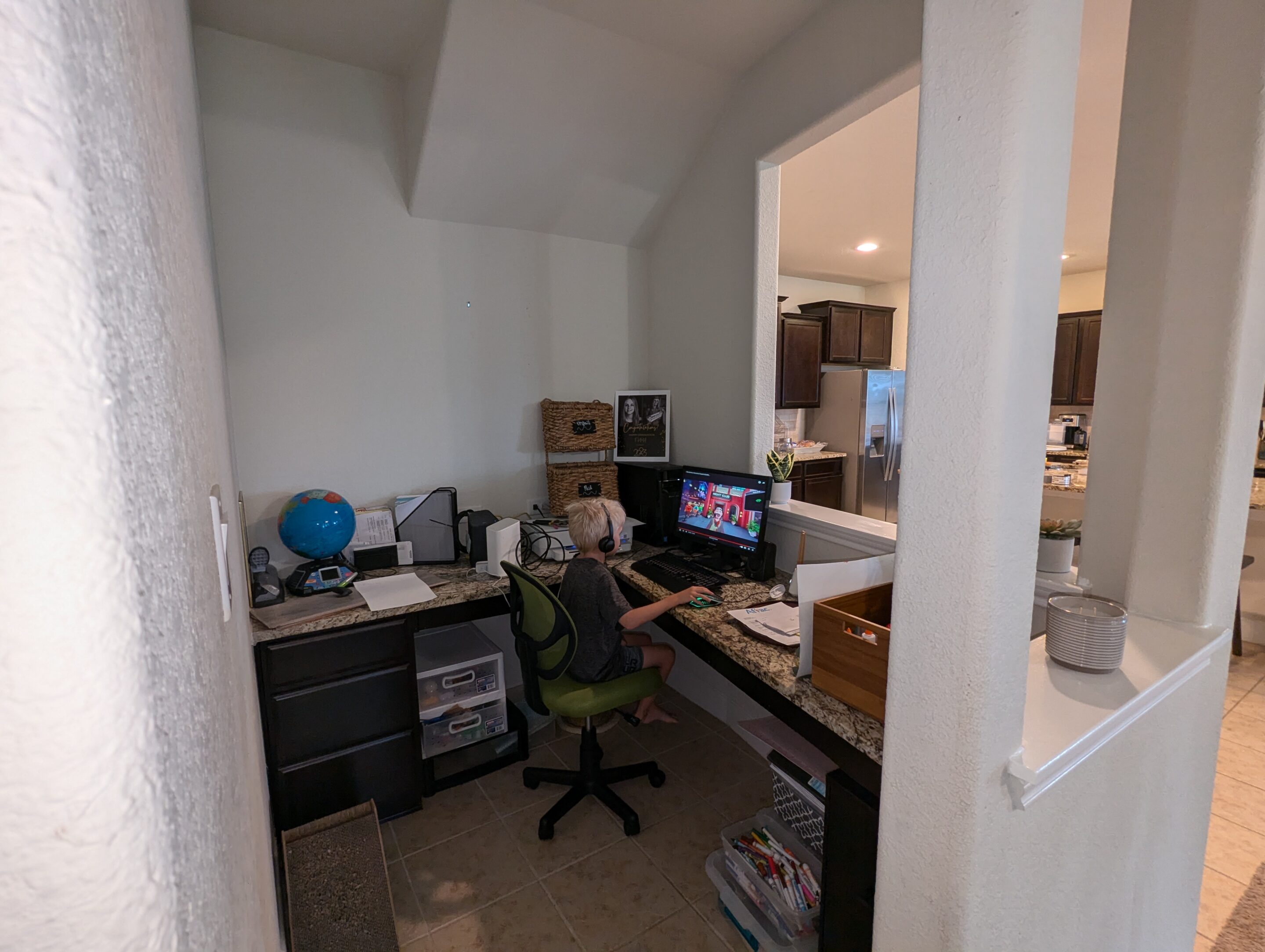
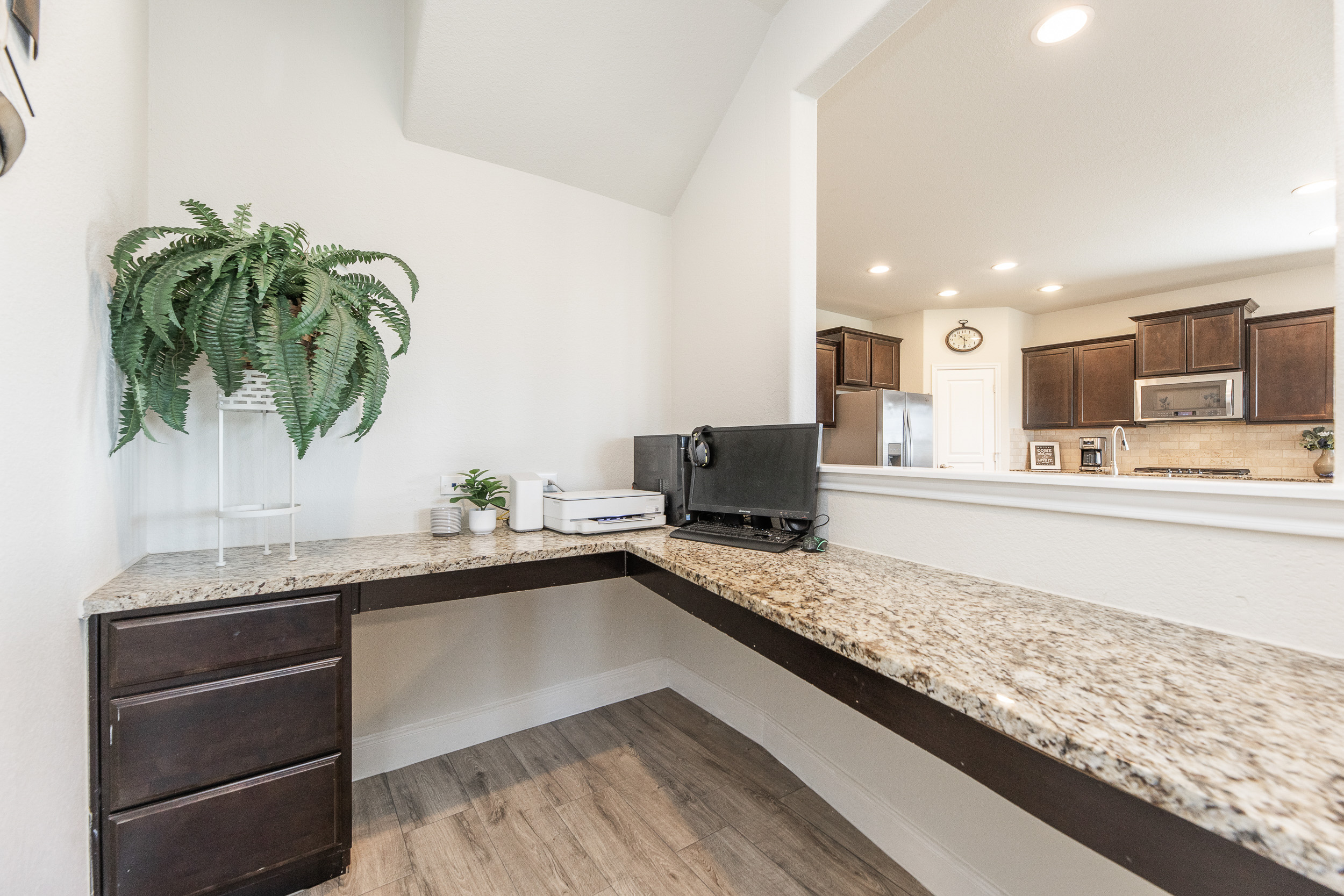
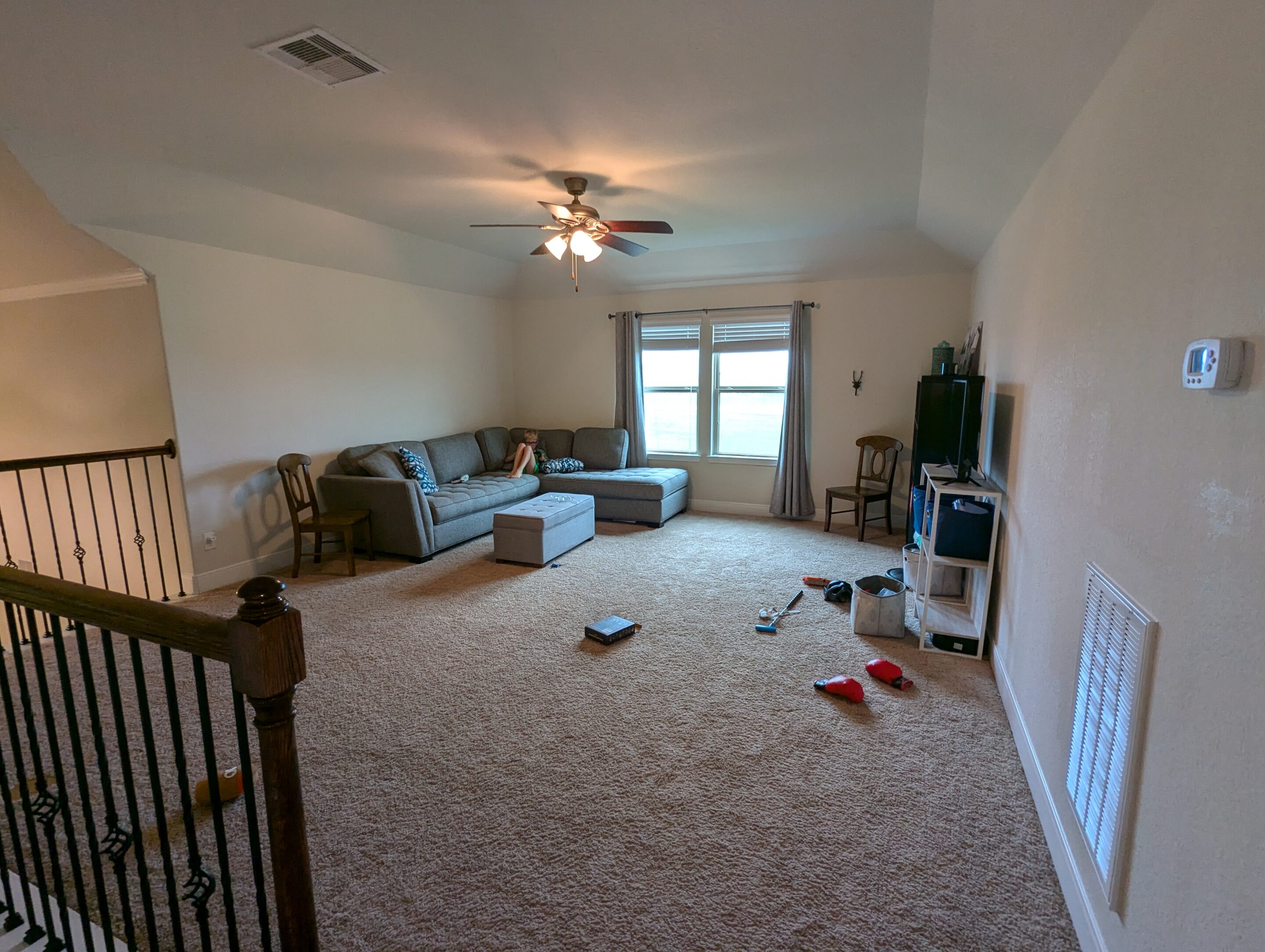
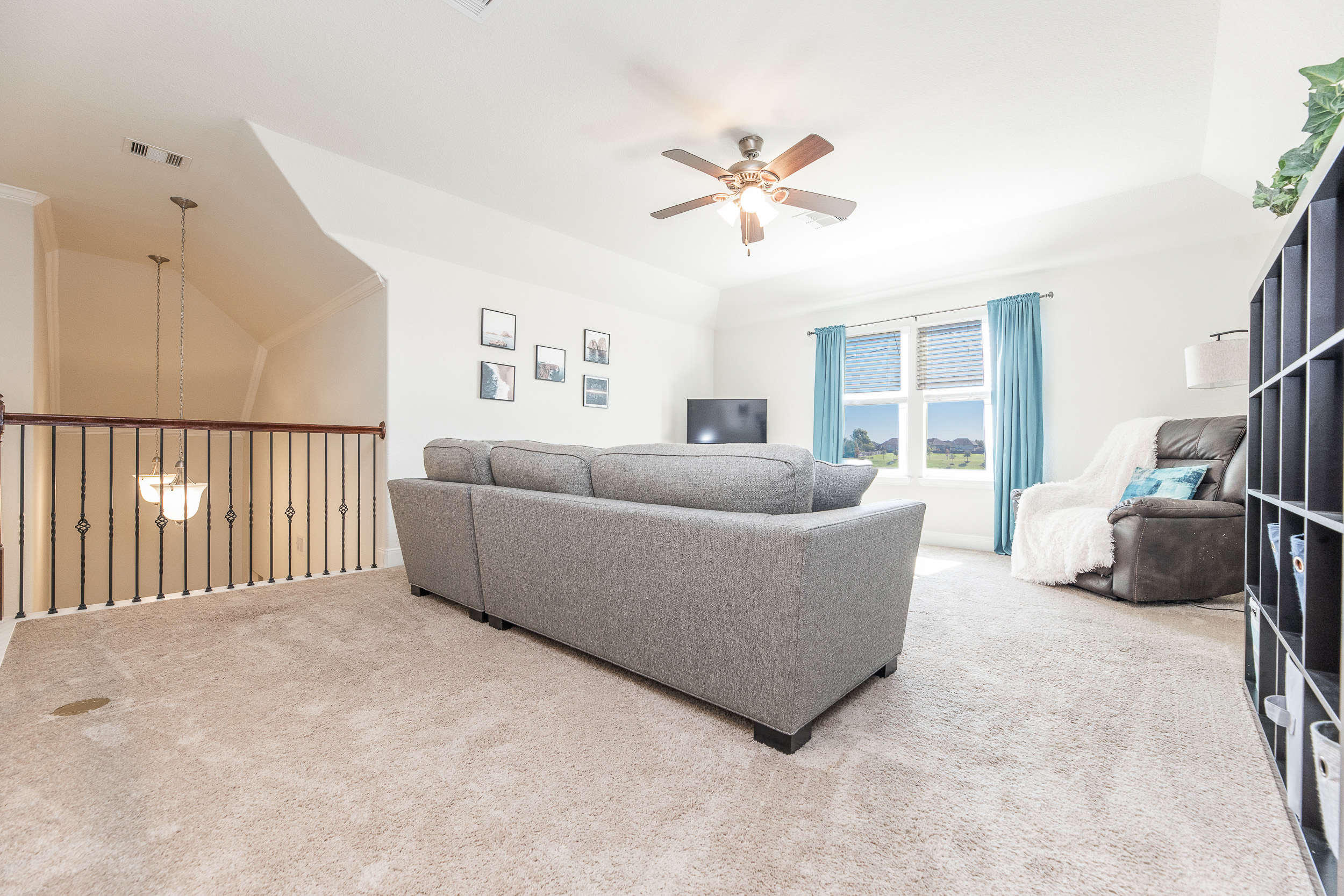
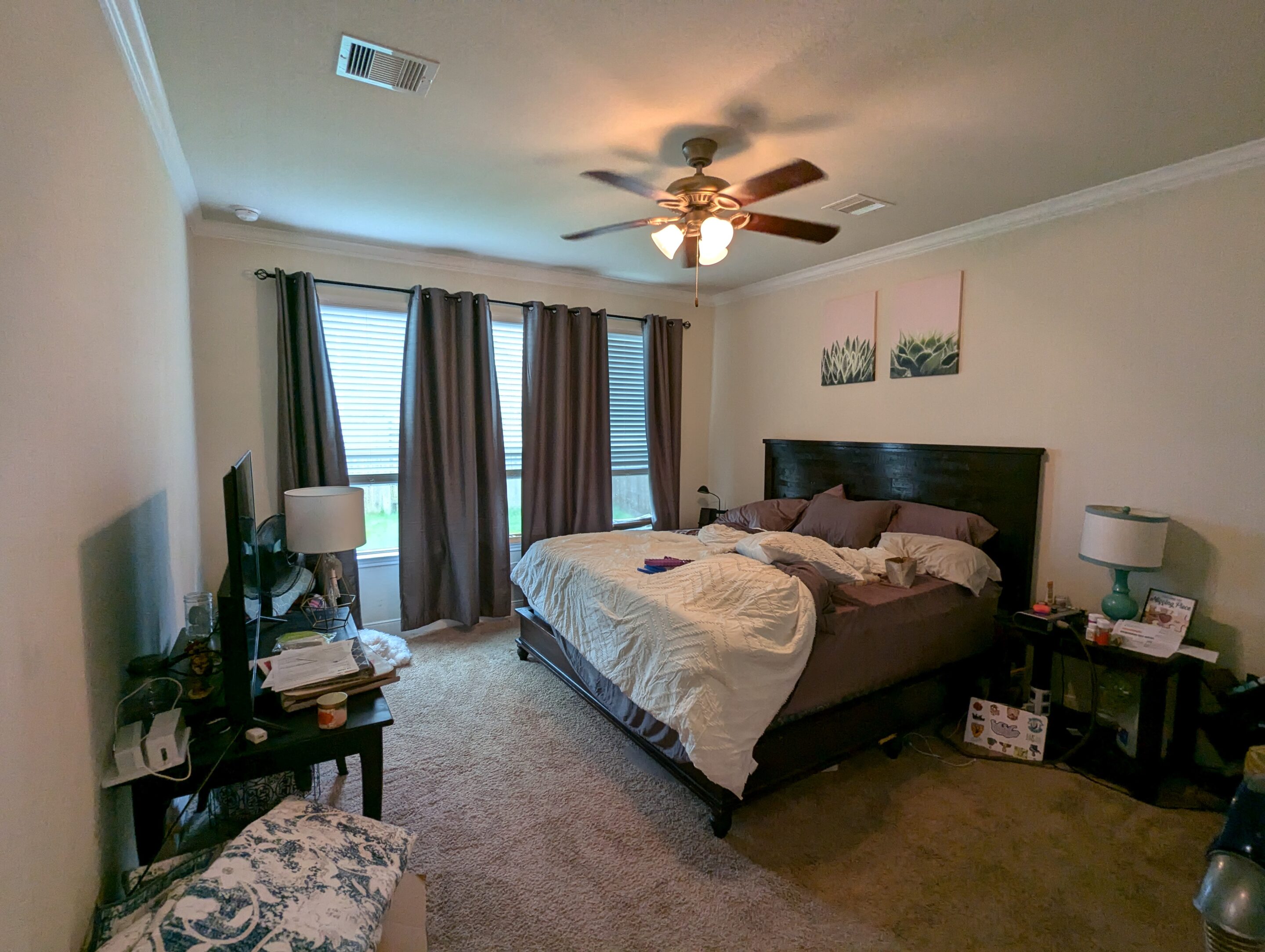
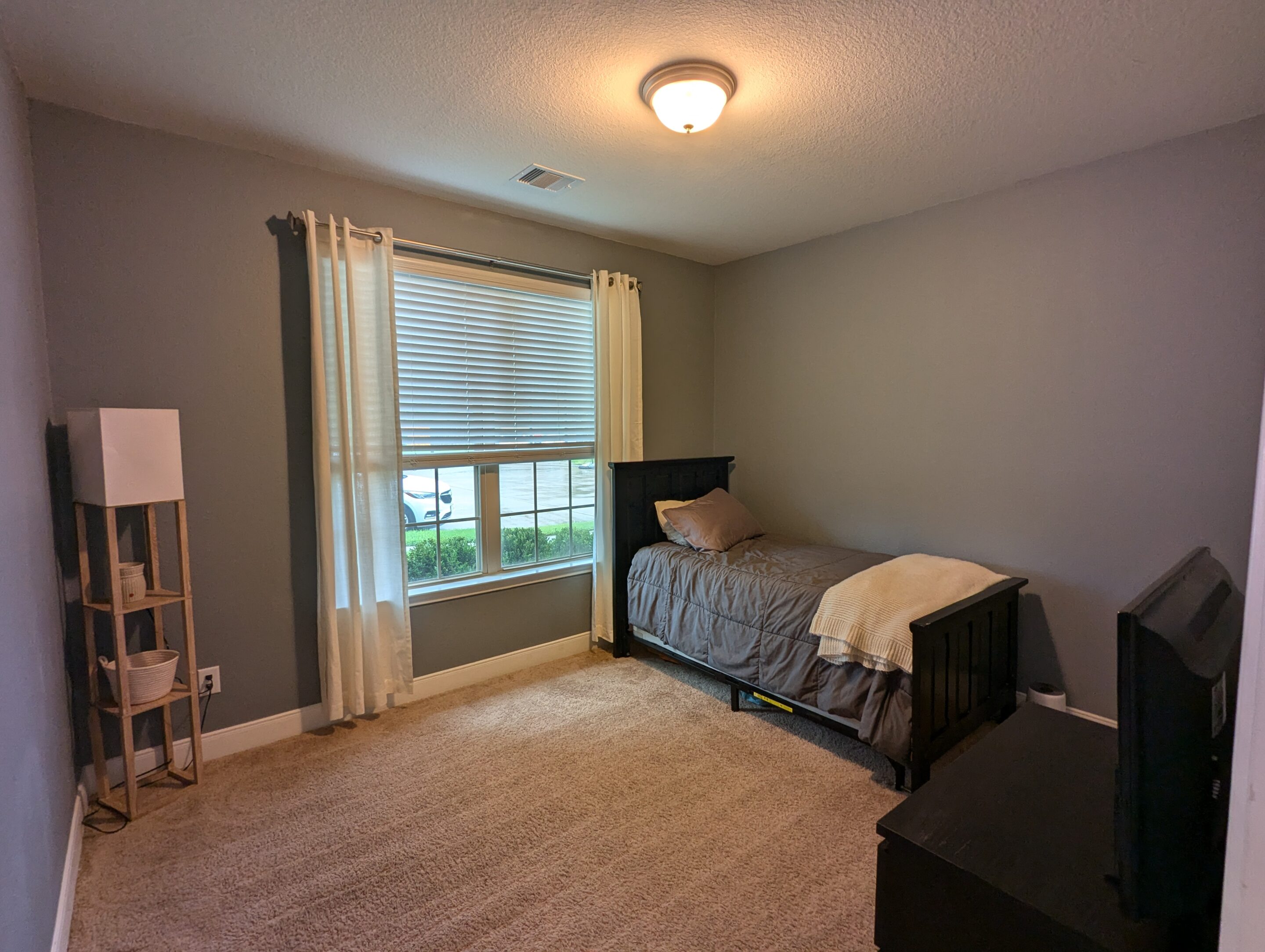
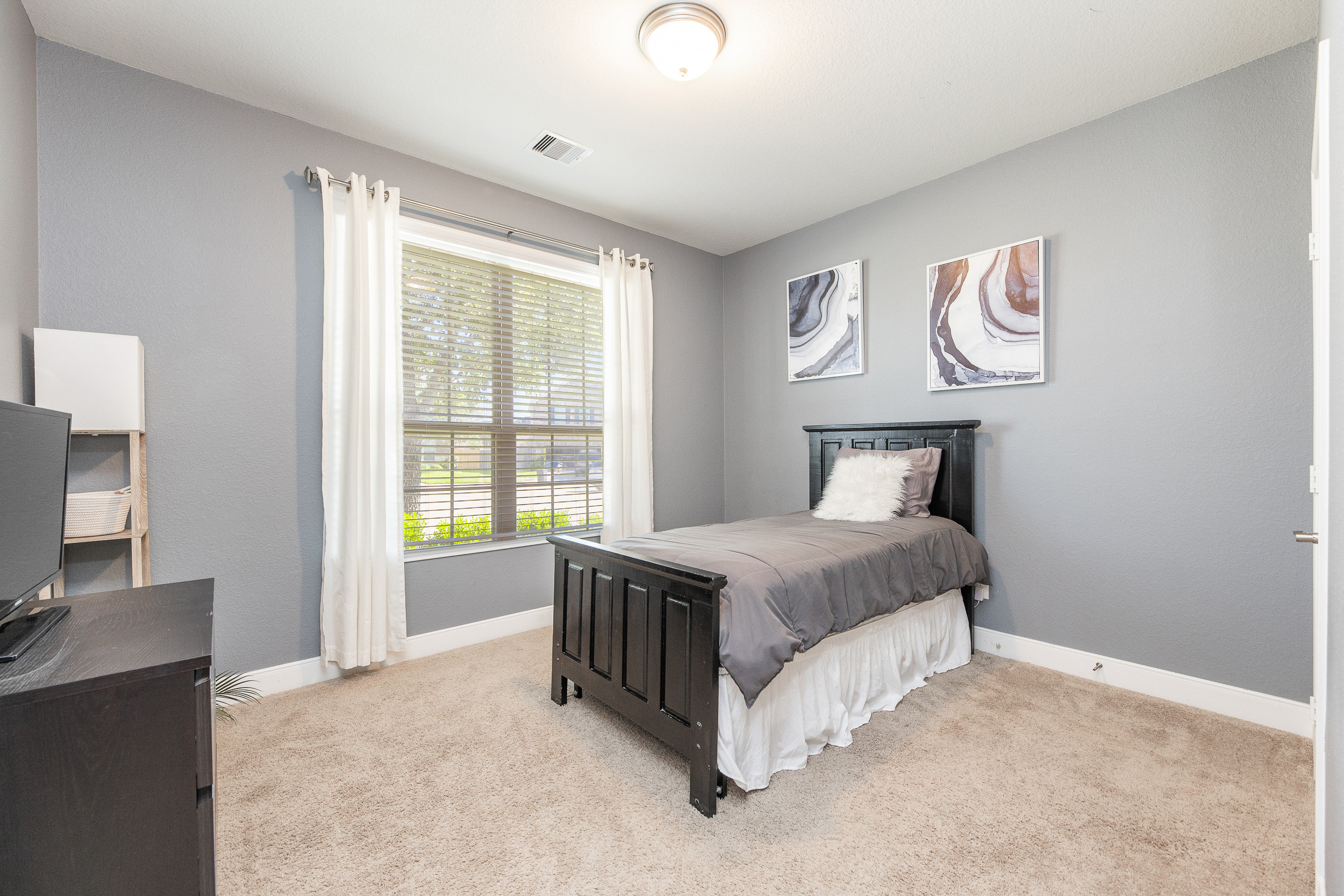
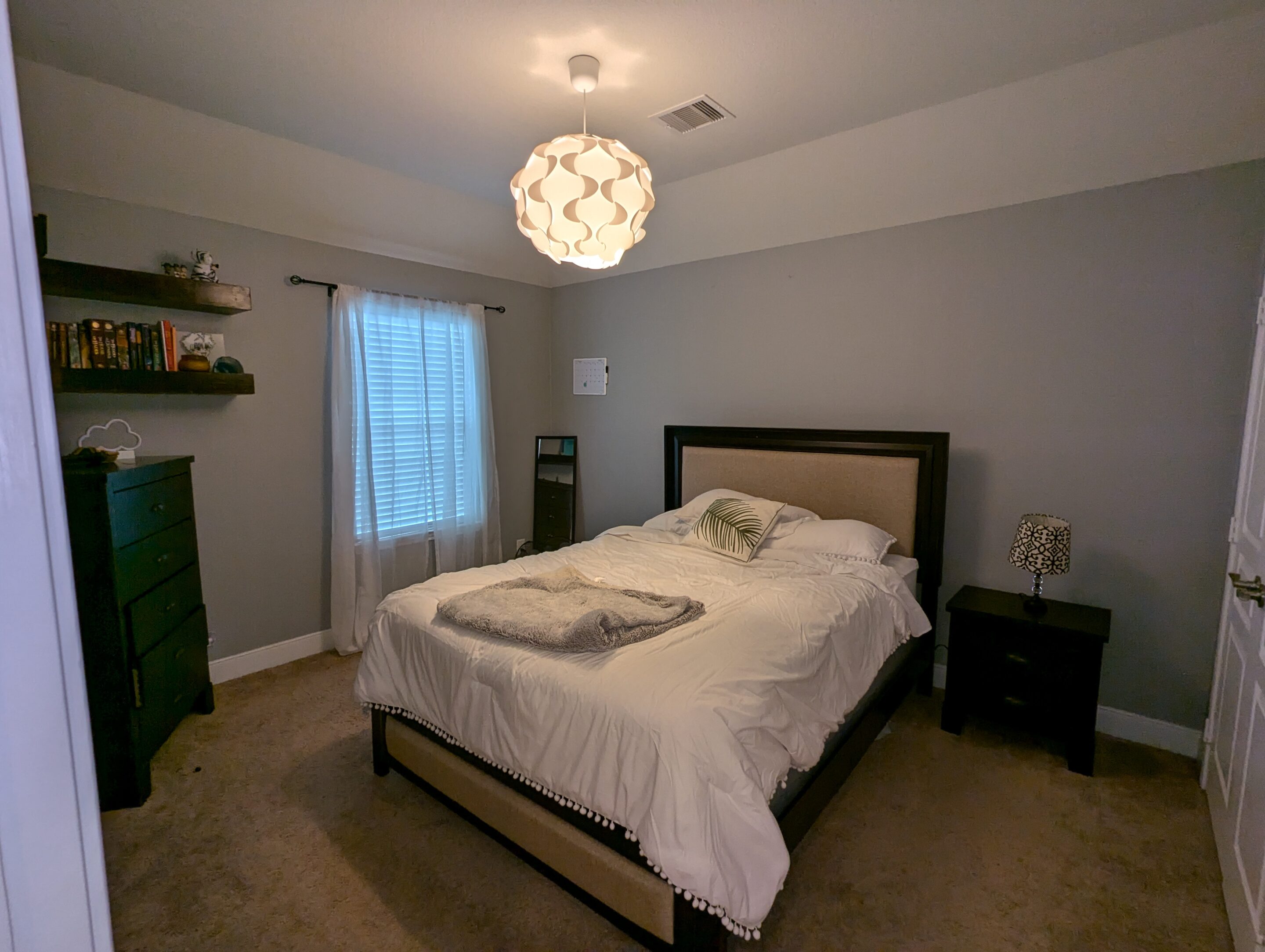
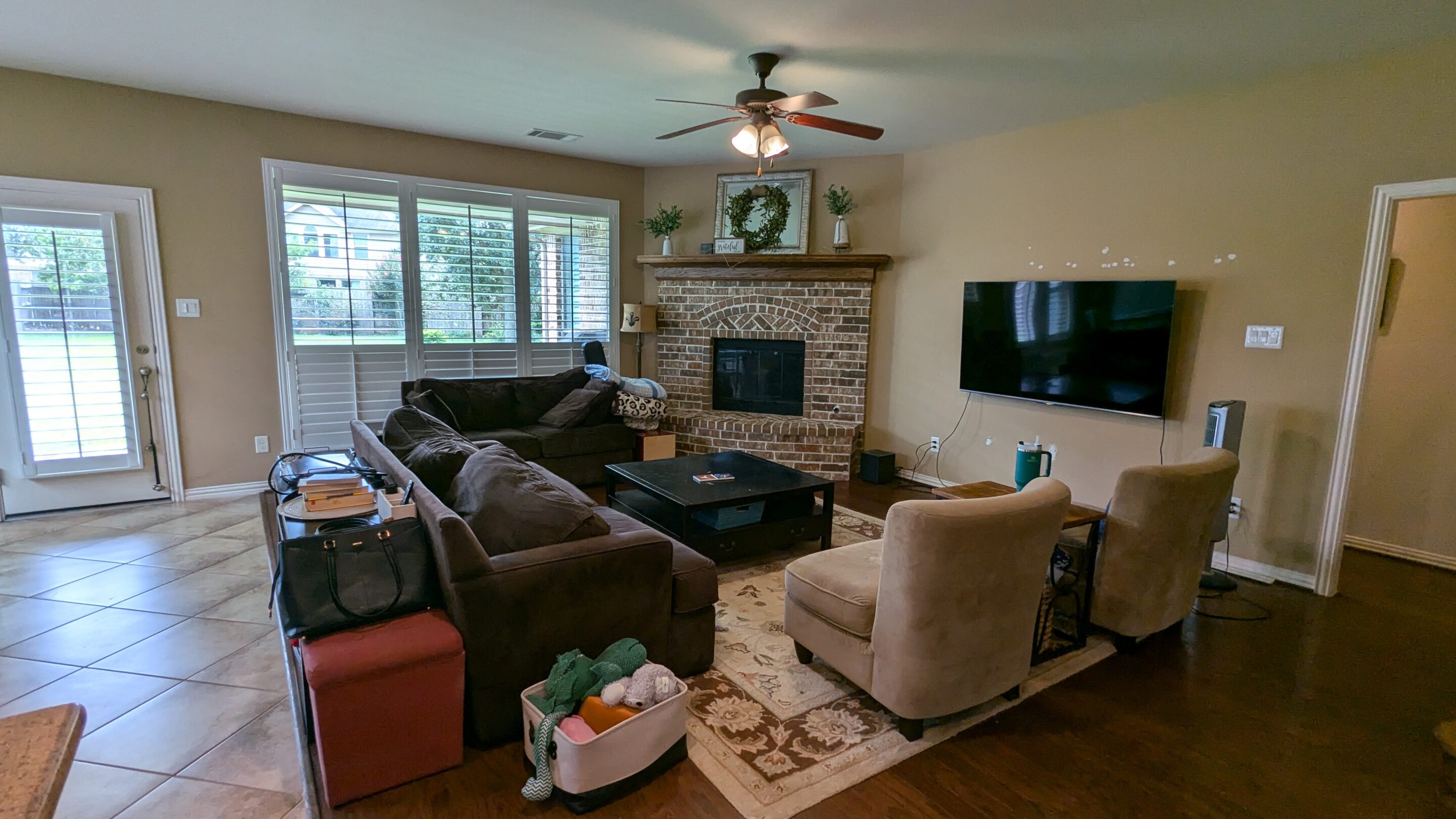
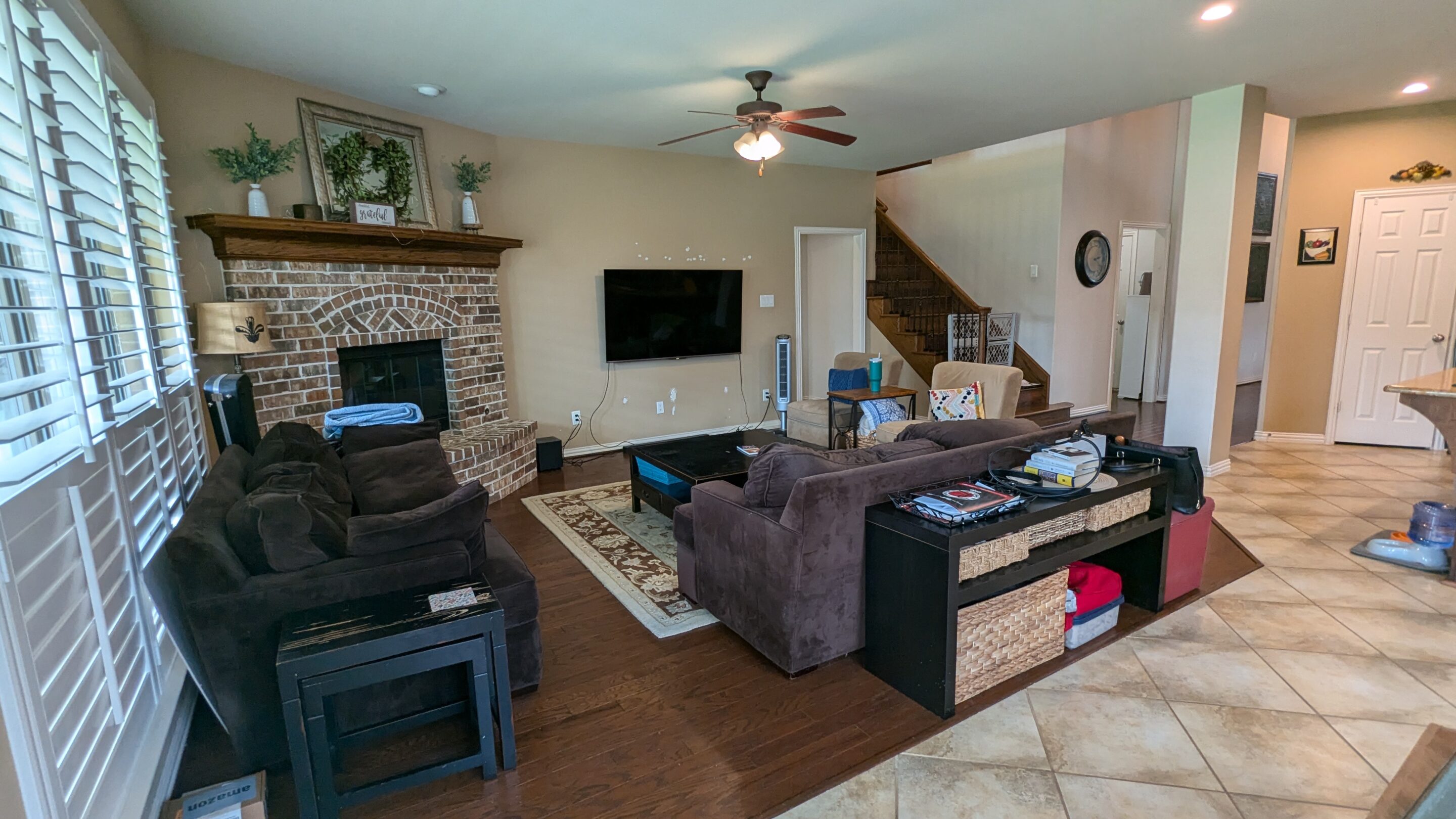
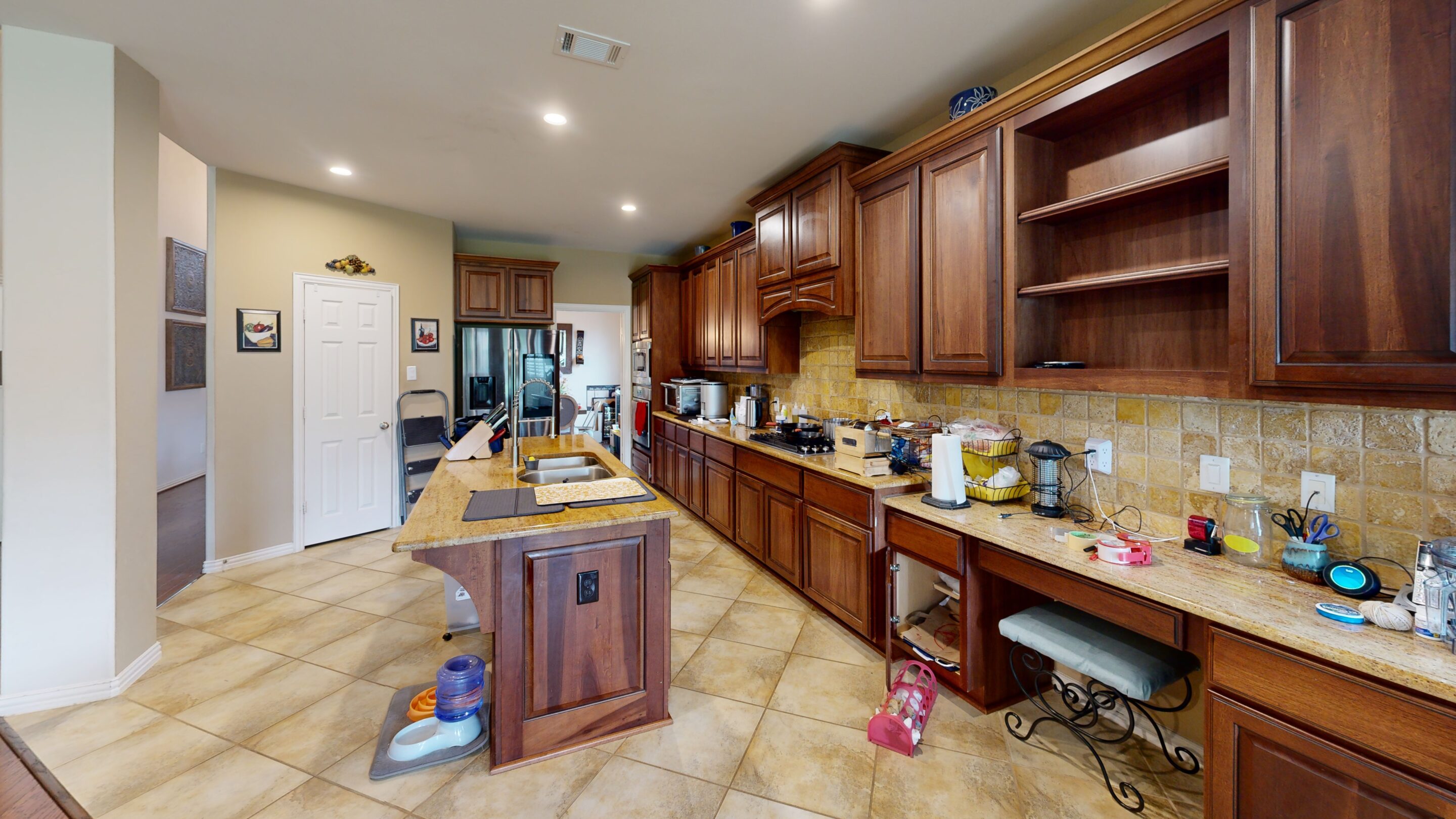
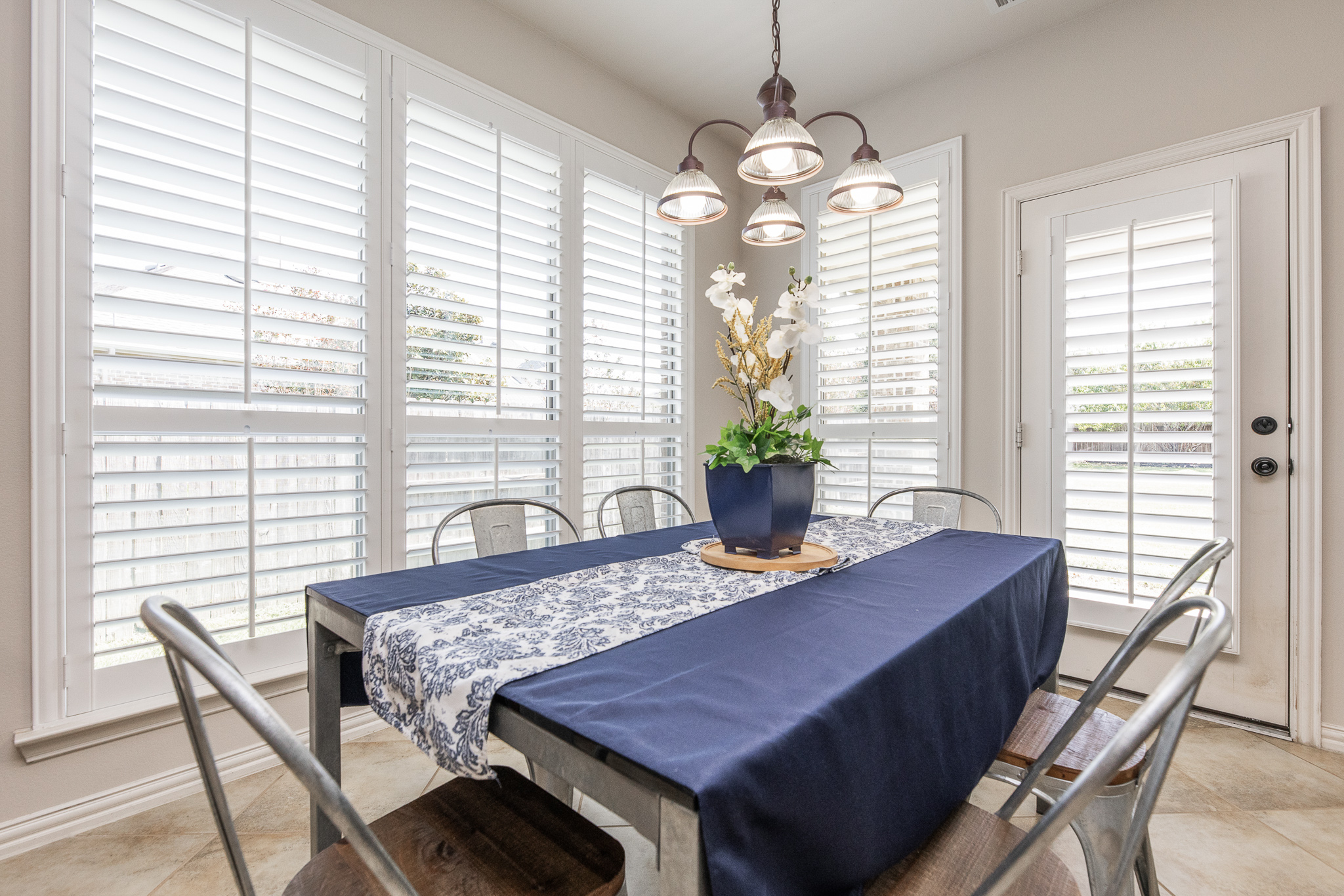
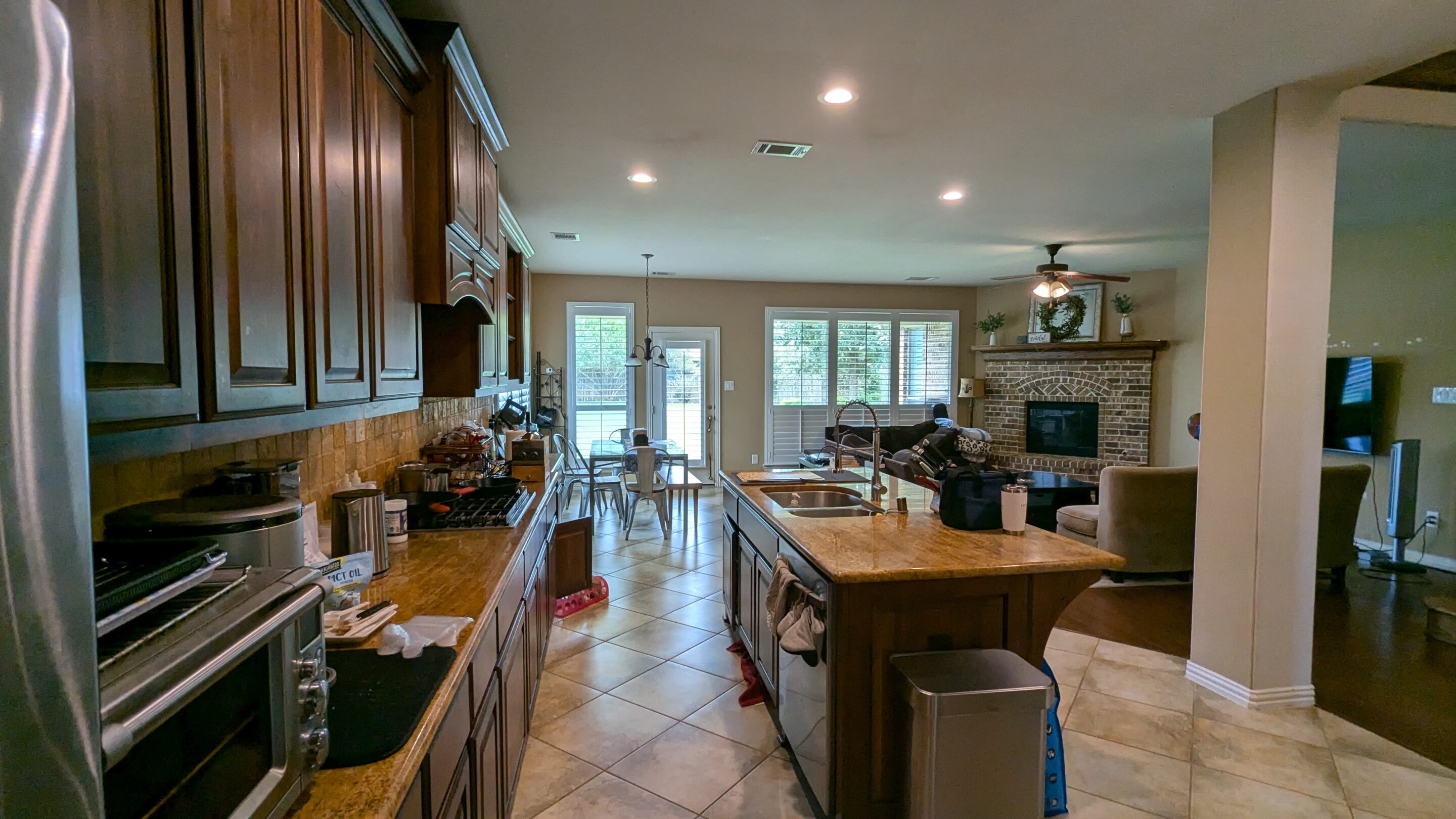
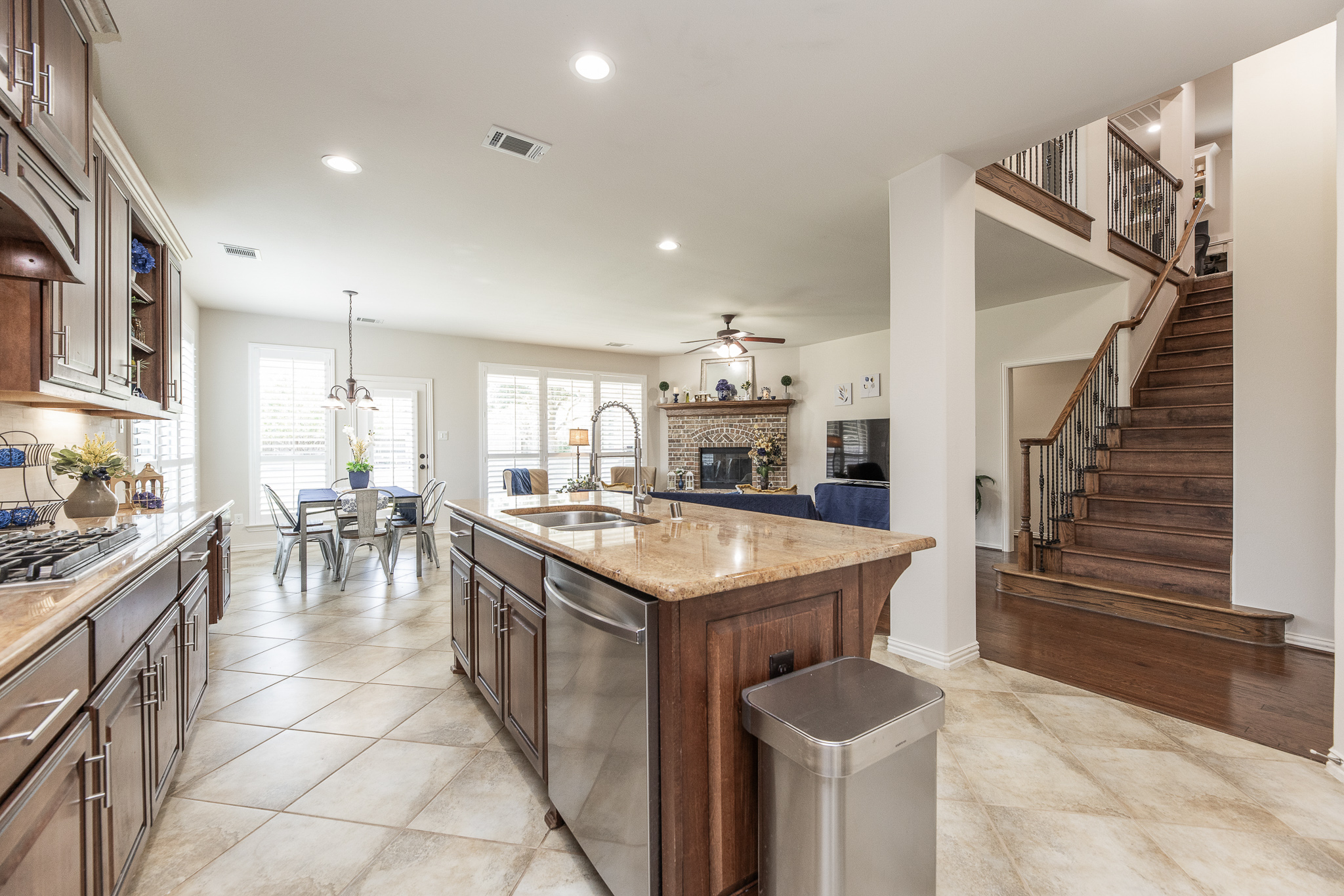
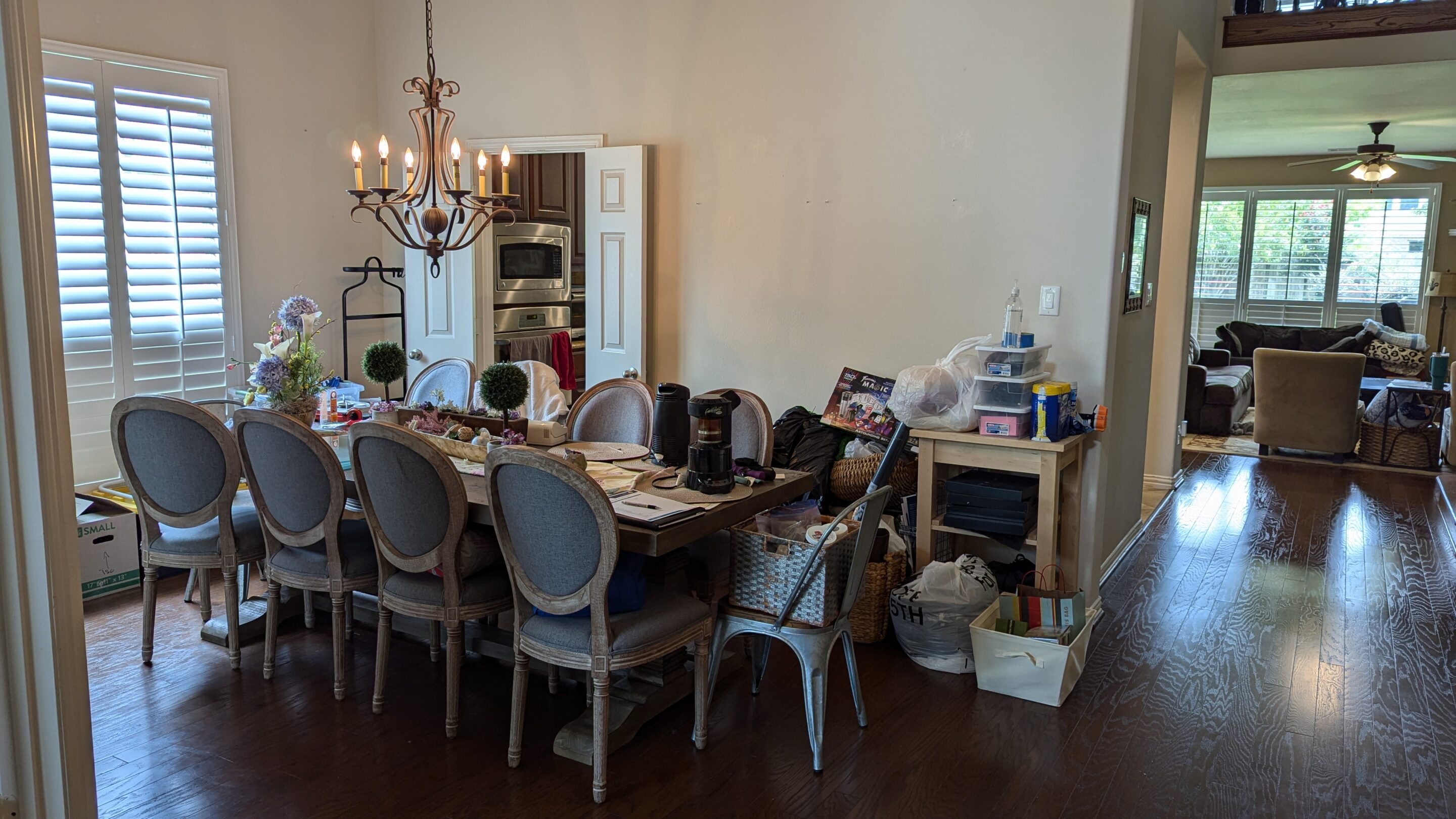
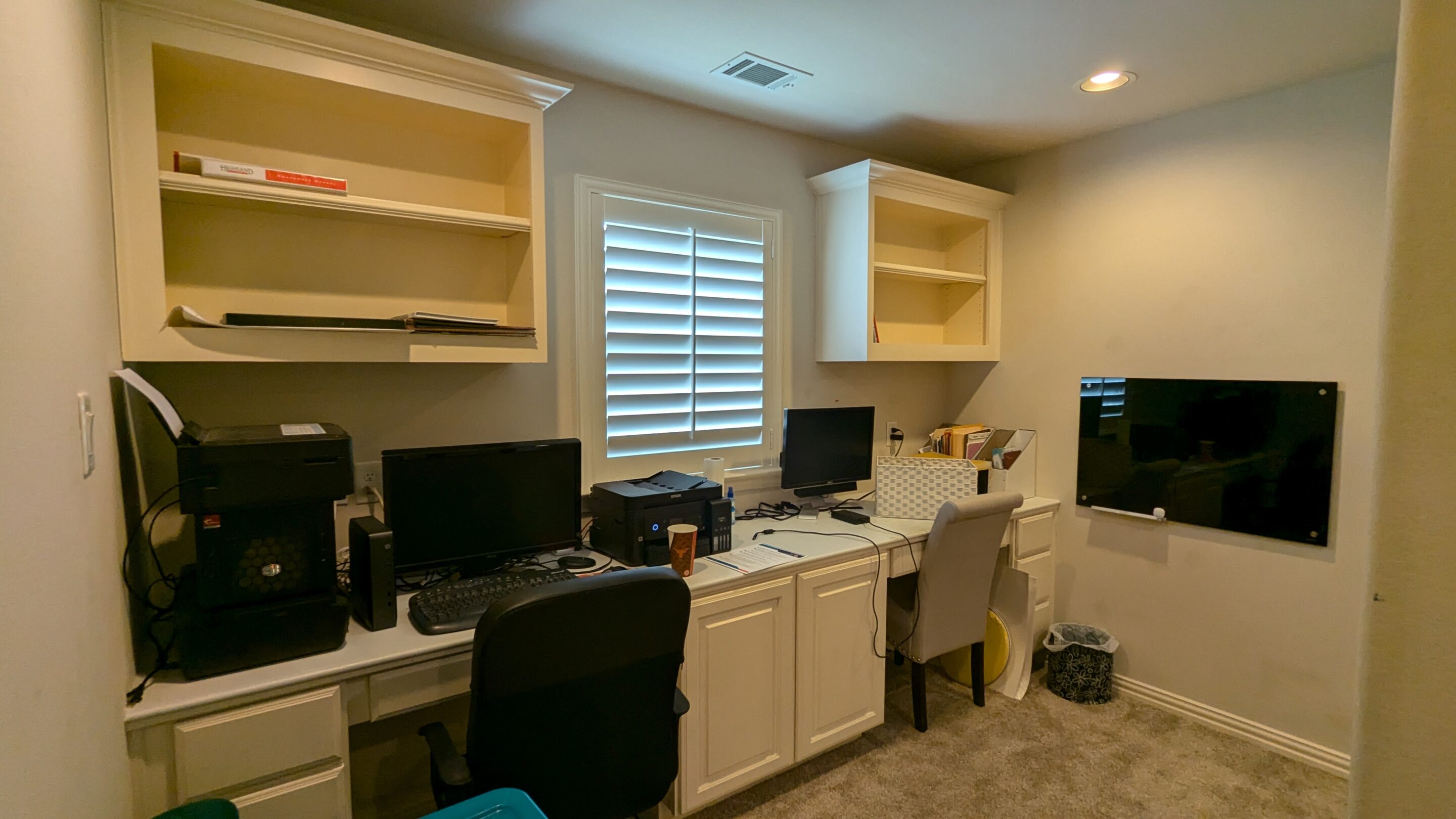
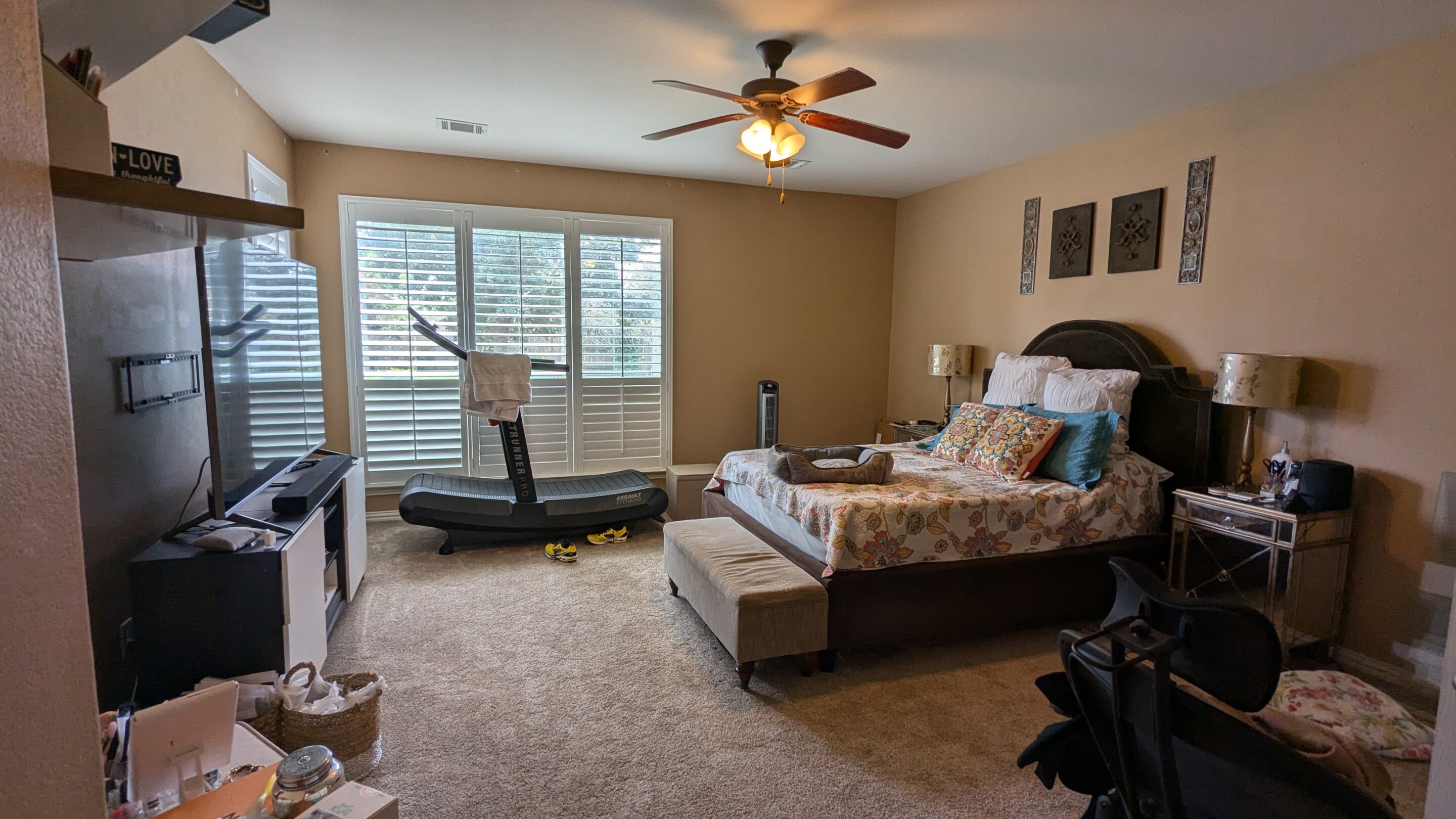
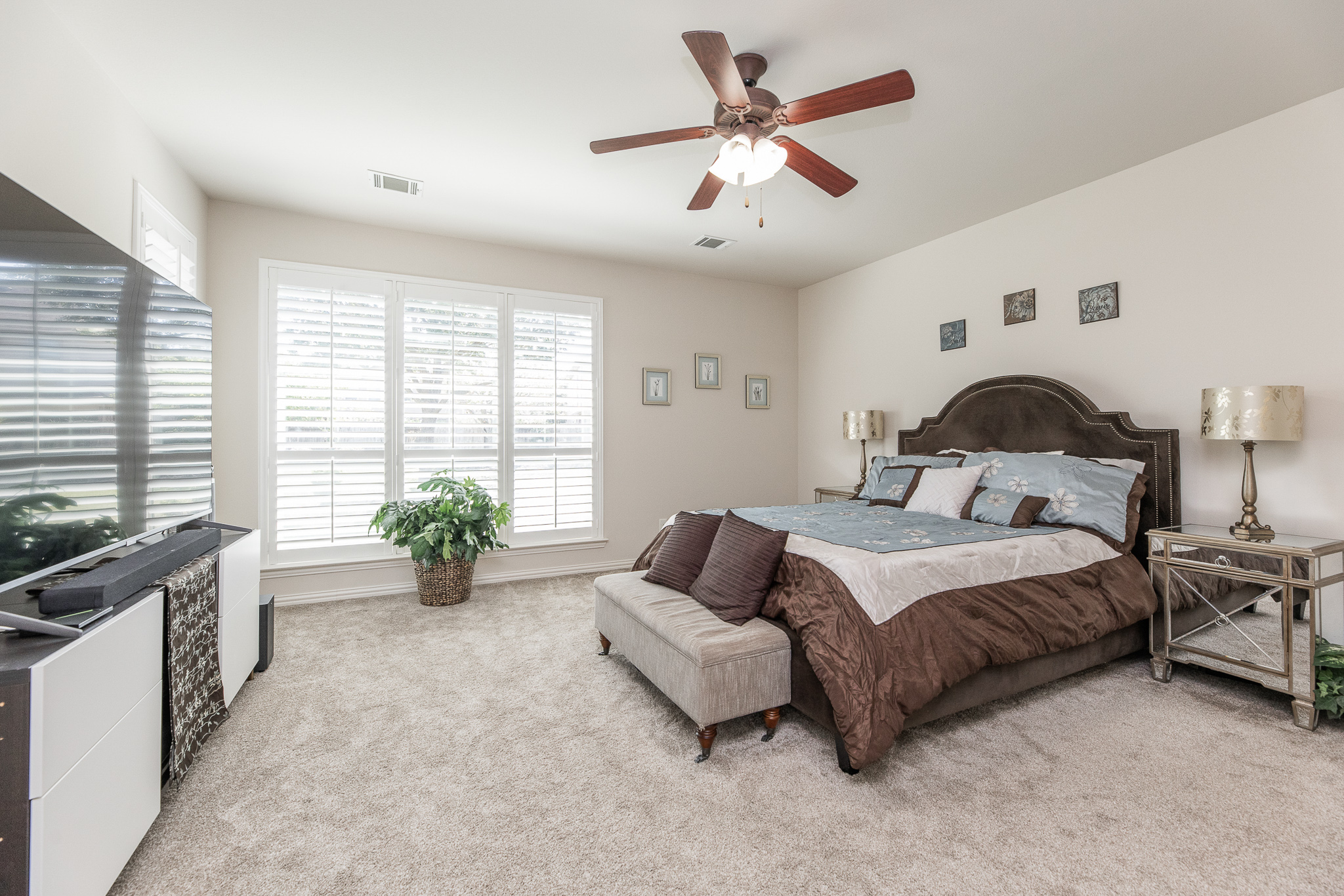
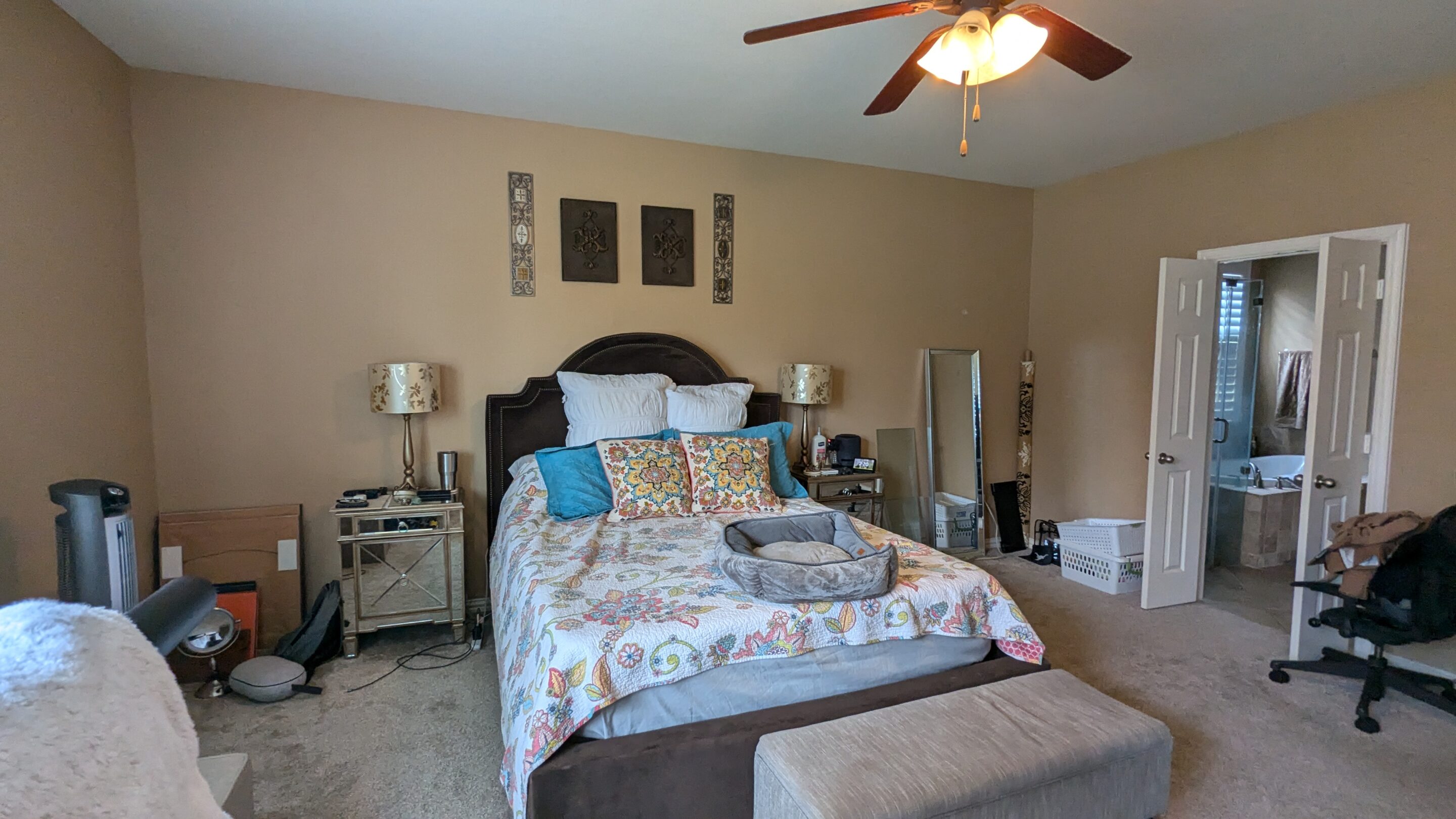
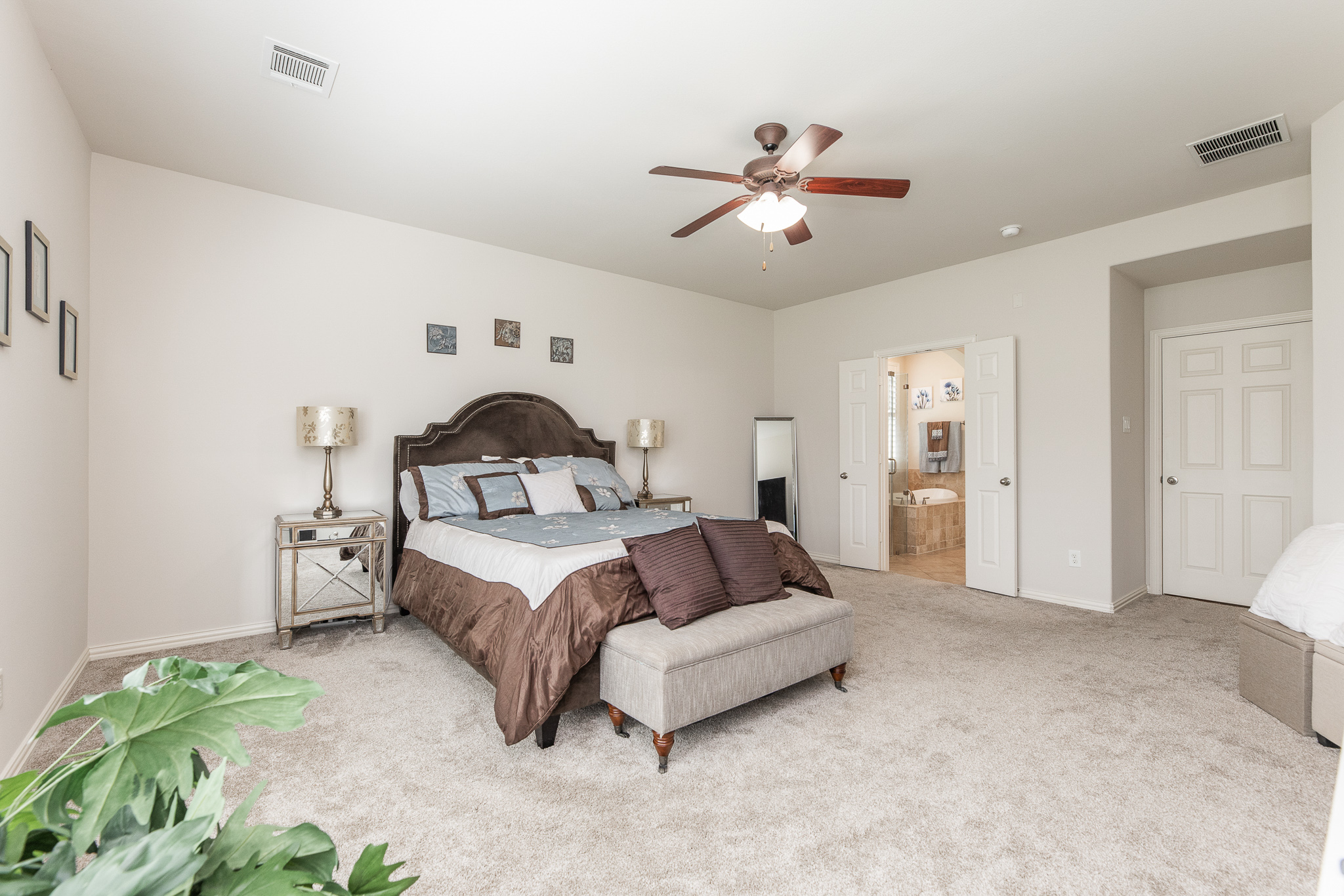
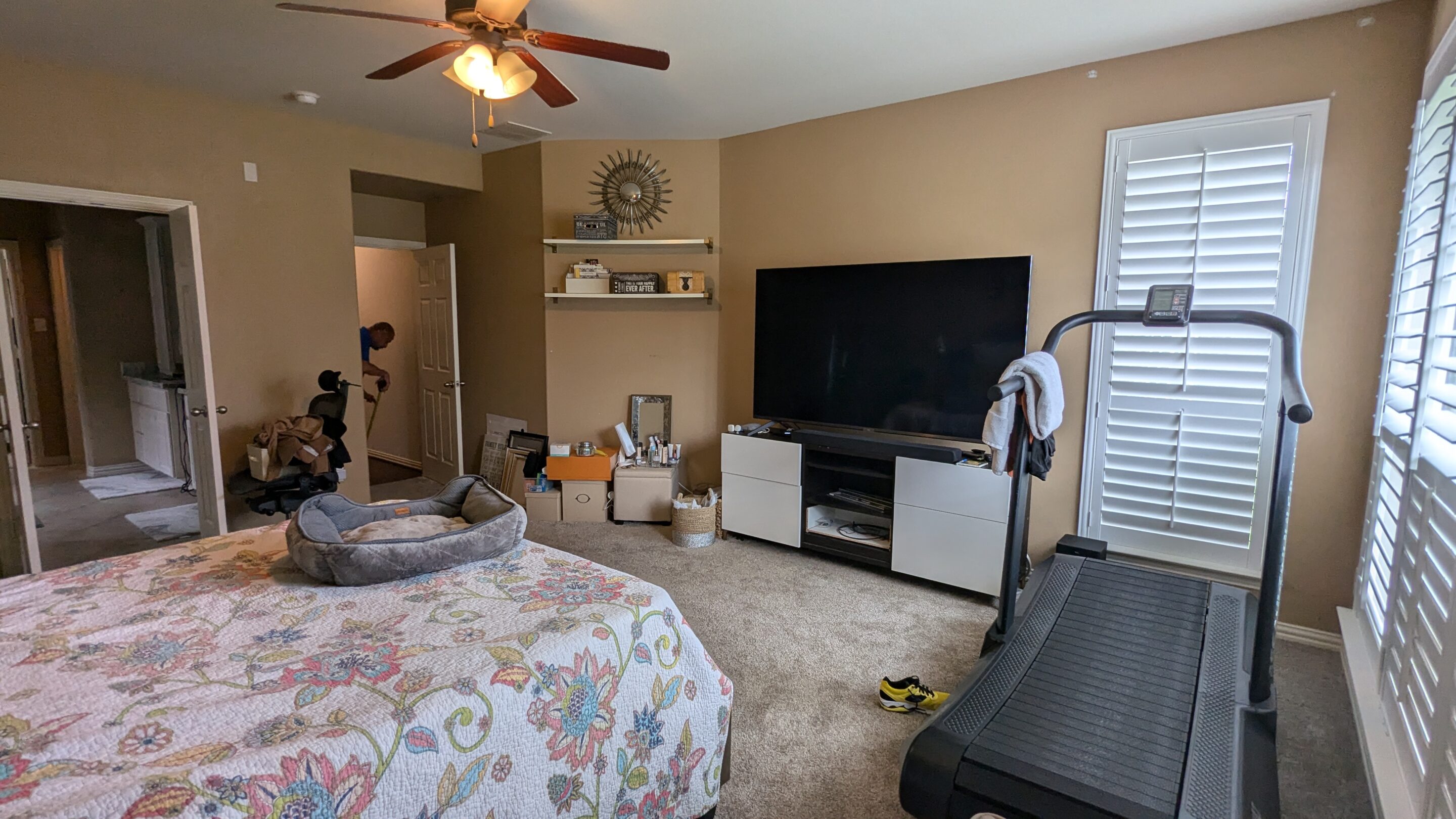
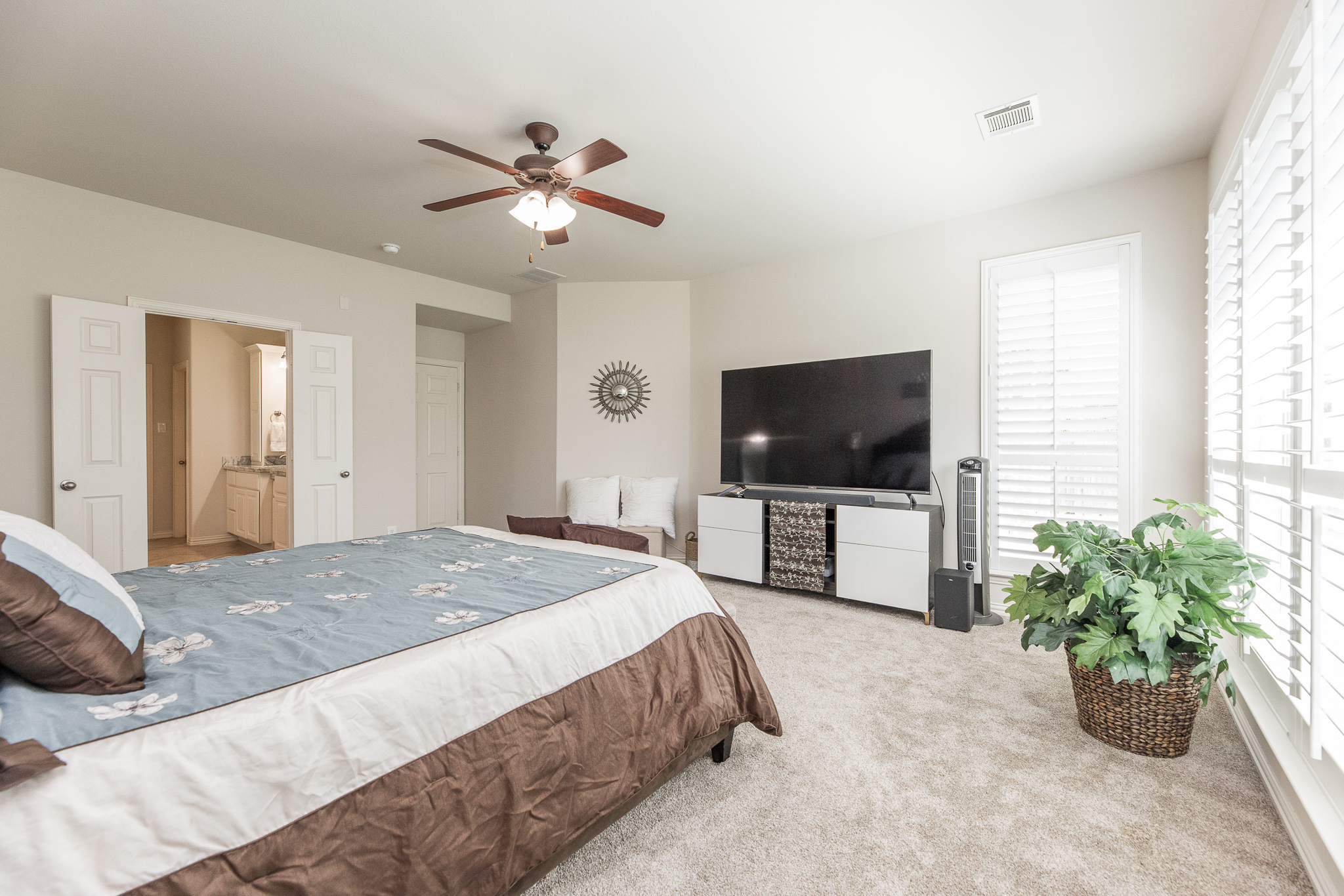
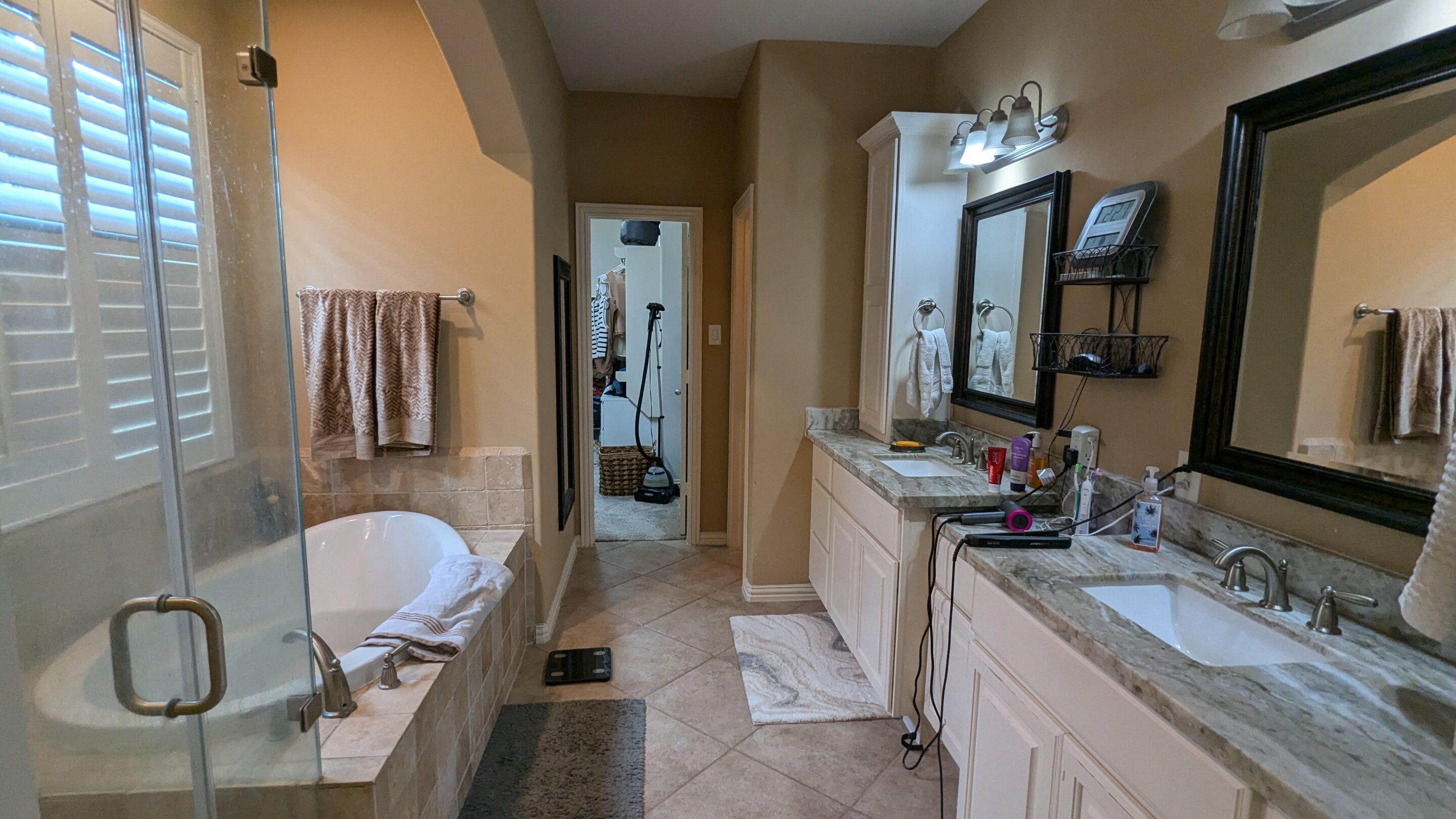
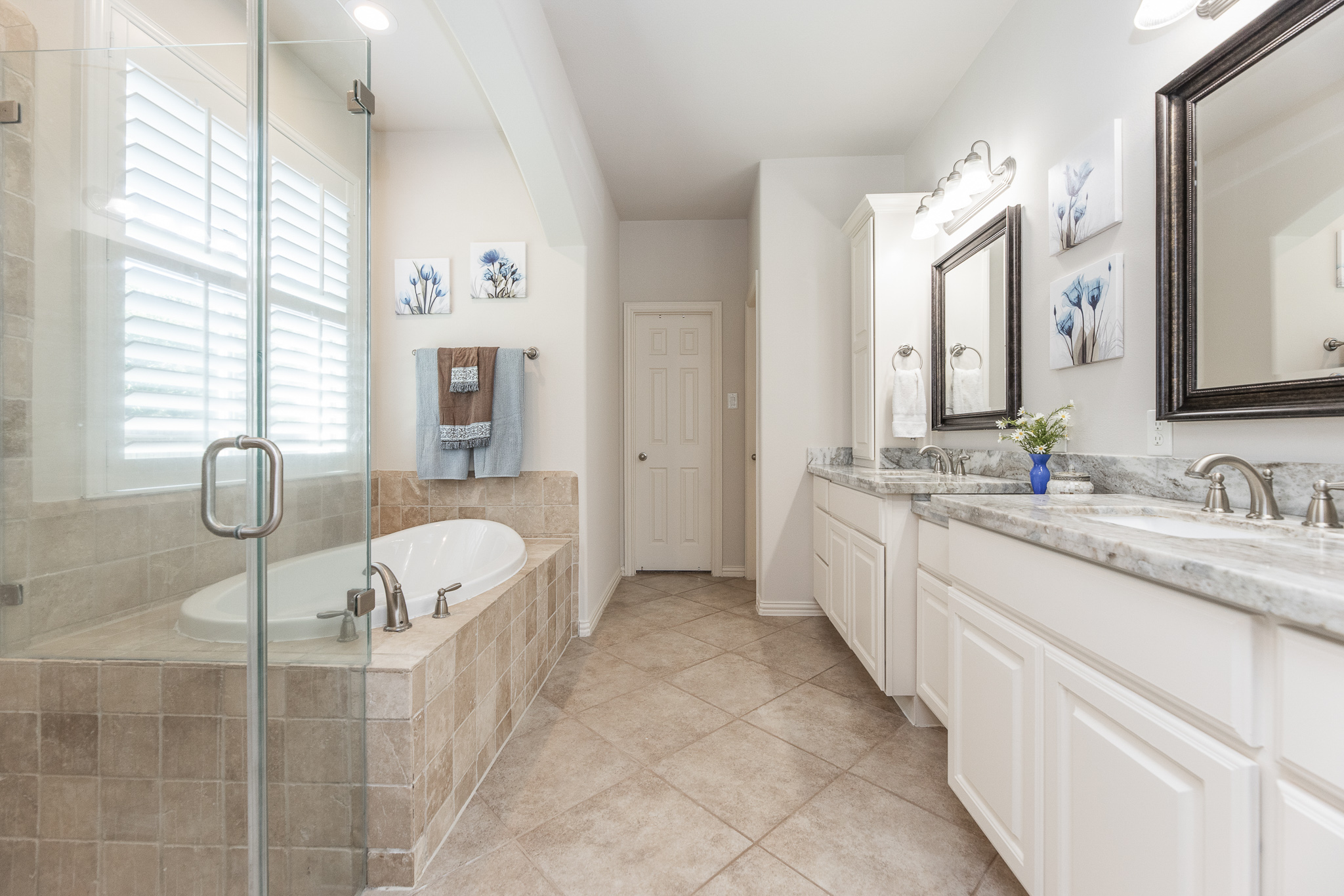
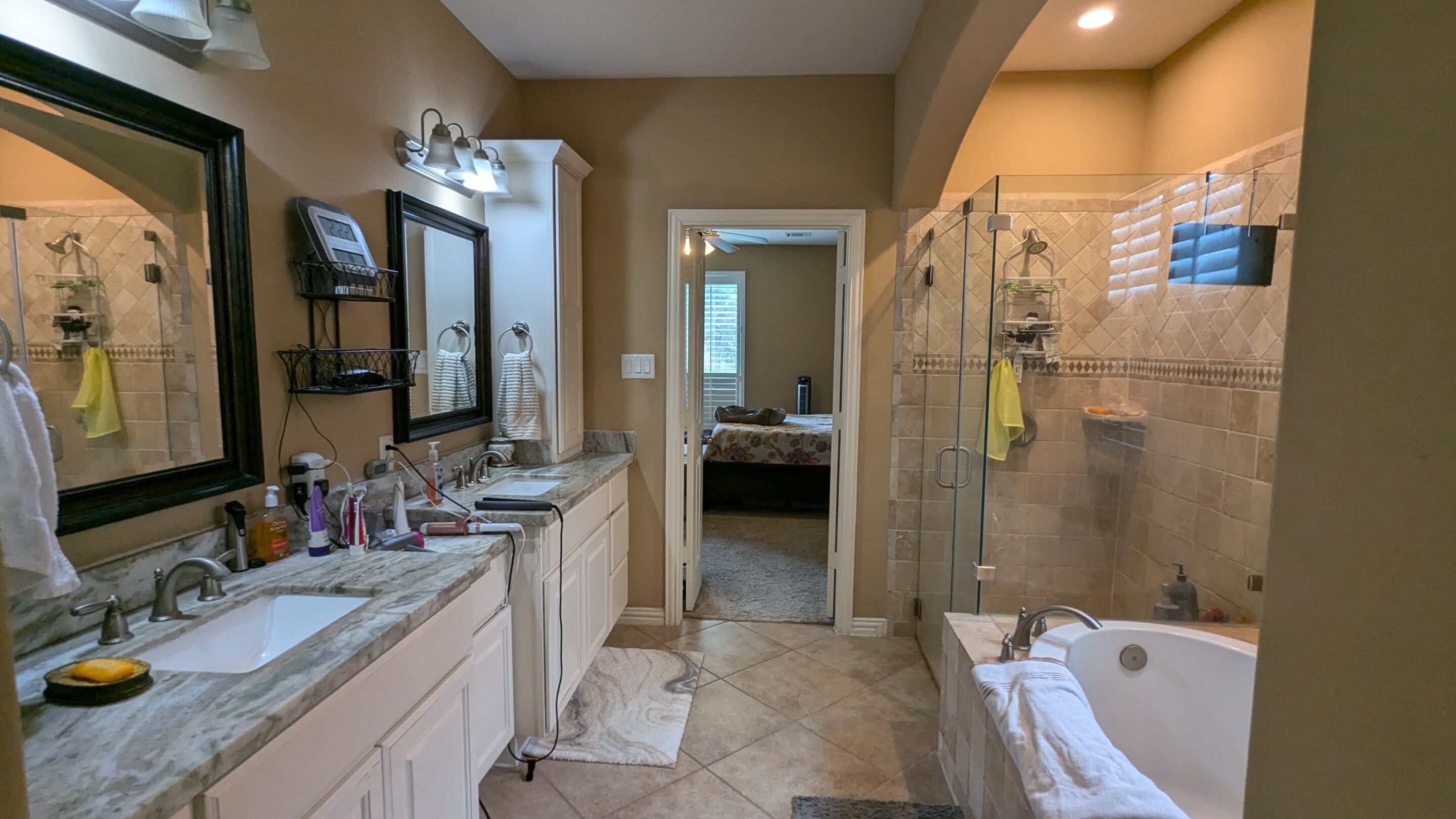
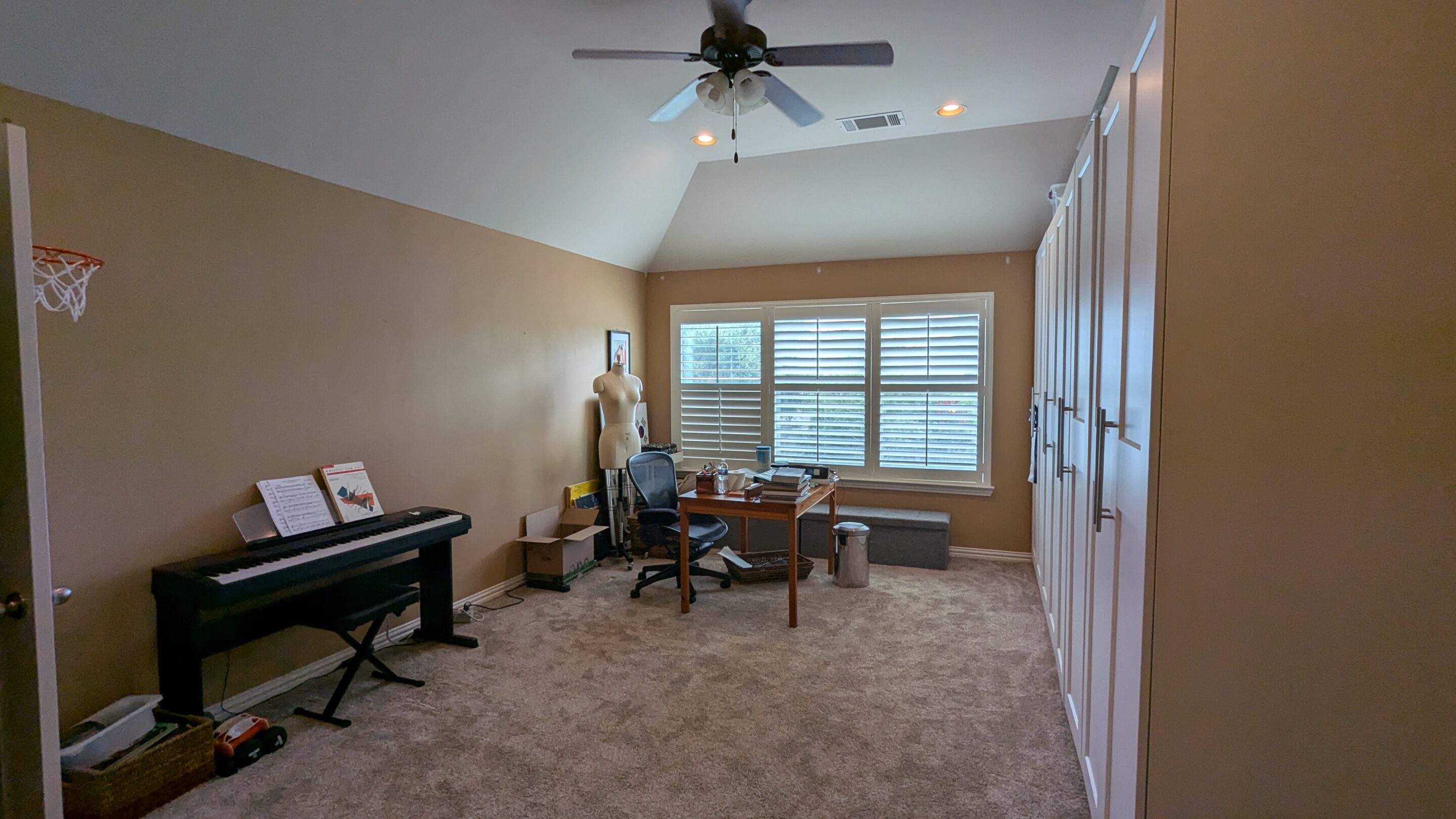
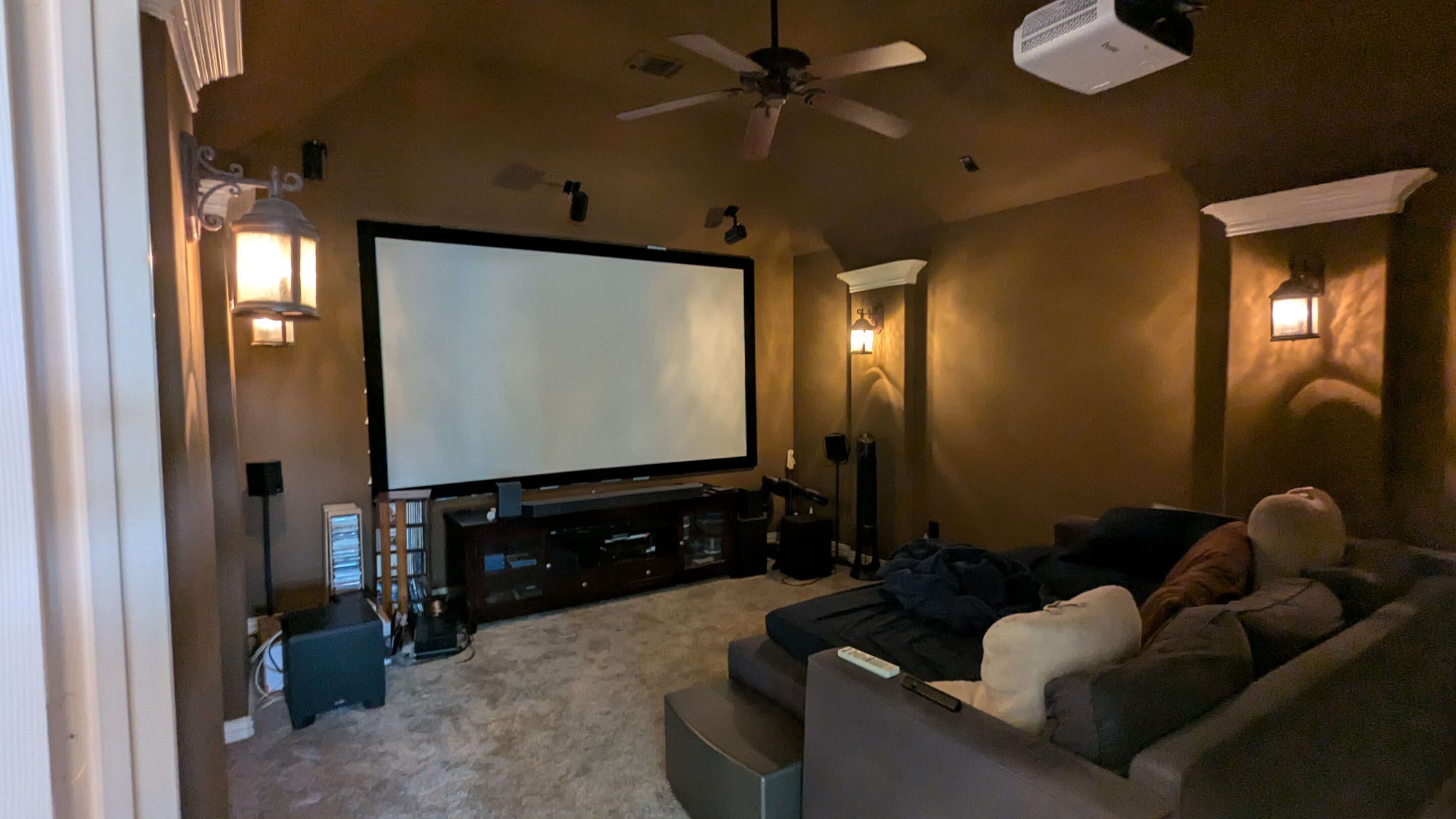
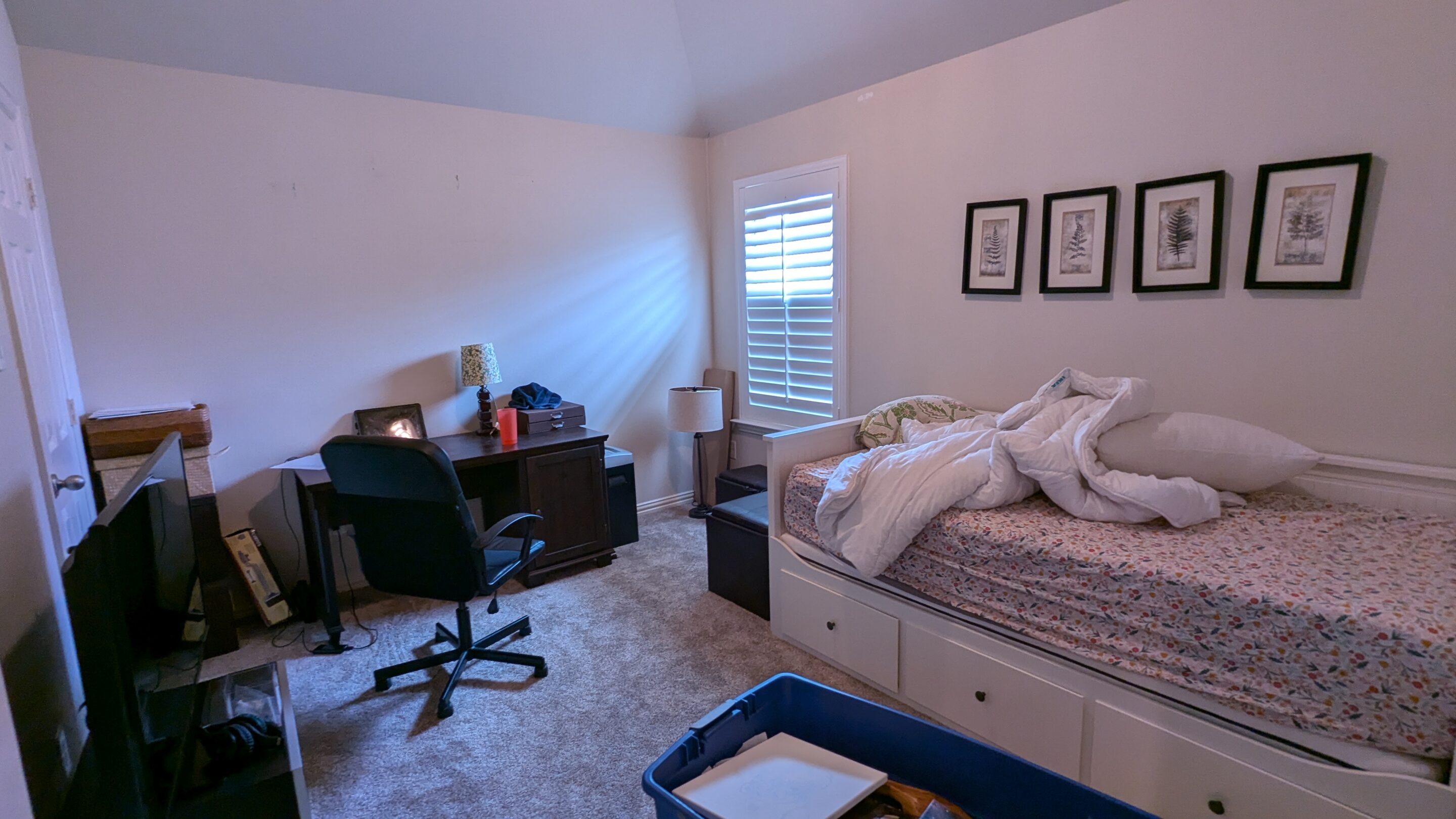
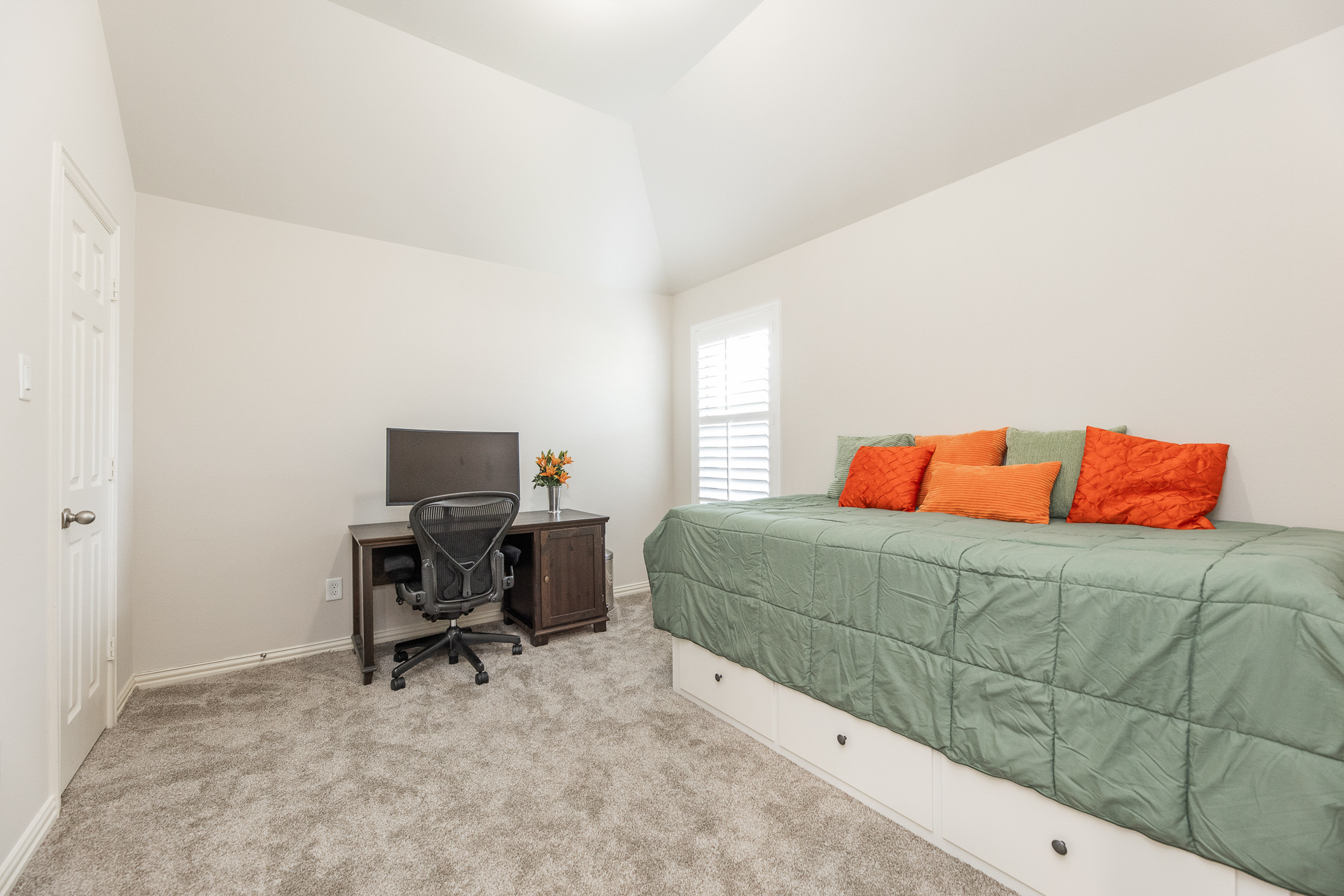
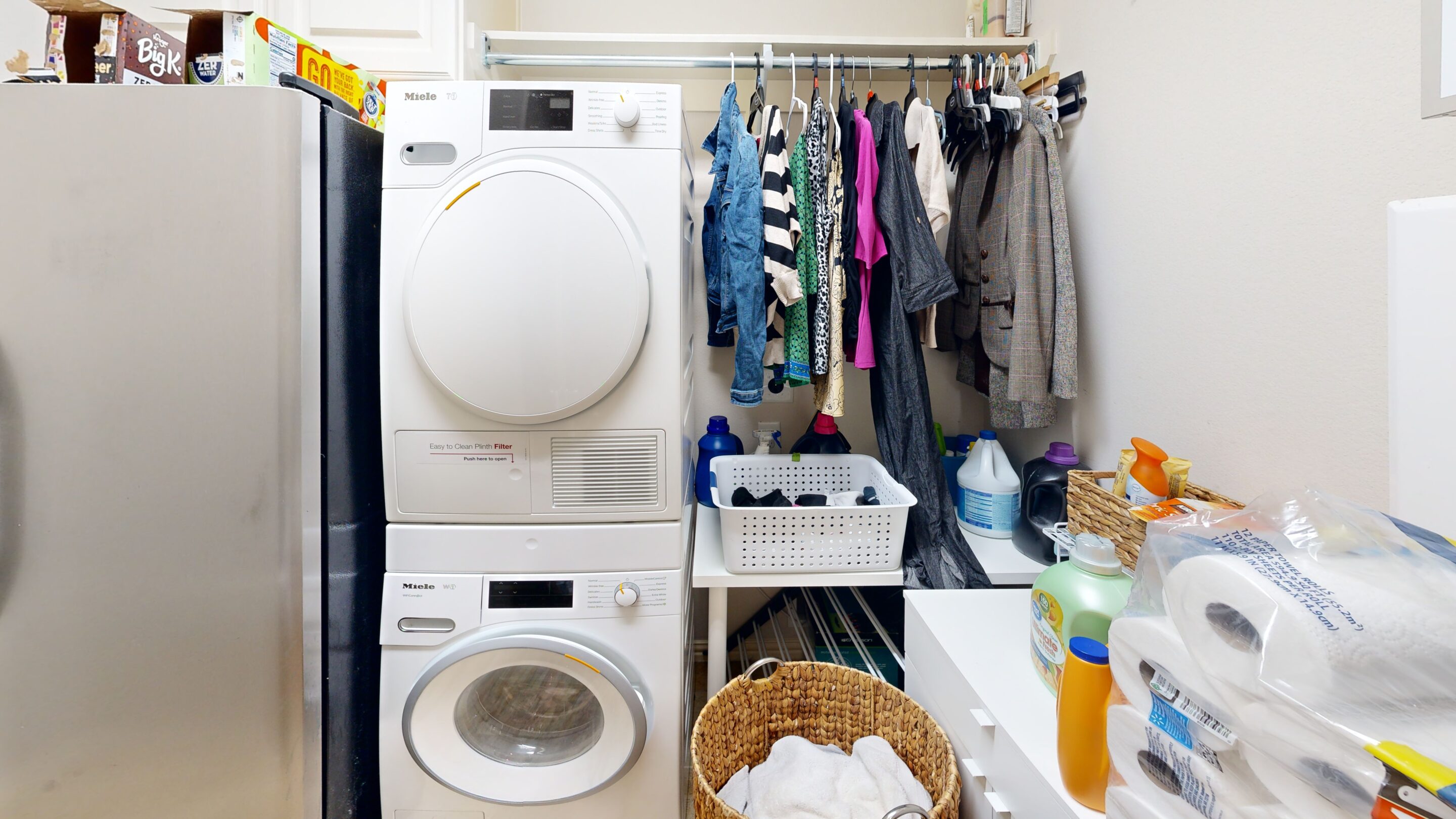
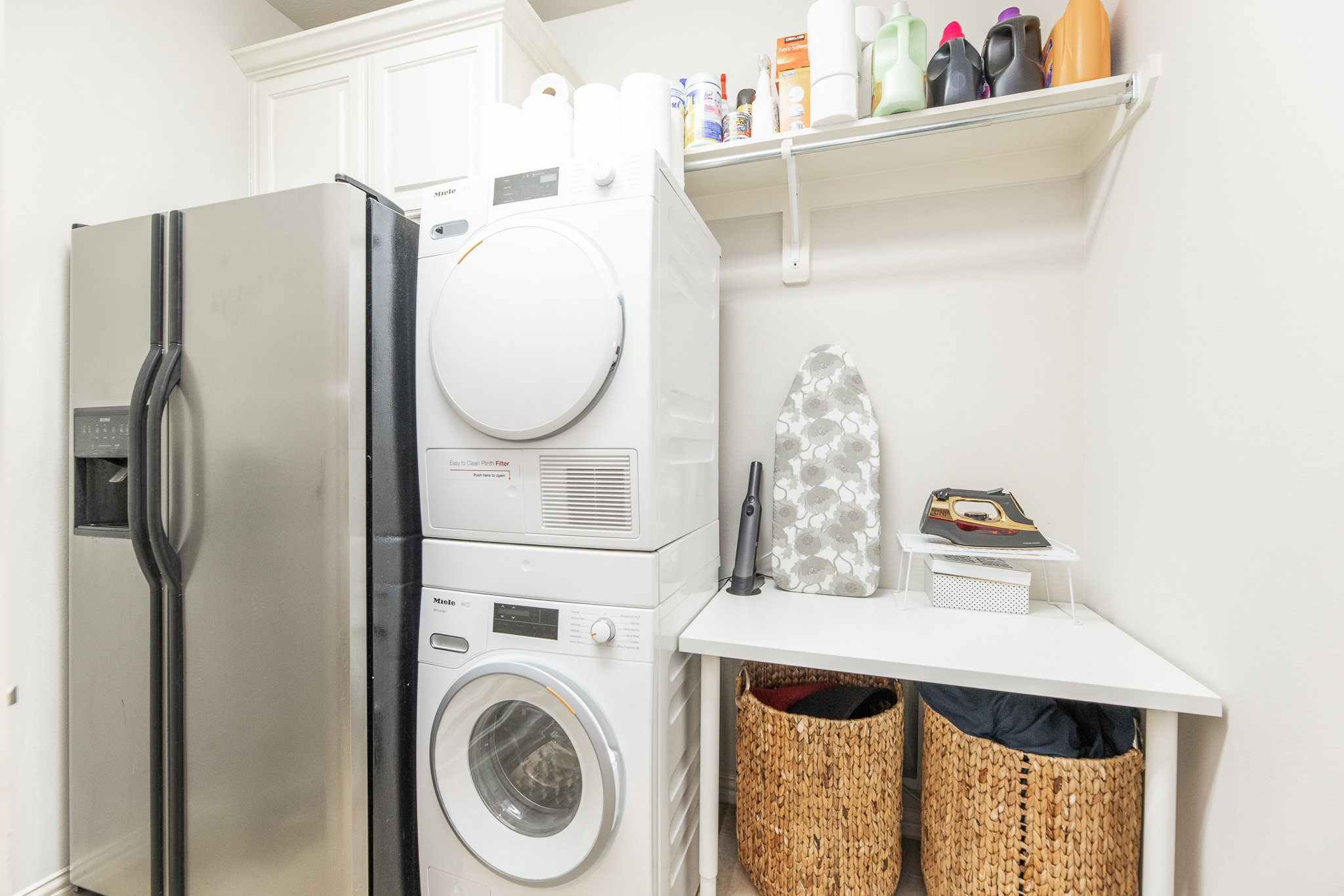
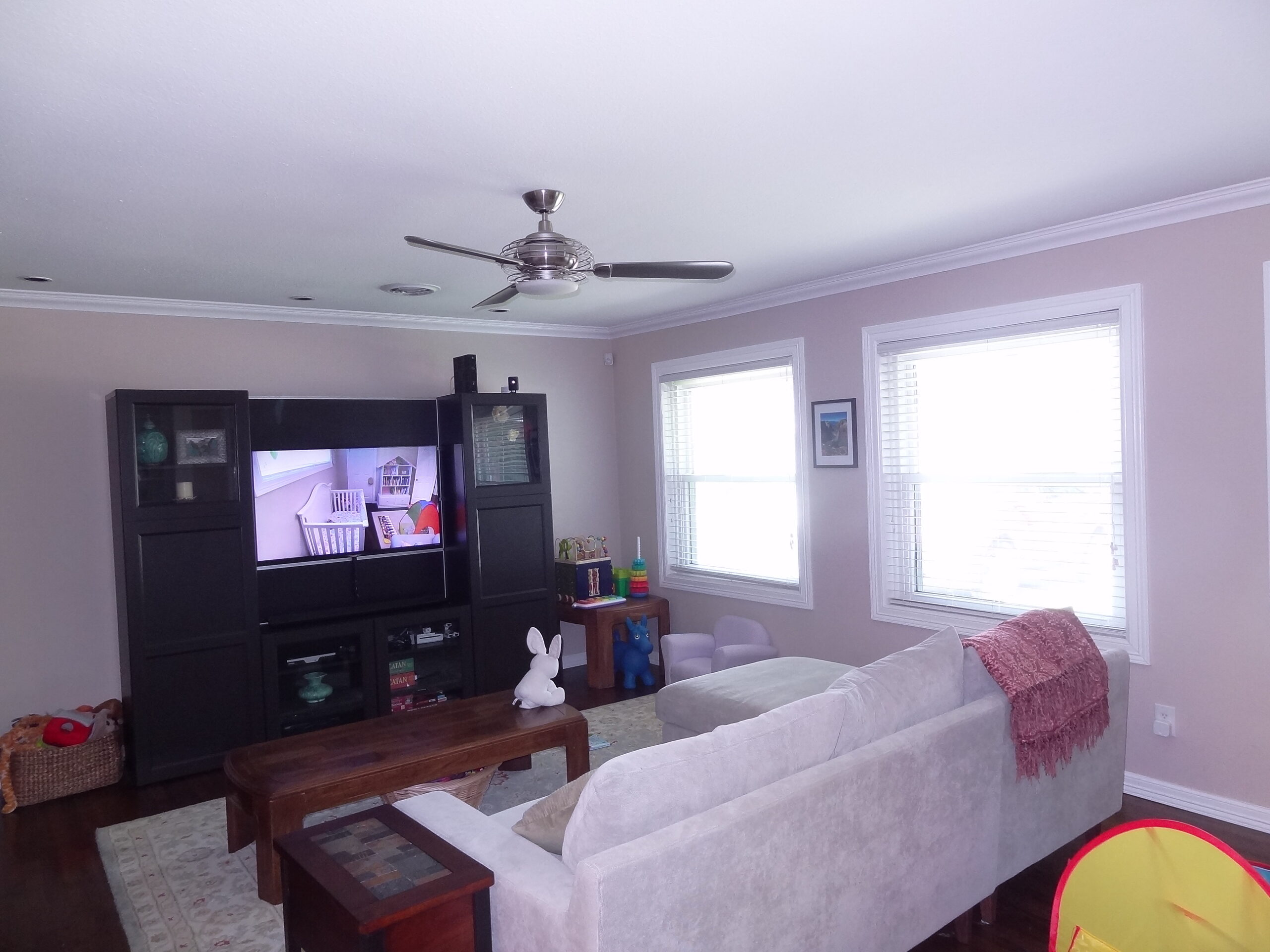
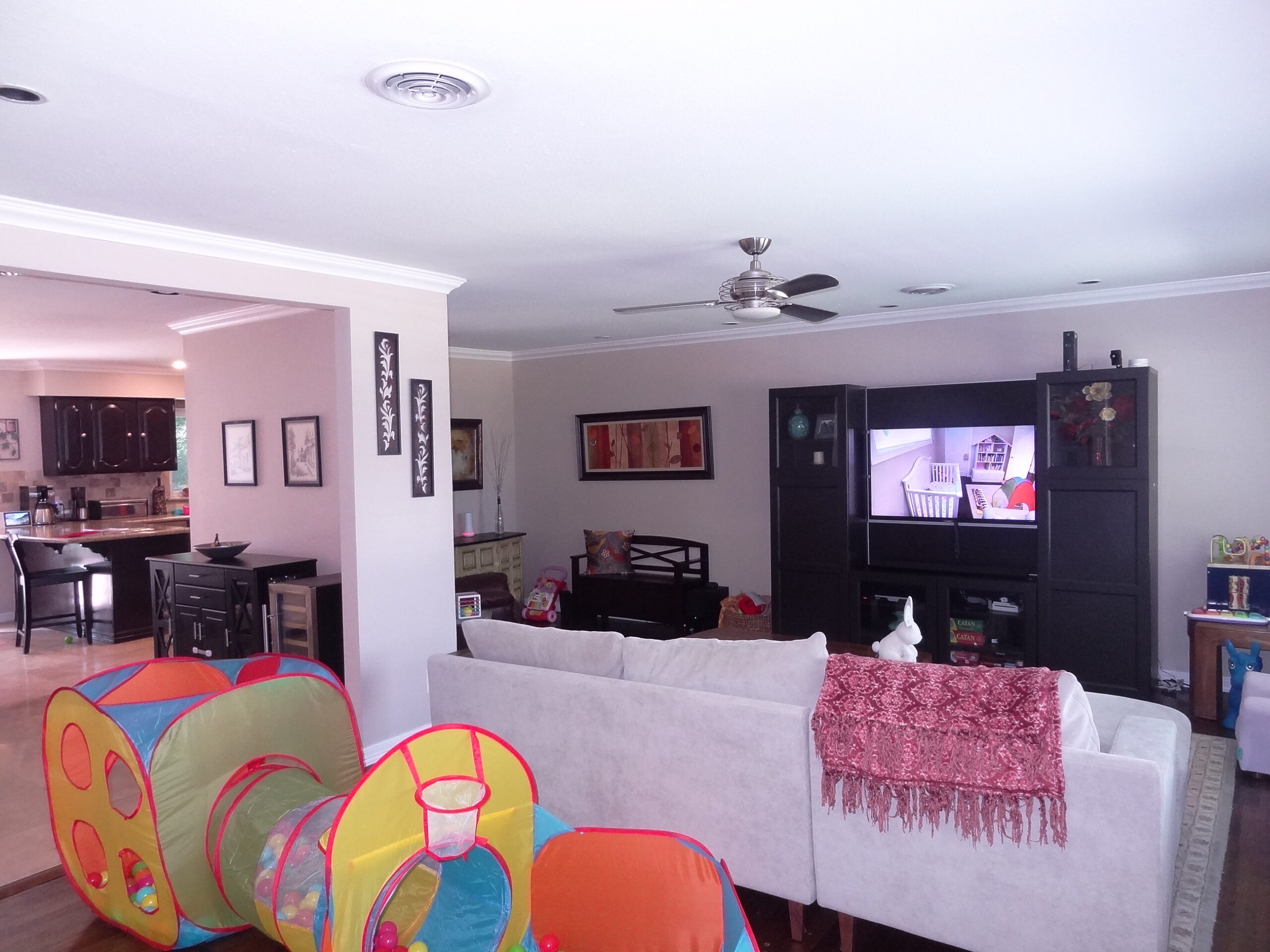
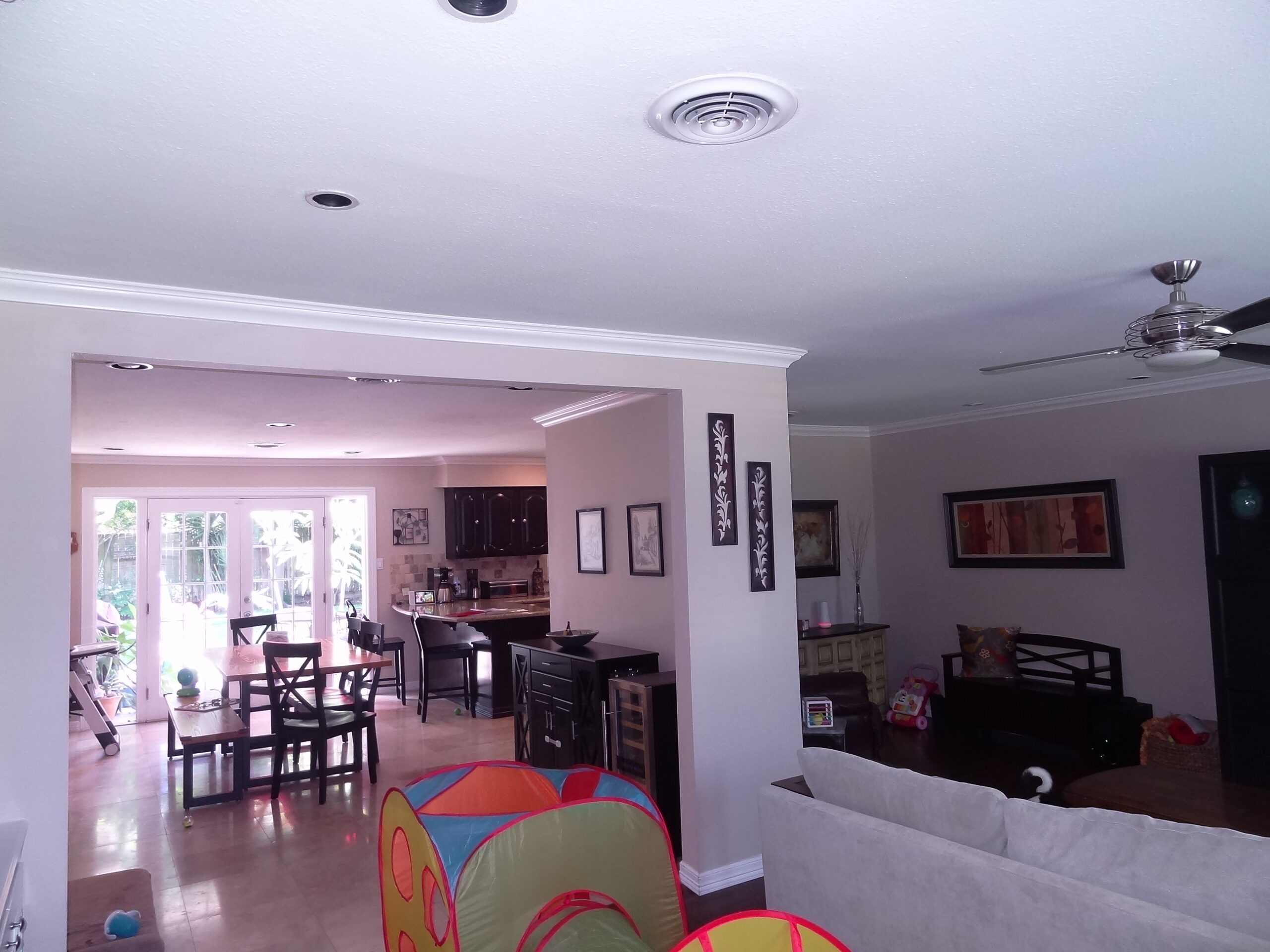
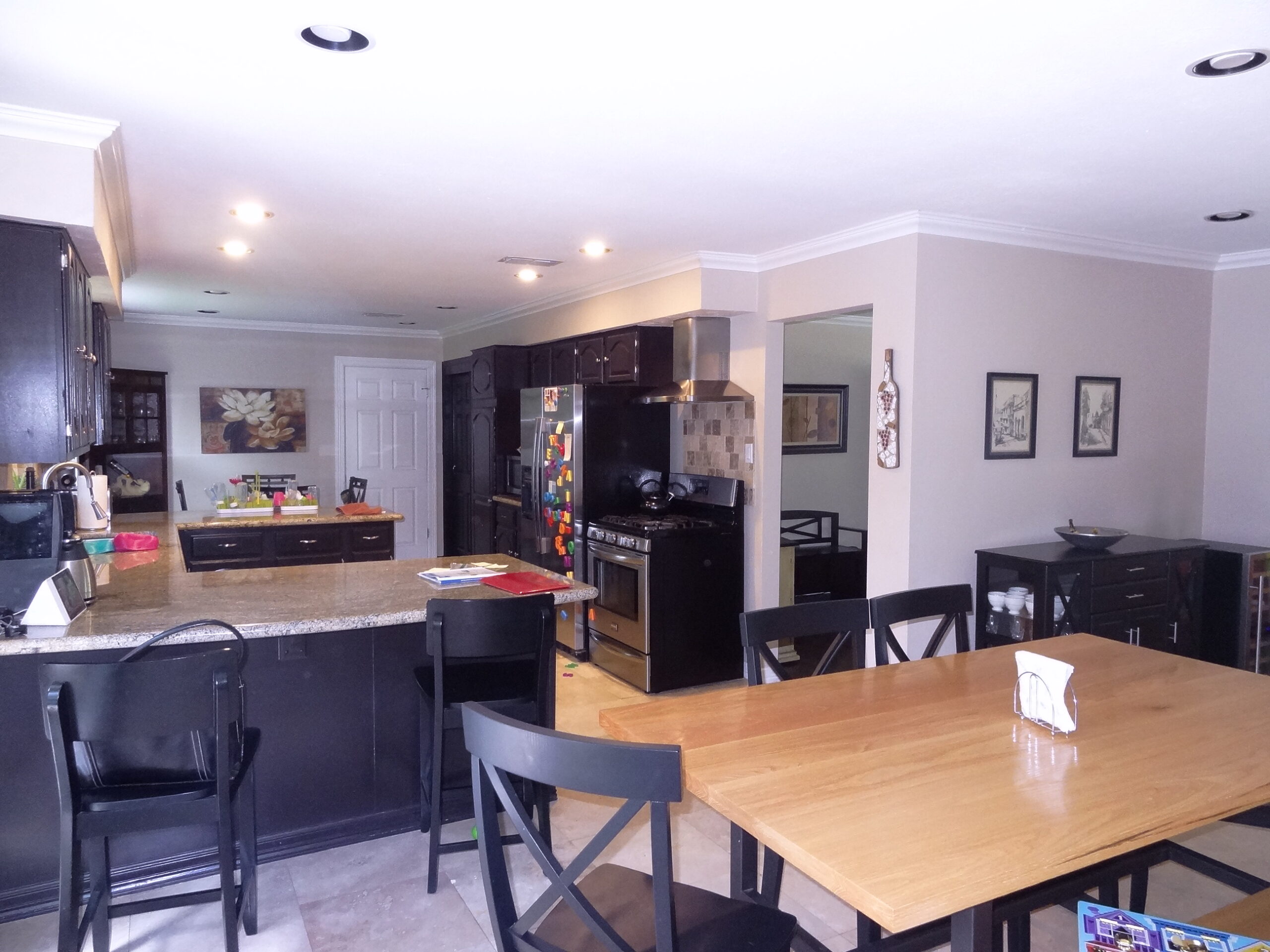
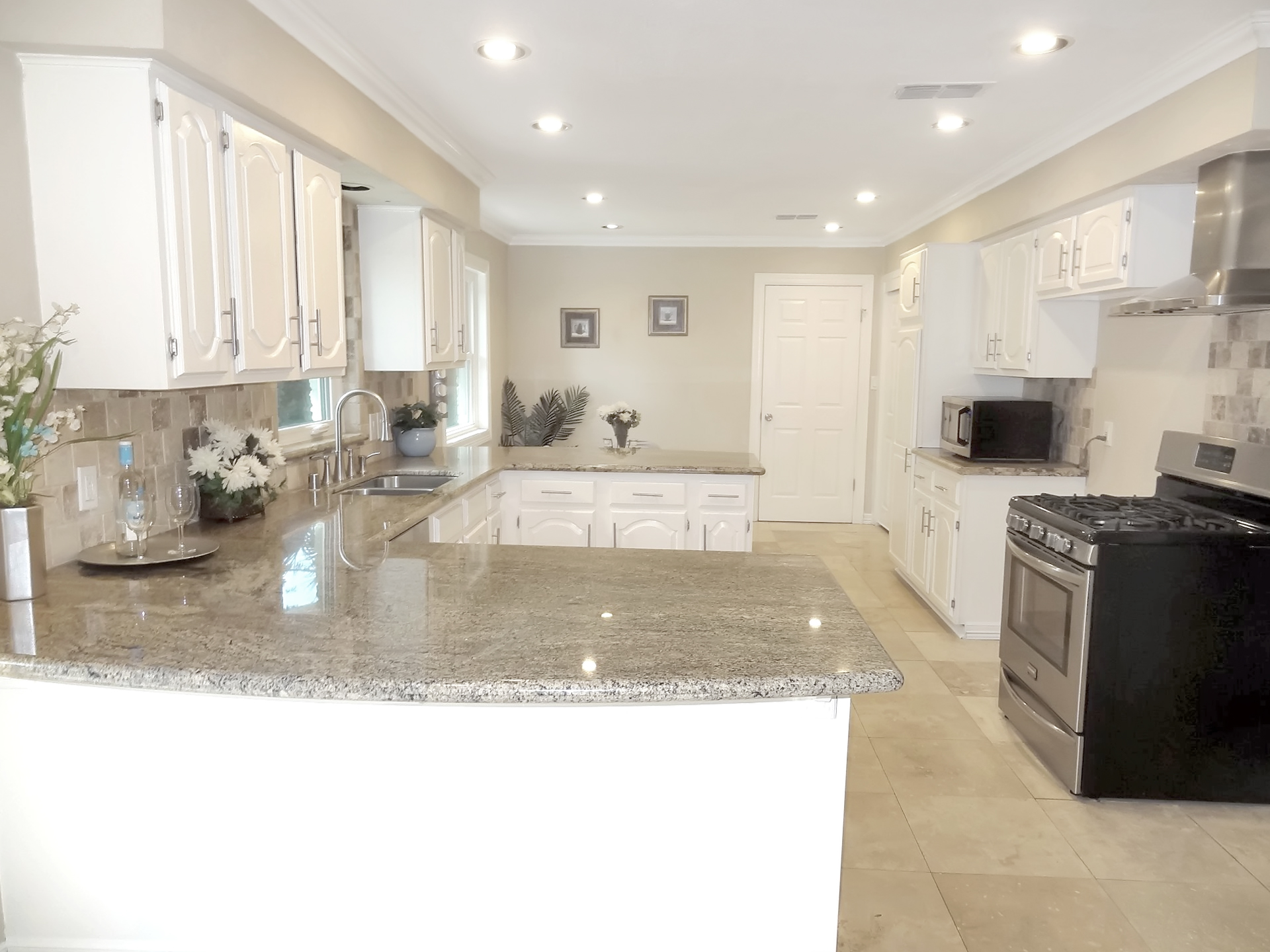
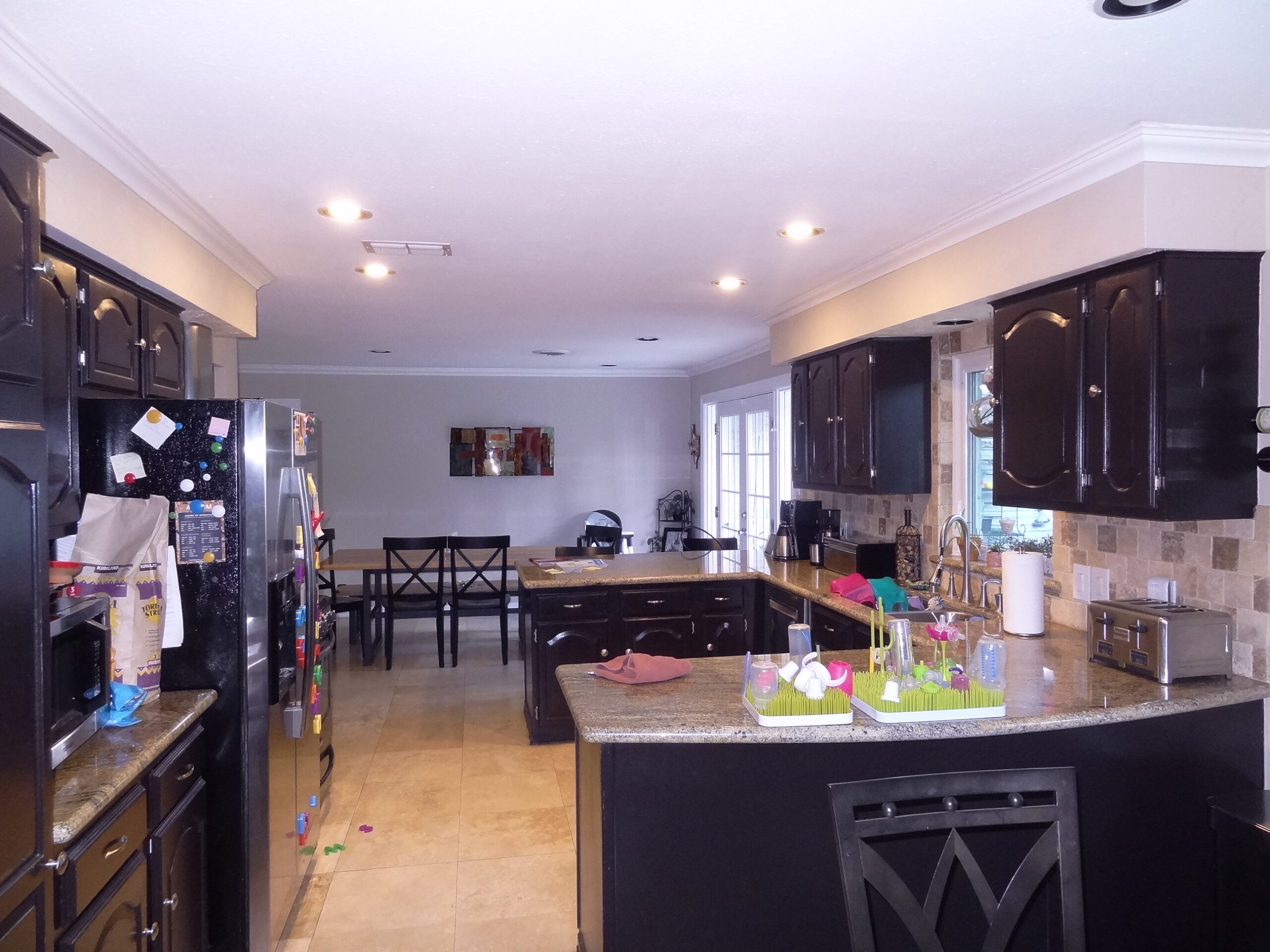
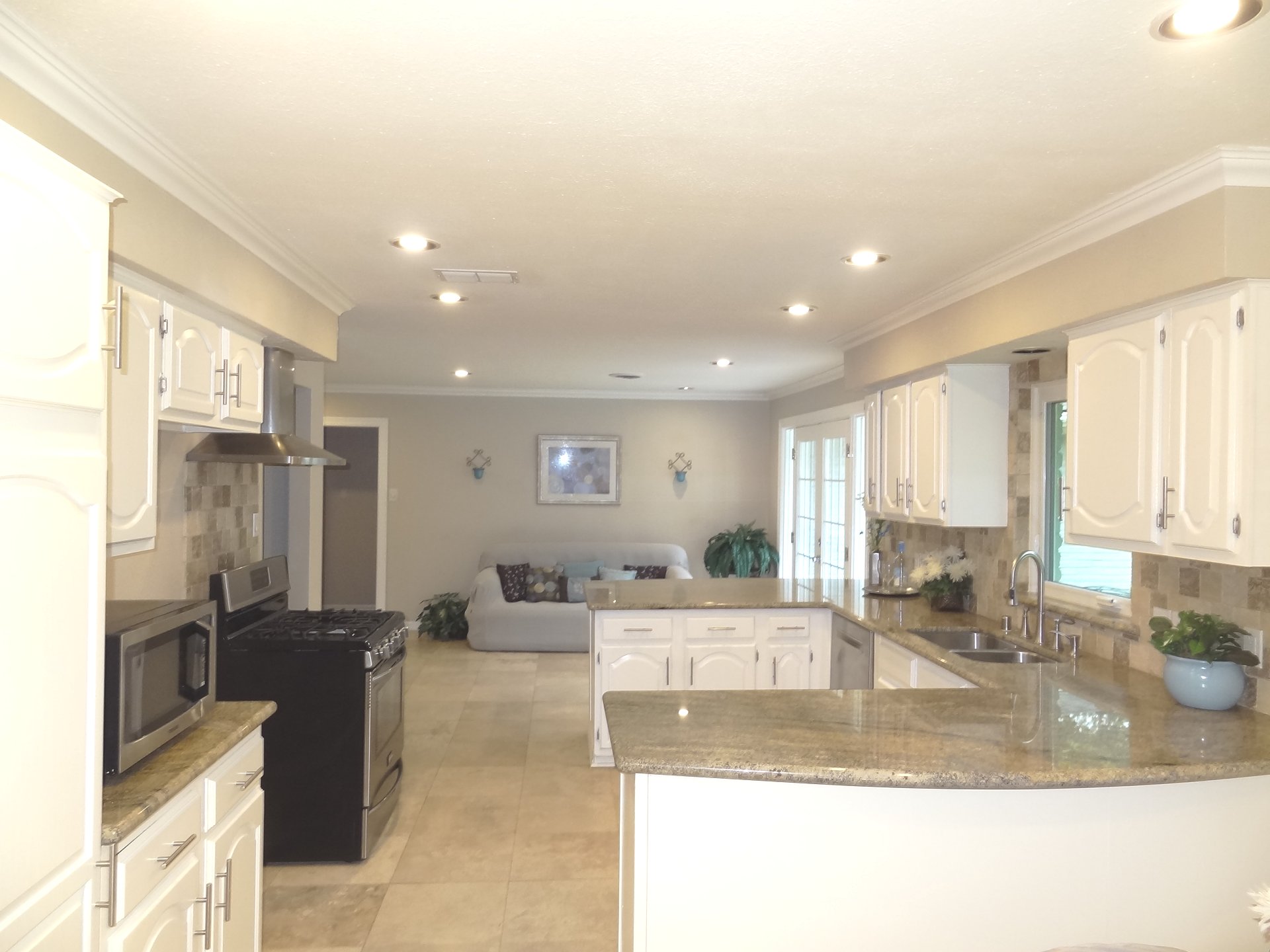
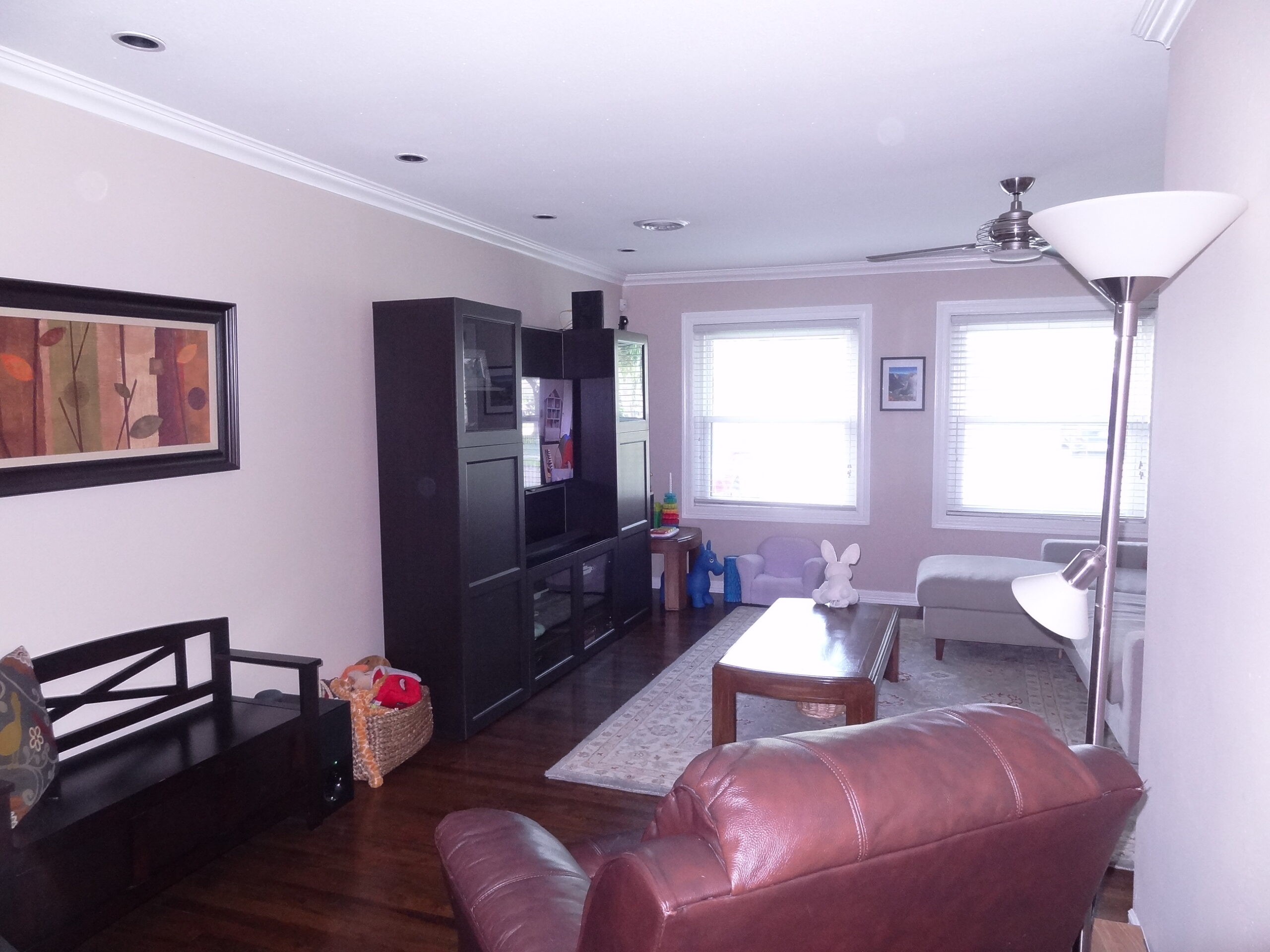
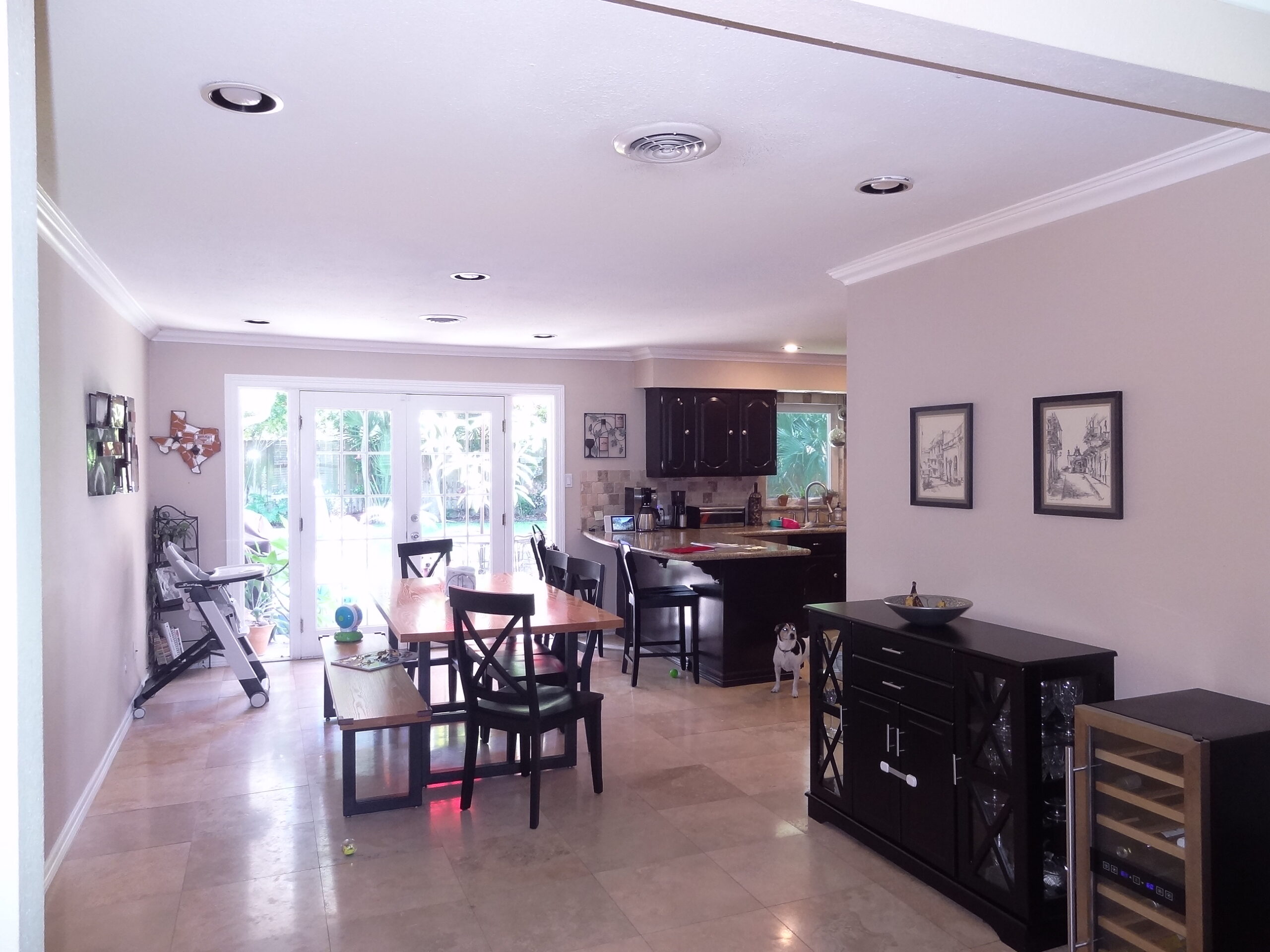
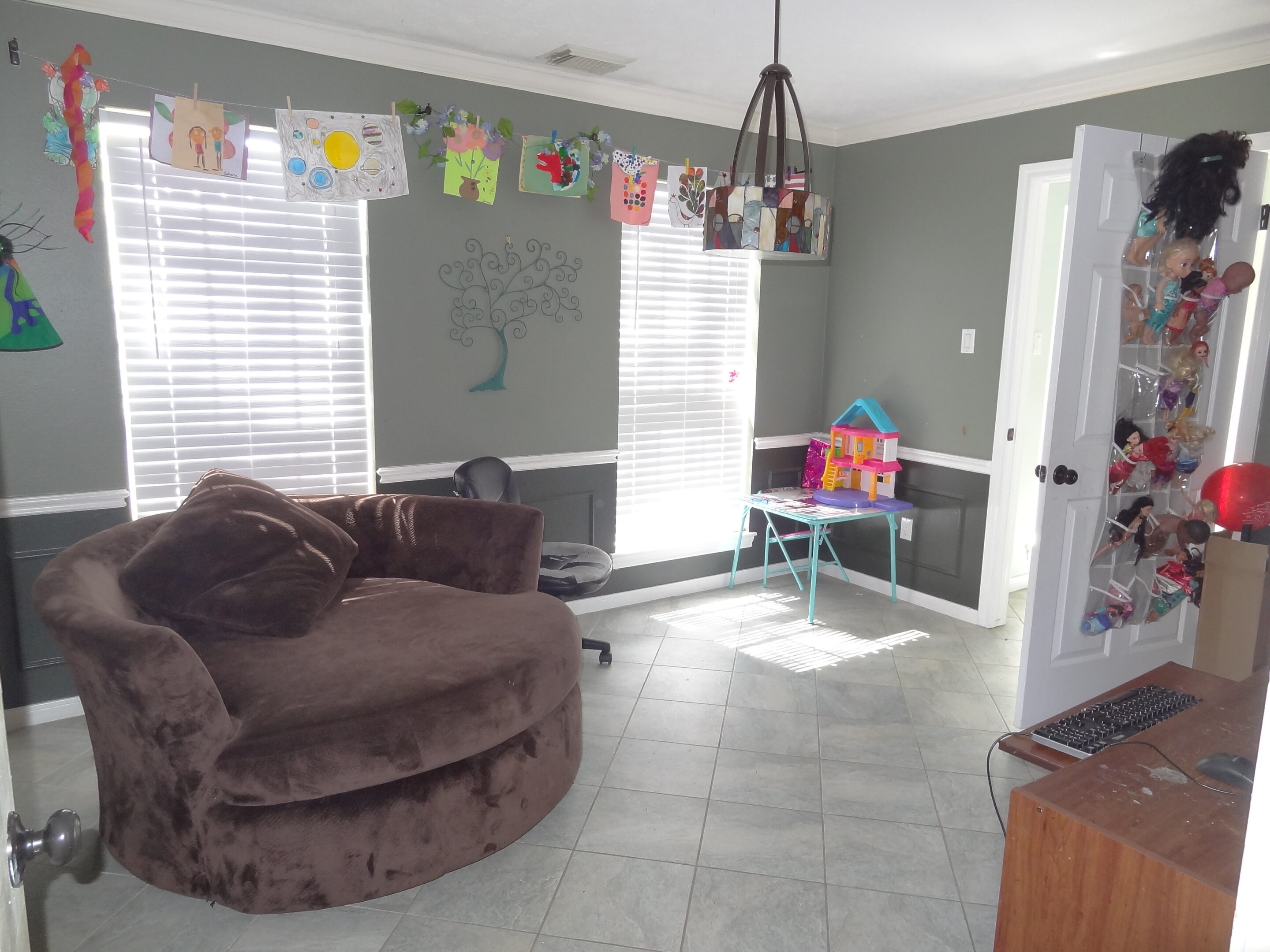
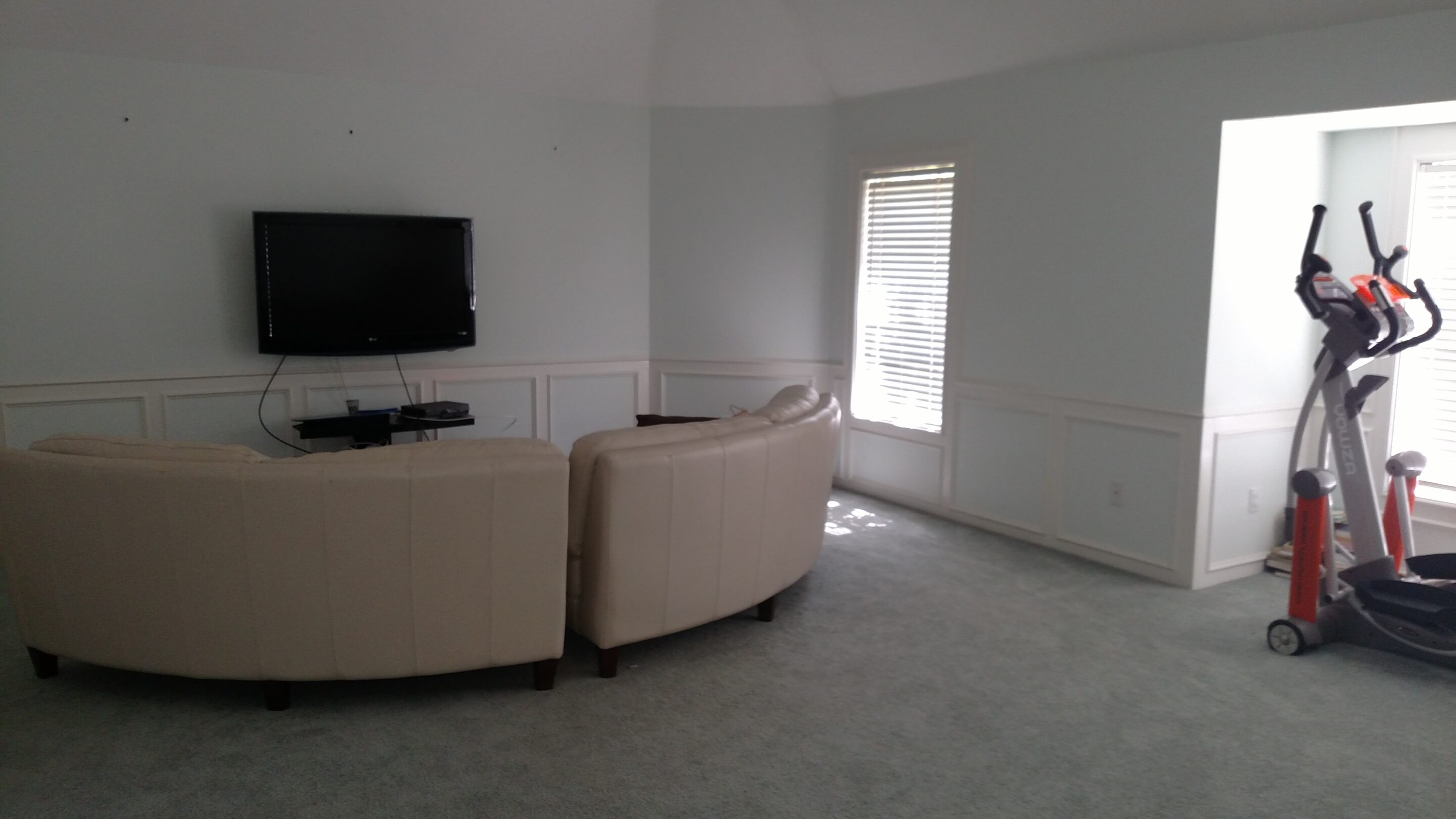
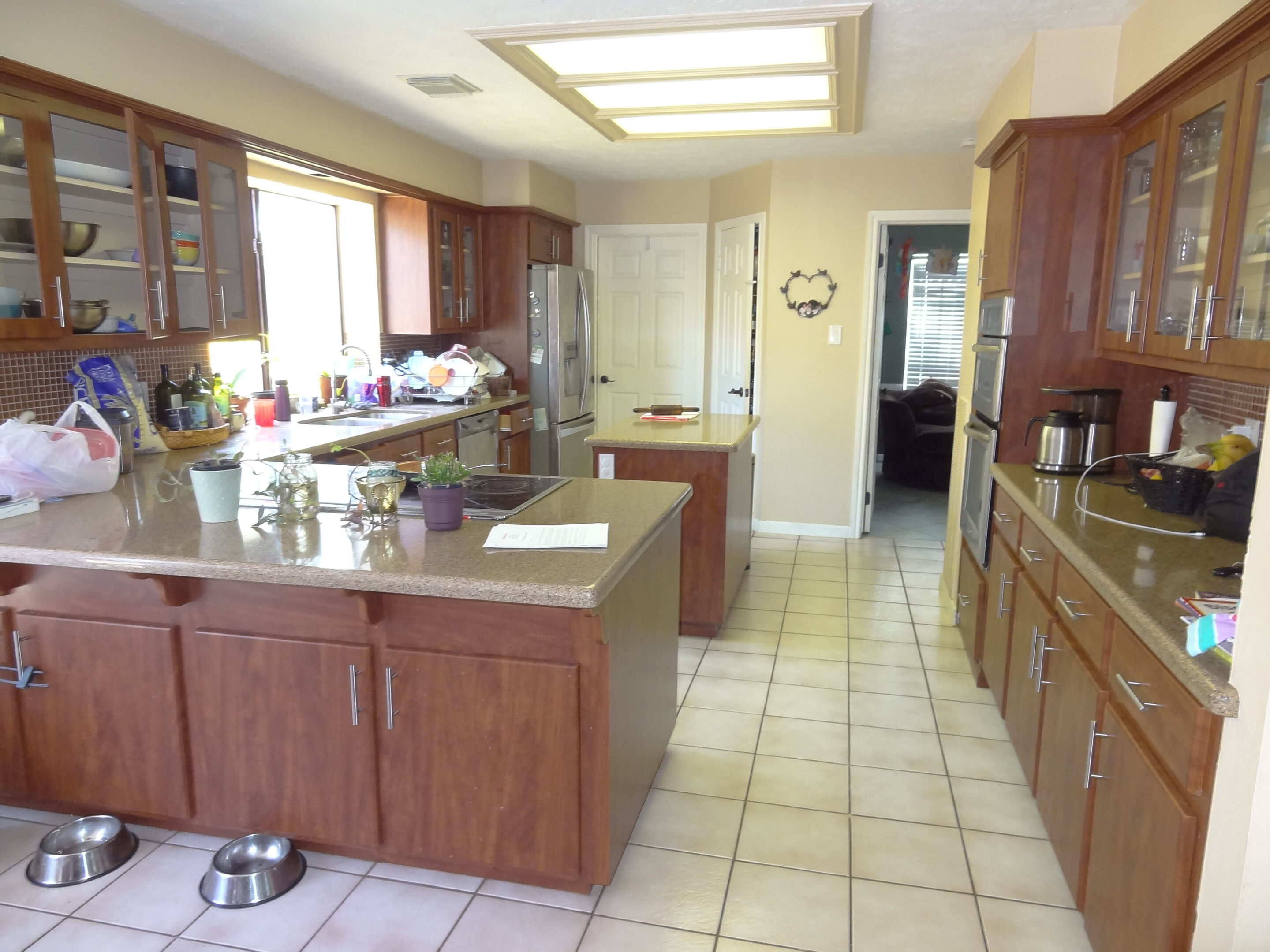
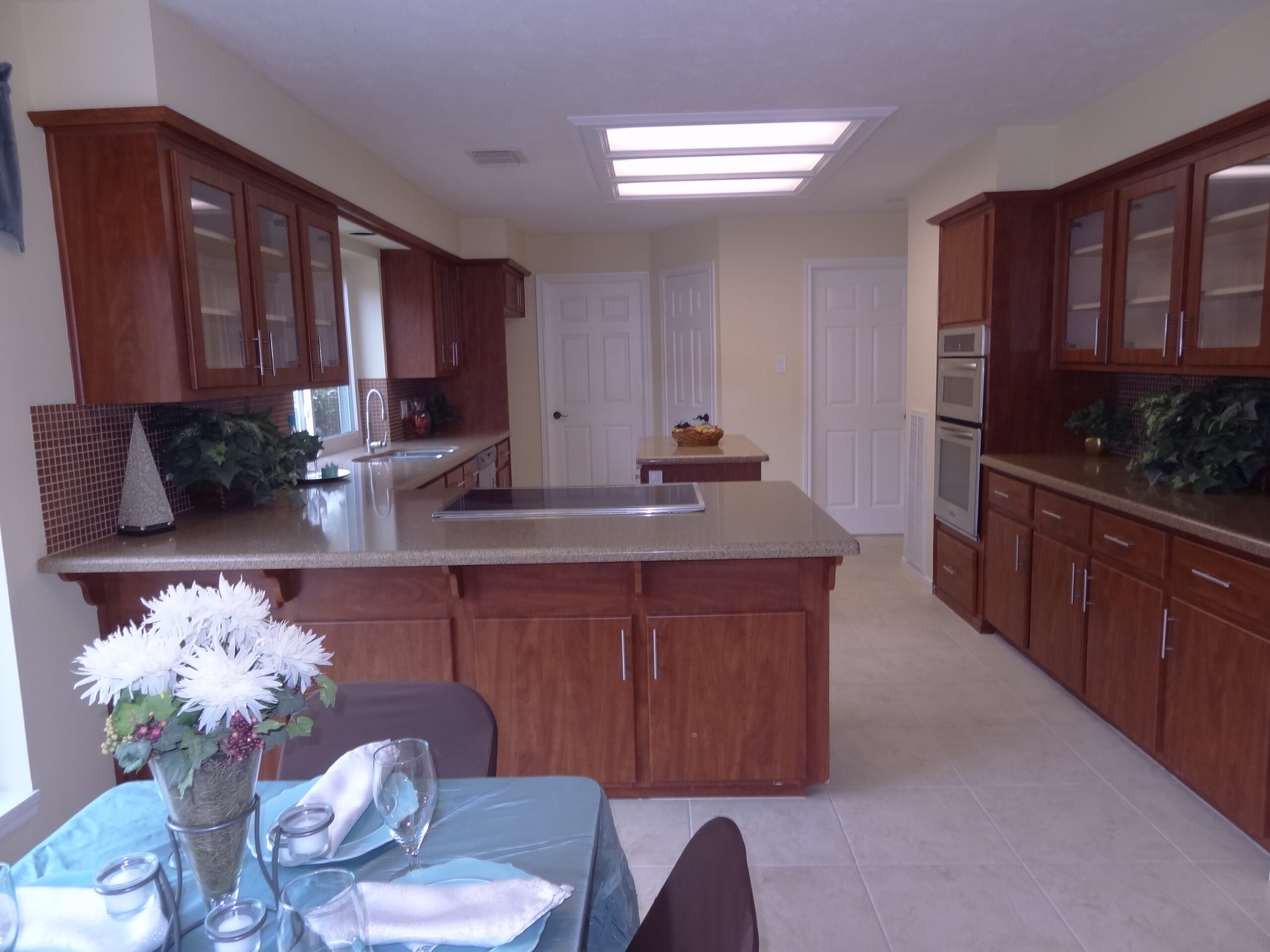
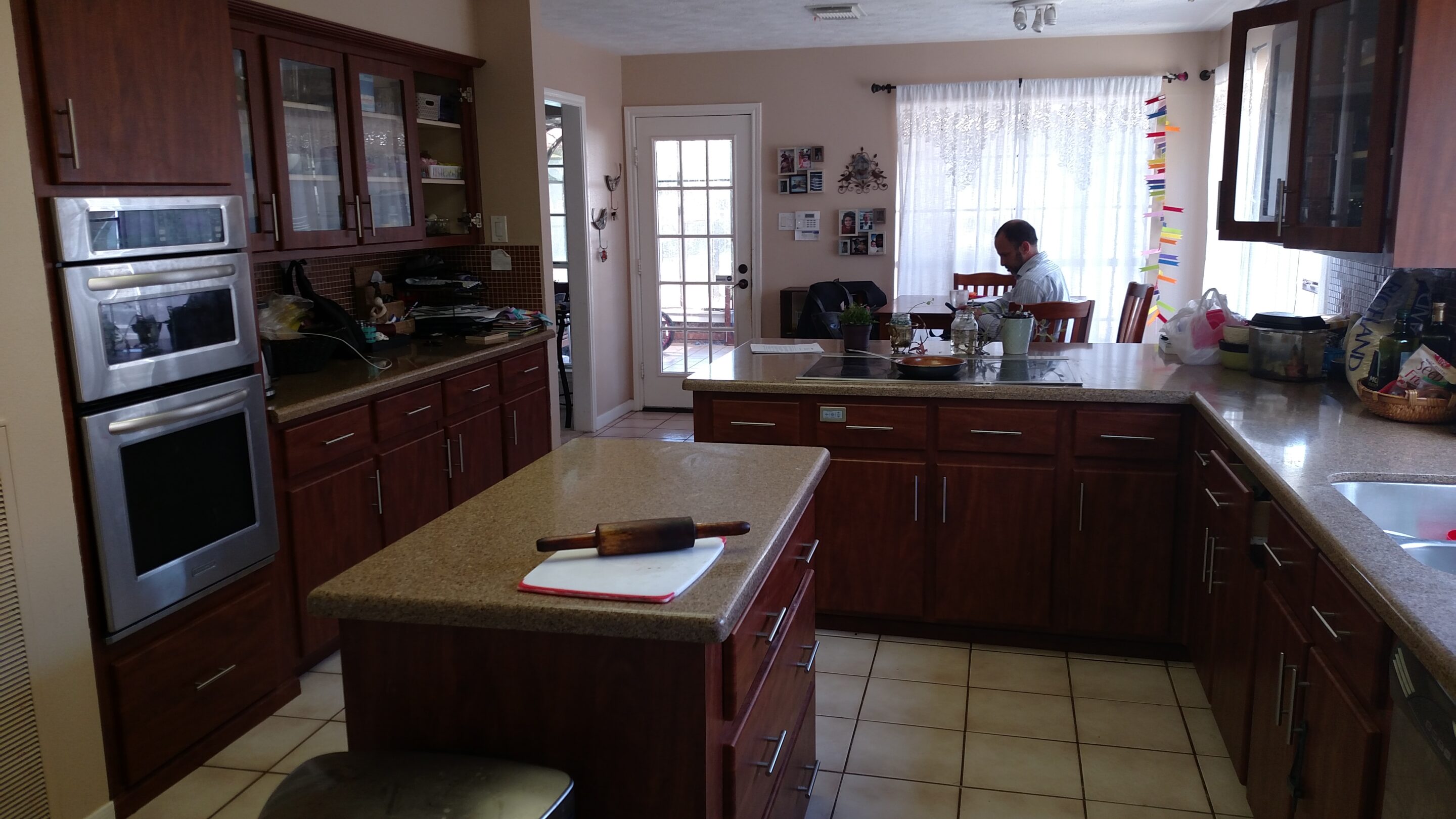
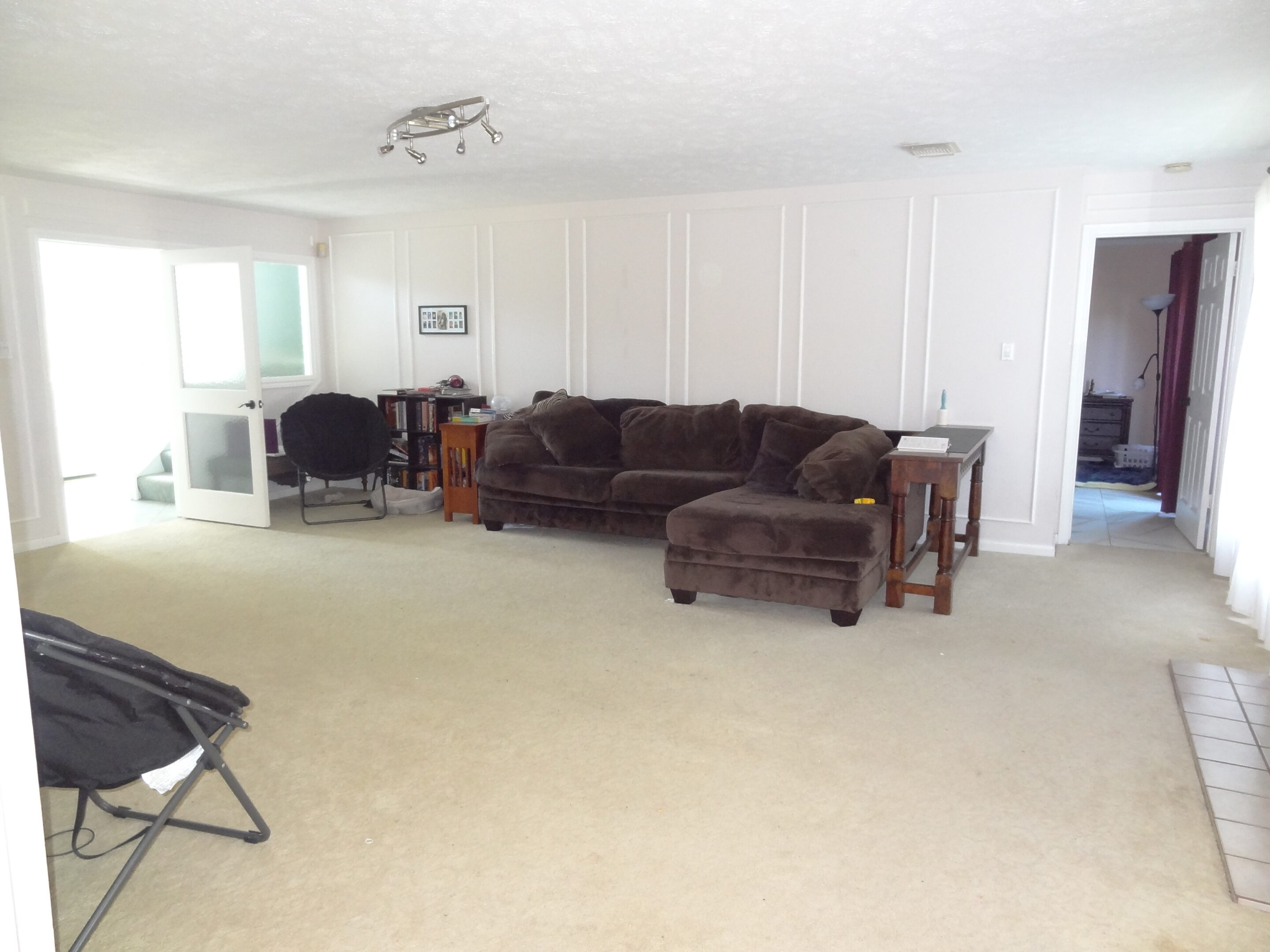
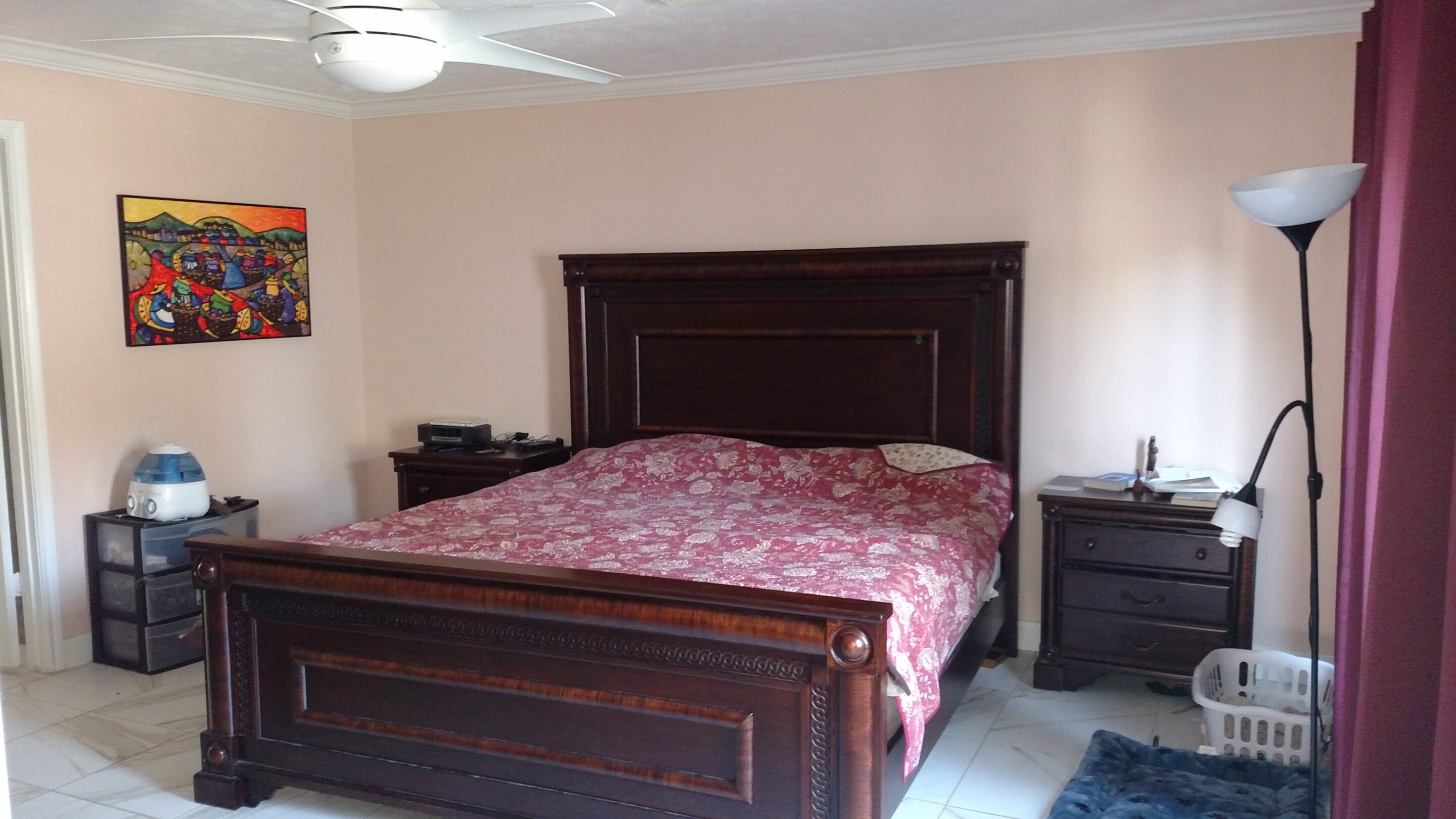
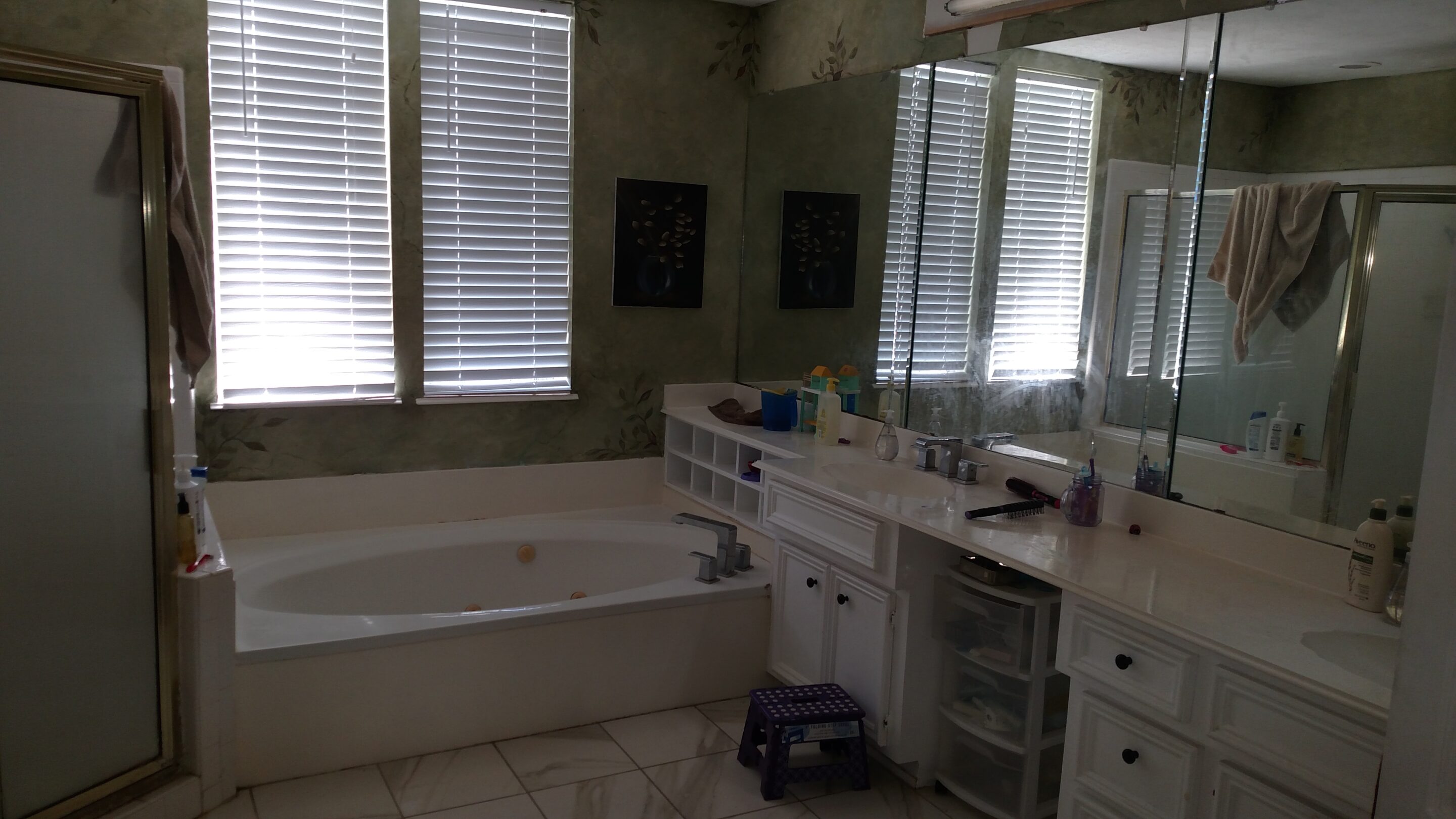
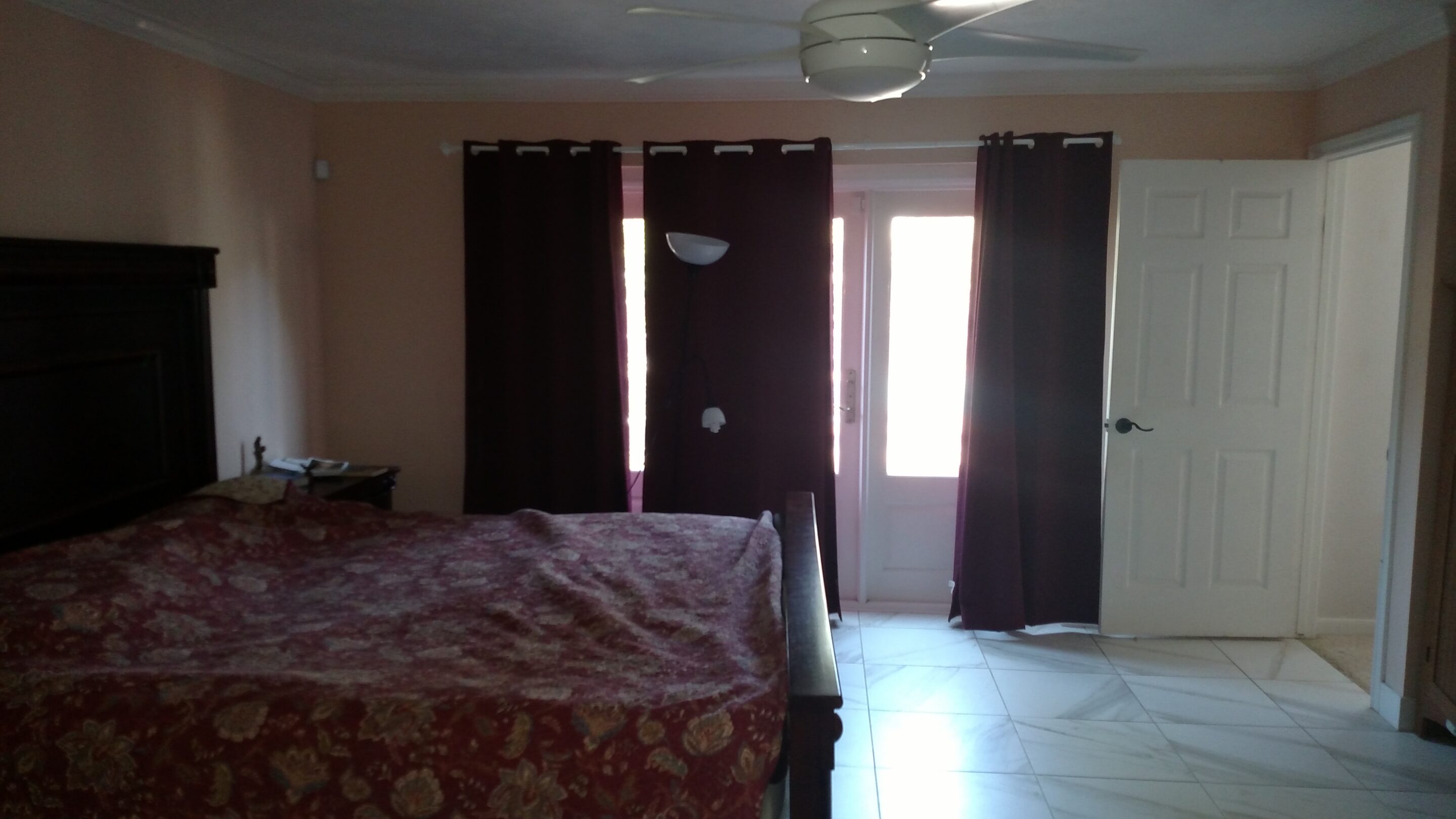
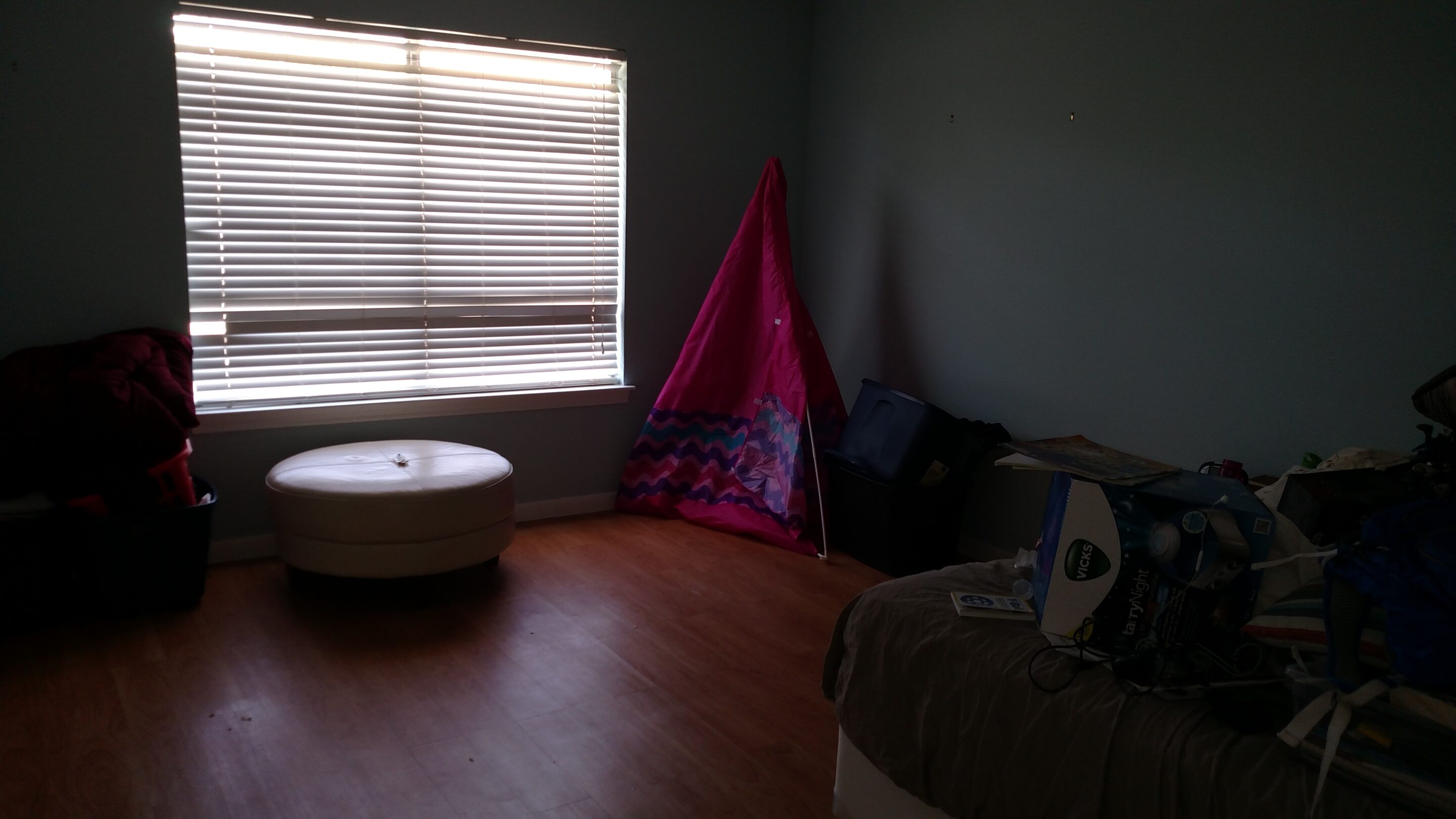
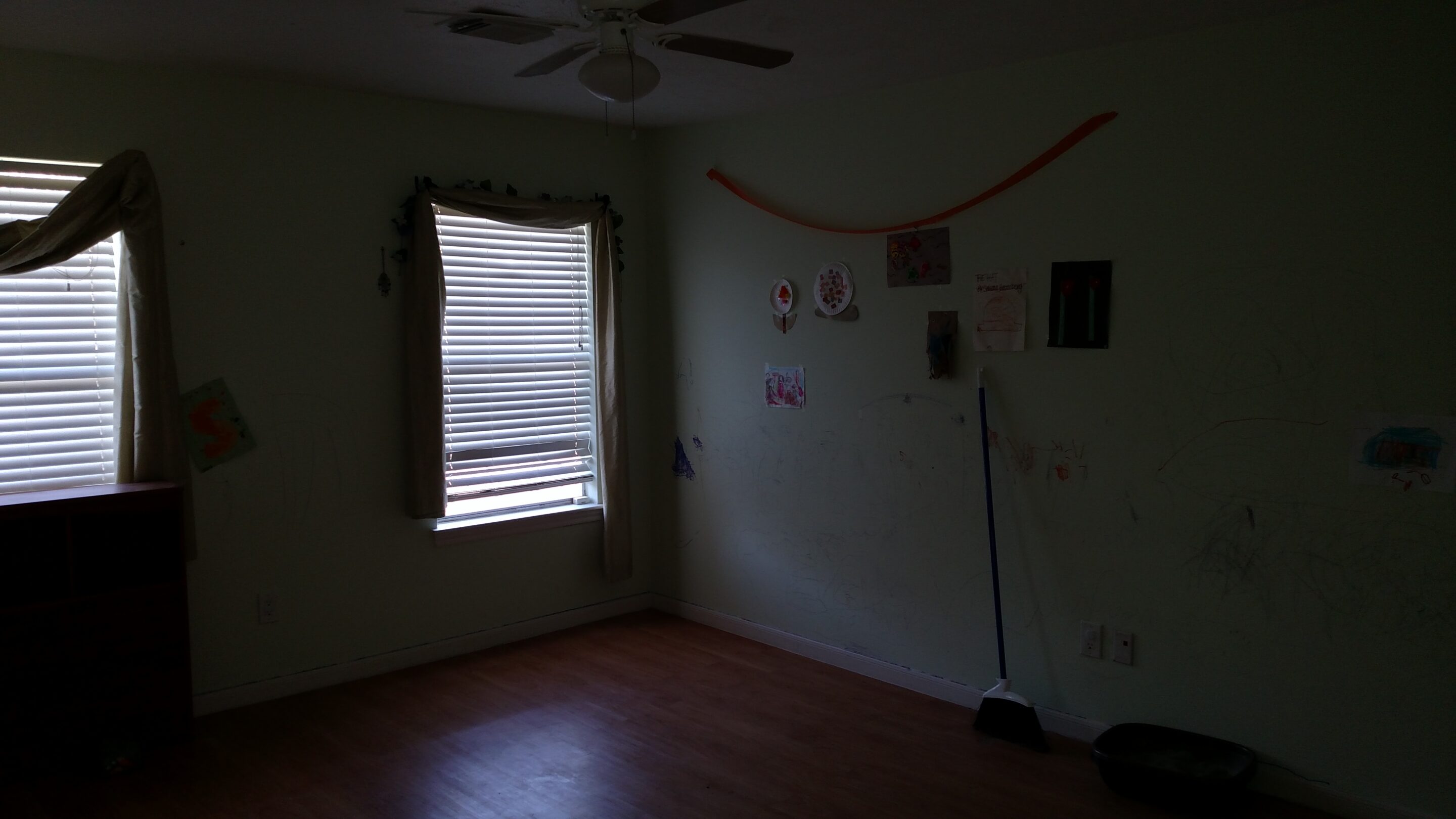
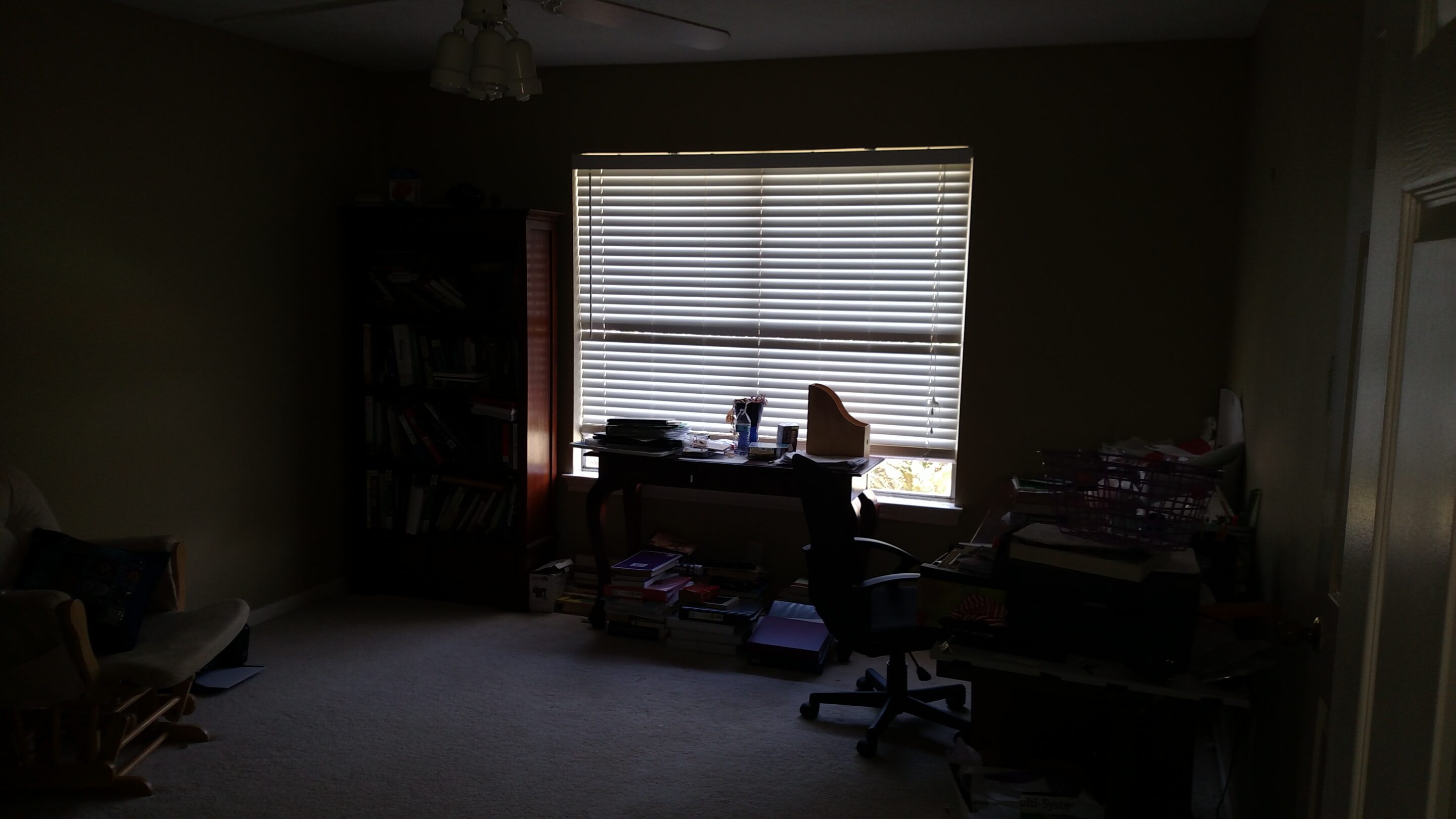
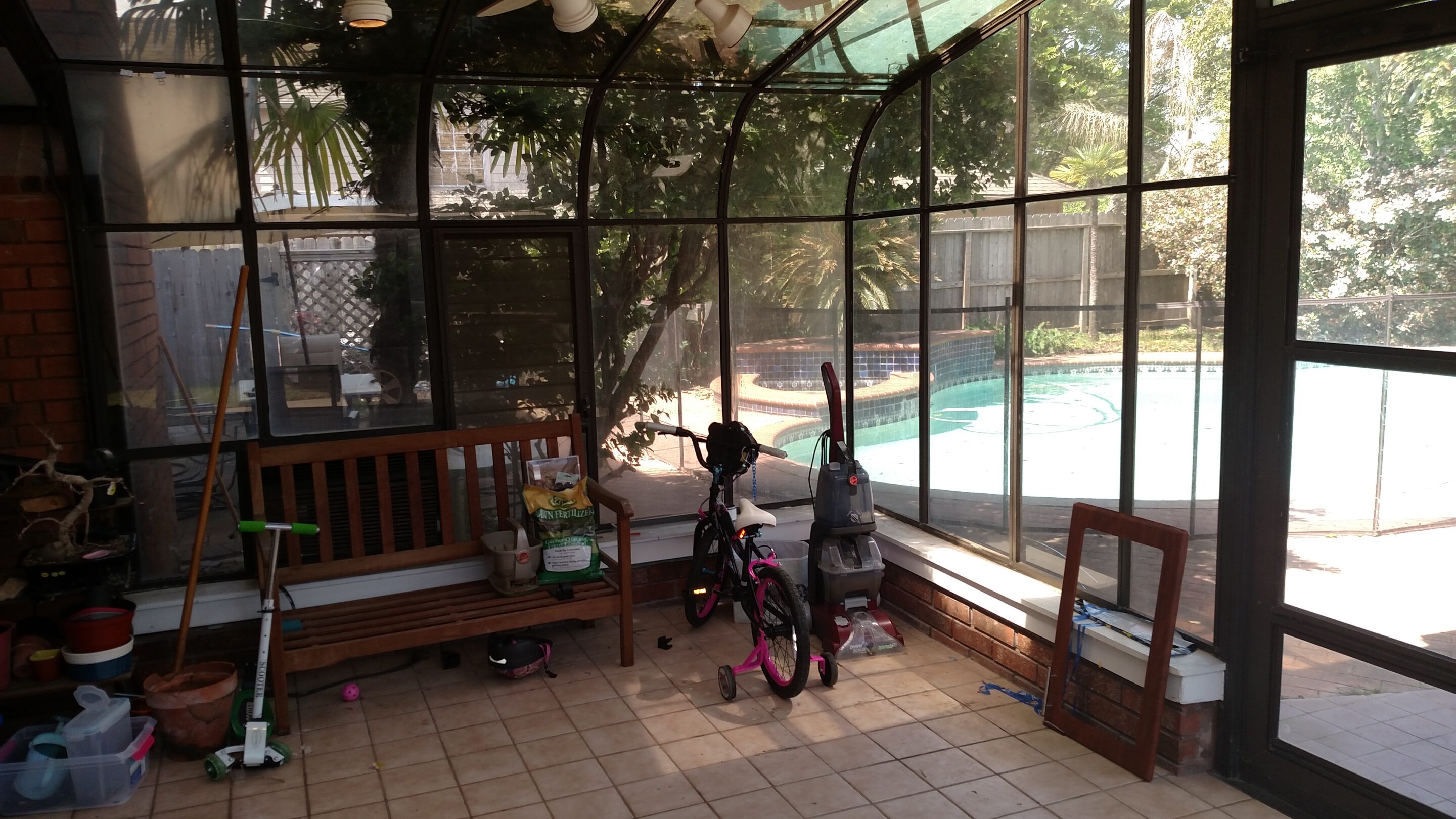
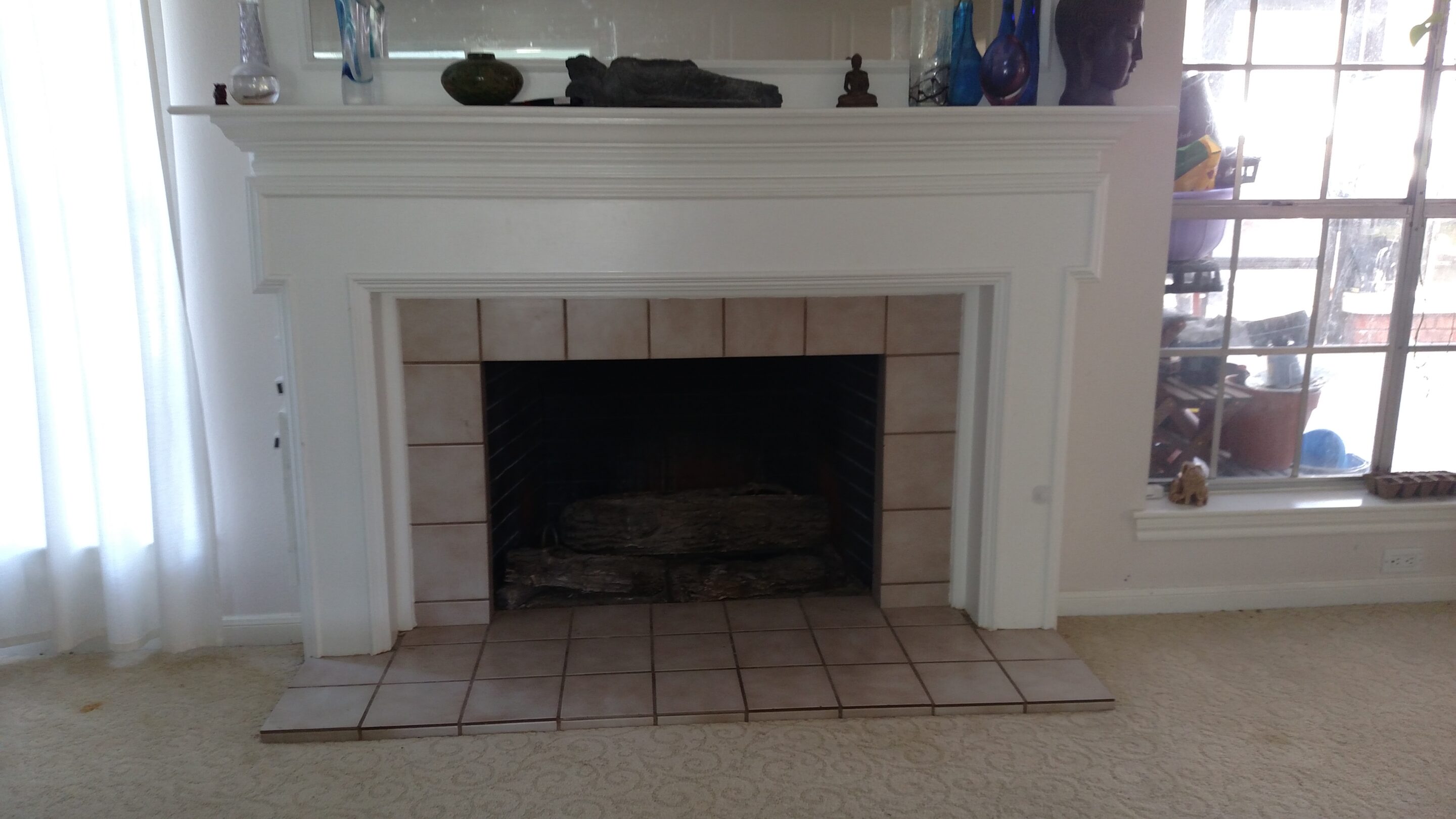
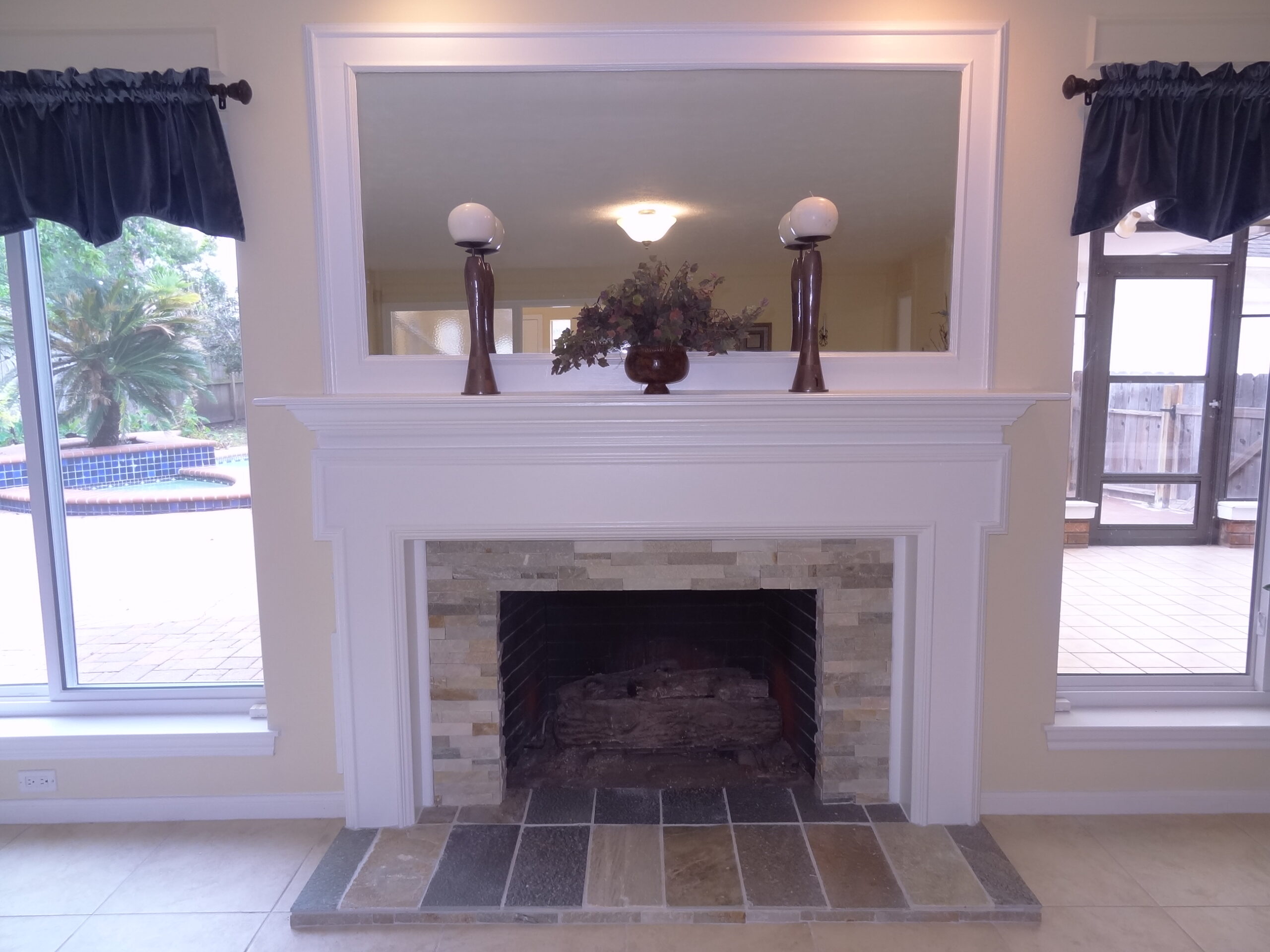
Here’s another example of a “lived in” home that I staged using their existing furniture. When I work with occupied homes, I create a Staging Plan for the home owners, showing exactly what items to remove, so they know how to prepare for “Staging Day.” I also helped this home owner get multiple estimates from local painters in order to select the best one for their project.
You can view the video tour here.
Staging Project 3
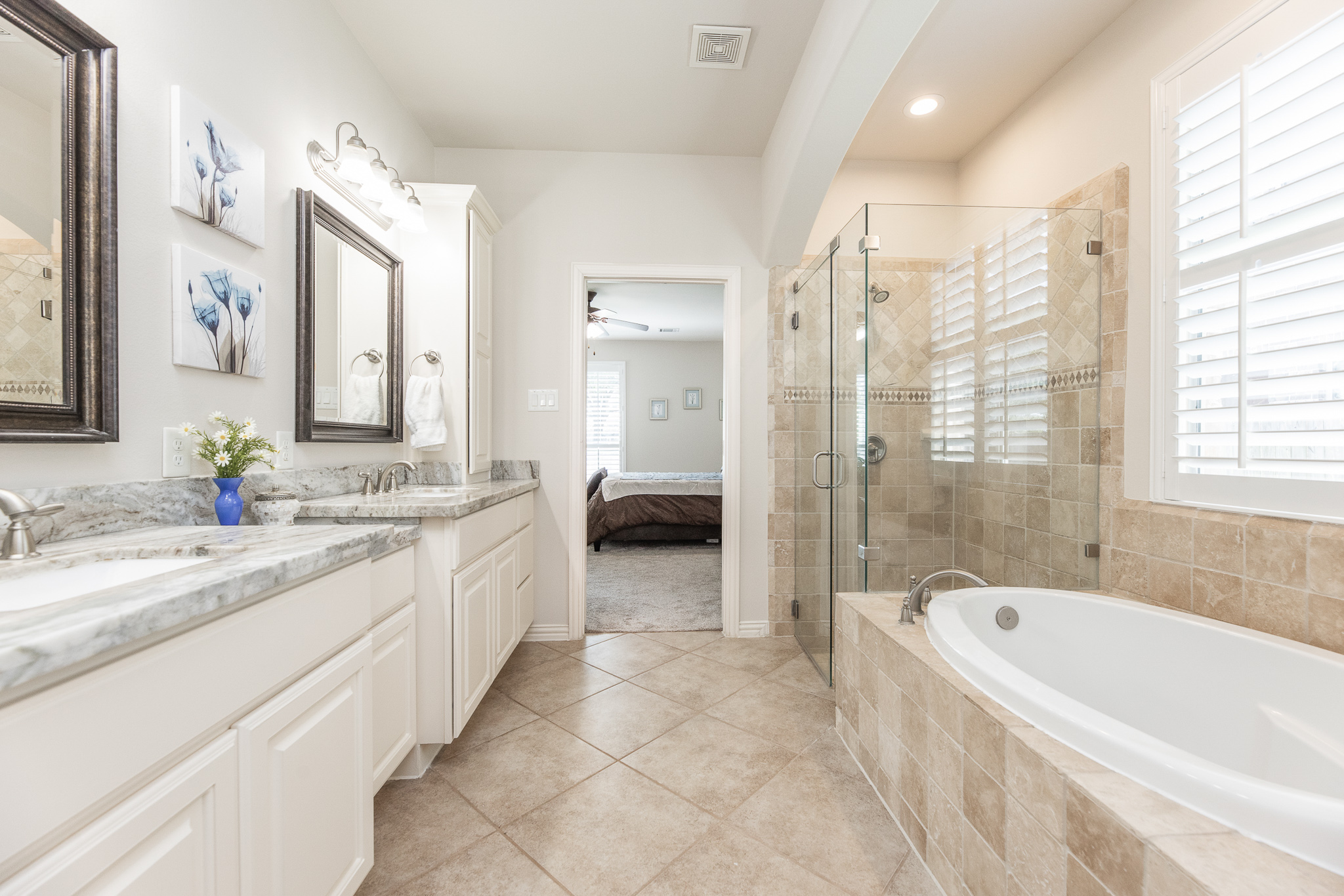
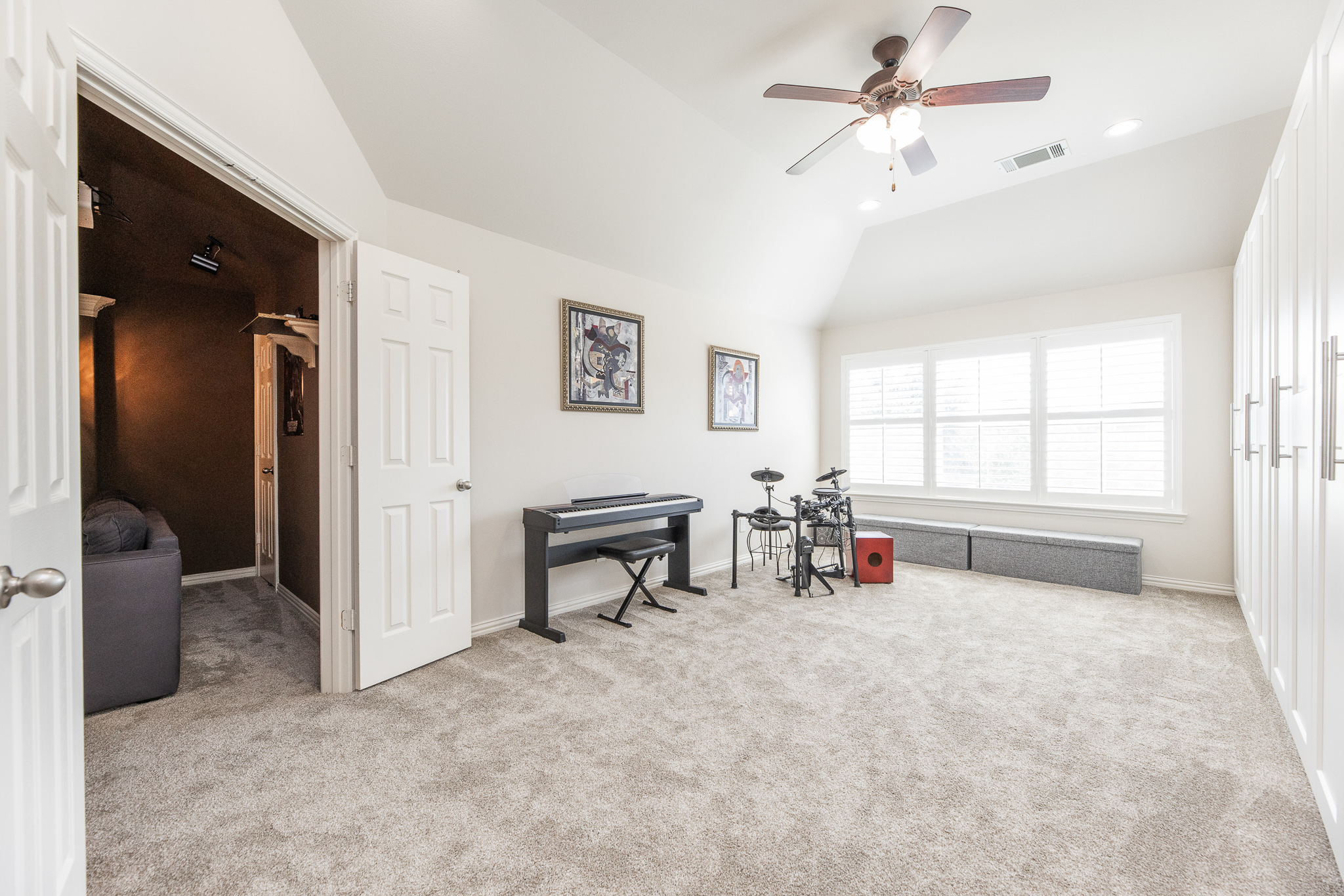
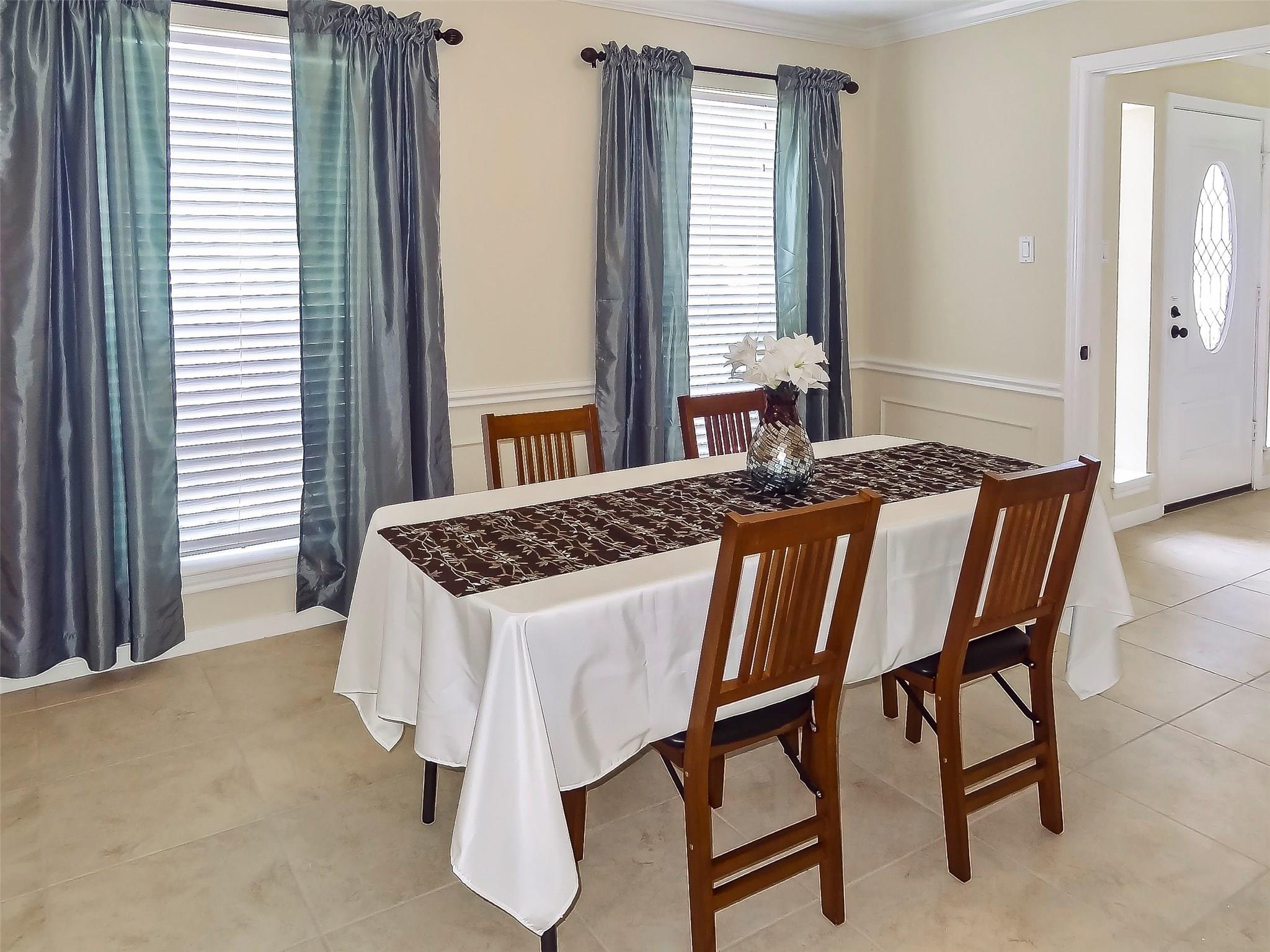
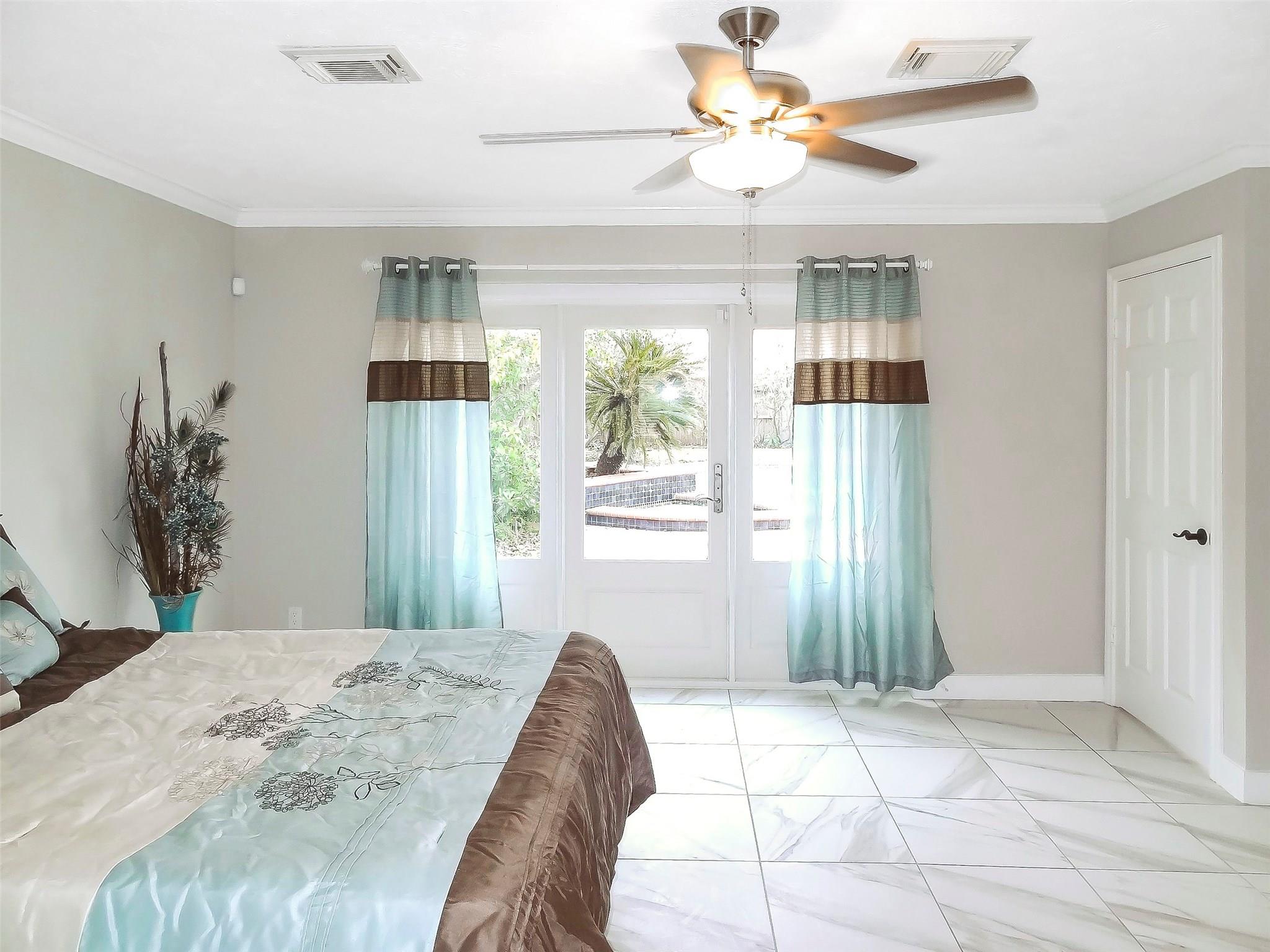
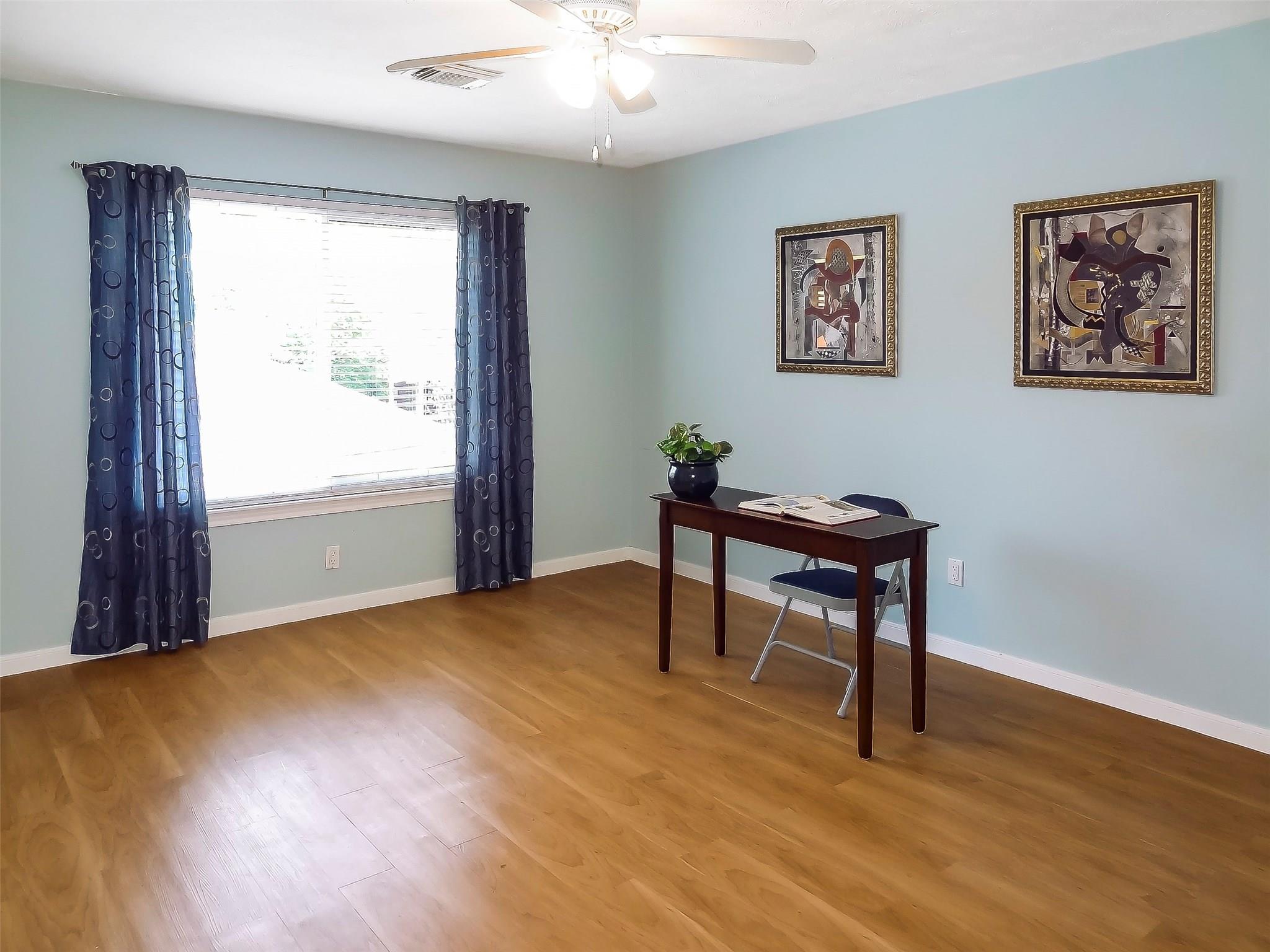
While being only one year old, this home needed a few things to make it more “homey.” This house went under contract in less than a week and the buyers told us, at the Closing, that the colors and staging is what sold the house!
By the way, this home was sold to out-of-town buyers who saw my video tour. They didn’t see the house in-person until the day before Closing. I have sold approximately 15 homes to out-of-town/state/country buyers through my TRUE video tours.
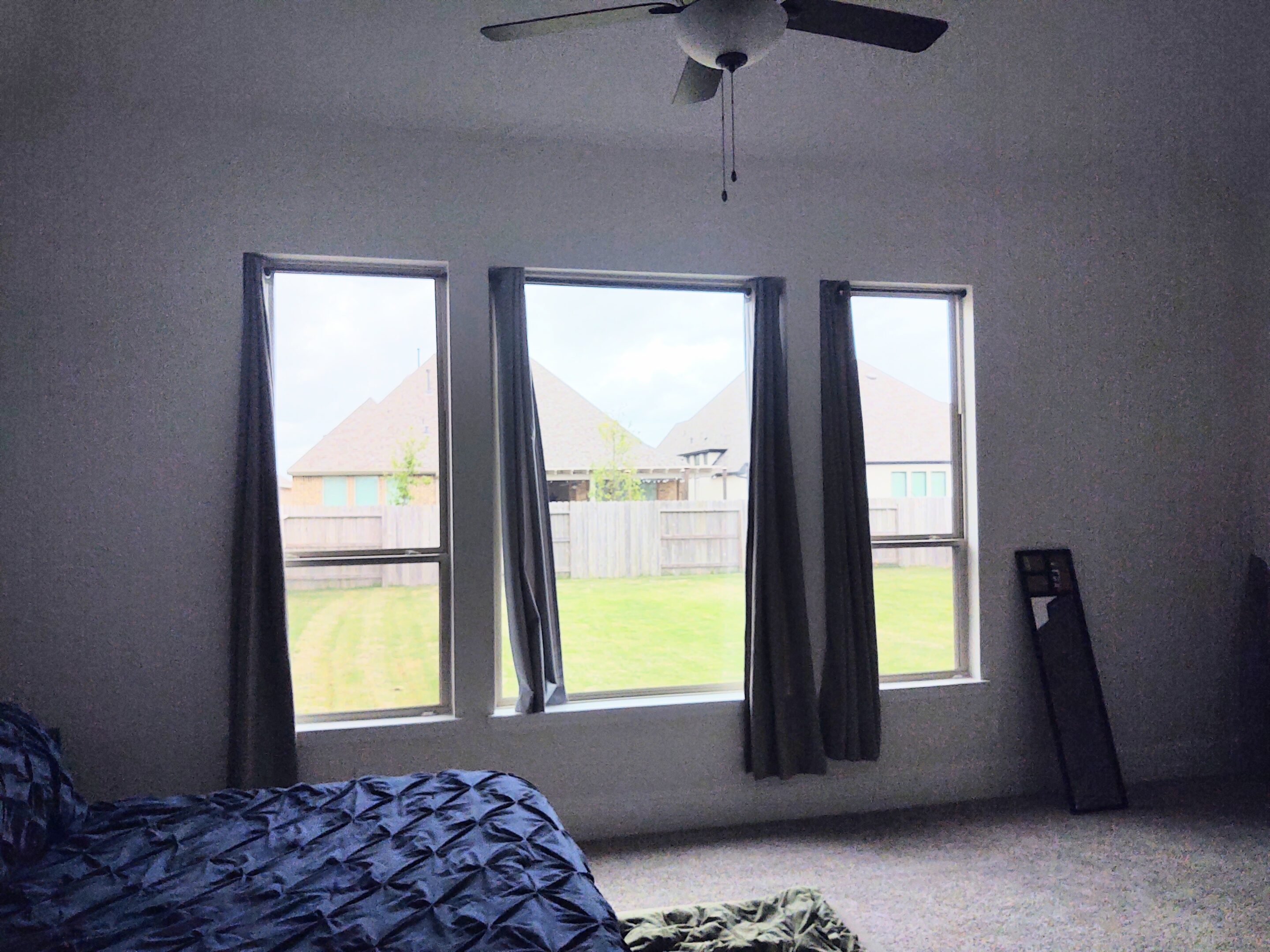
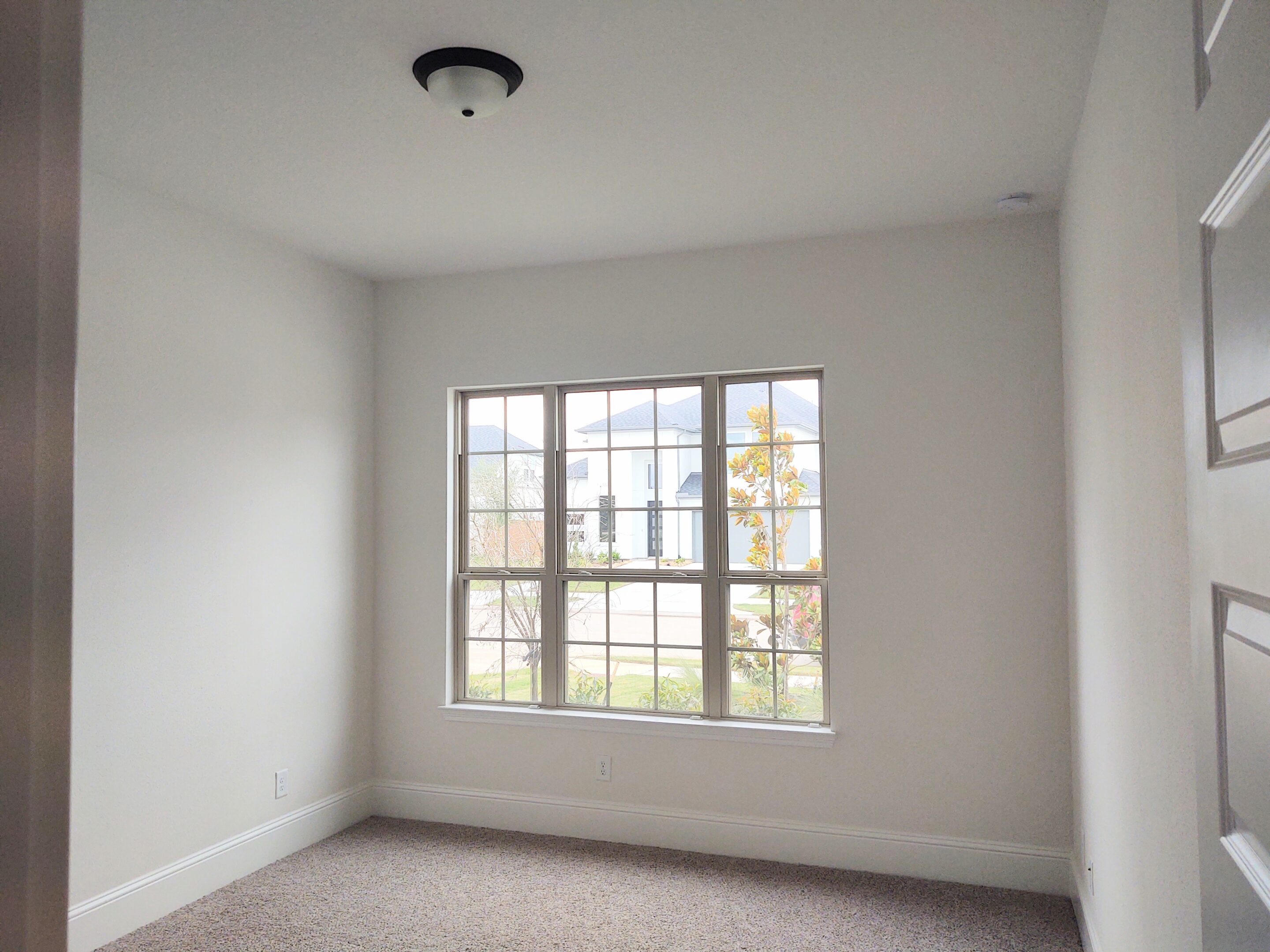
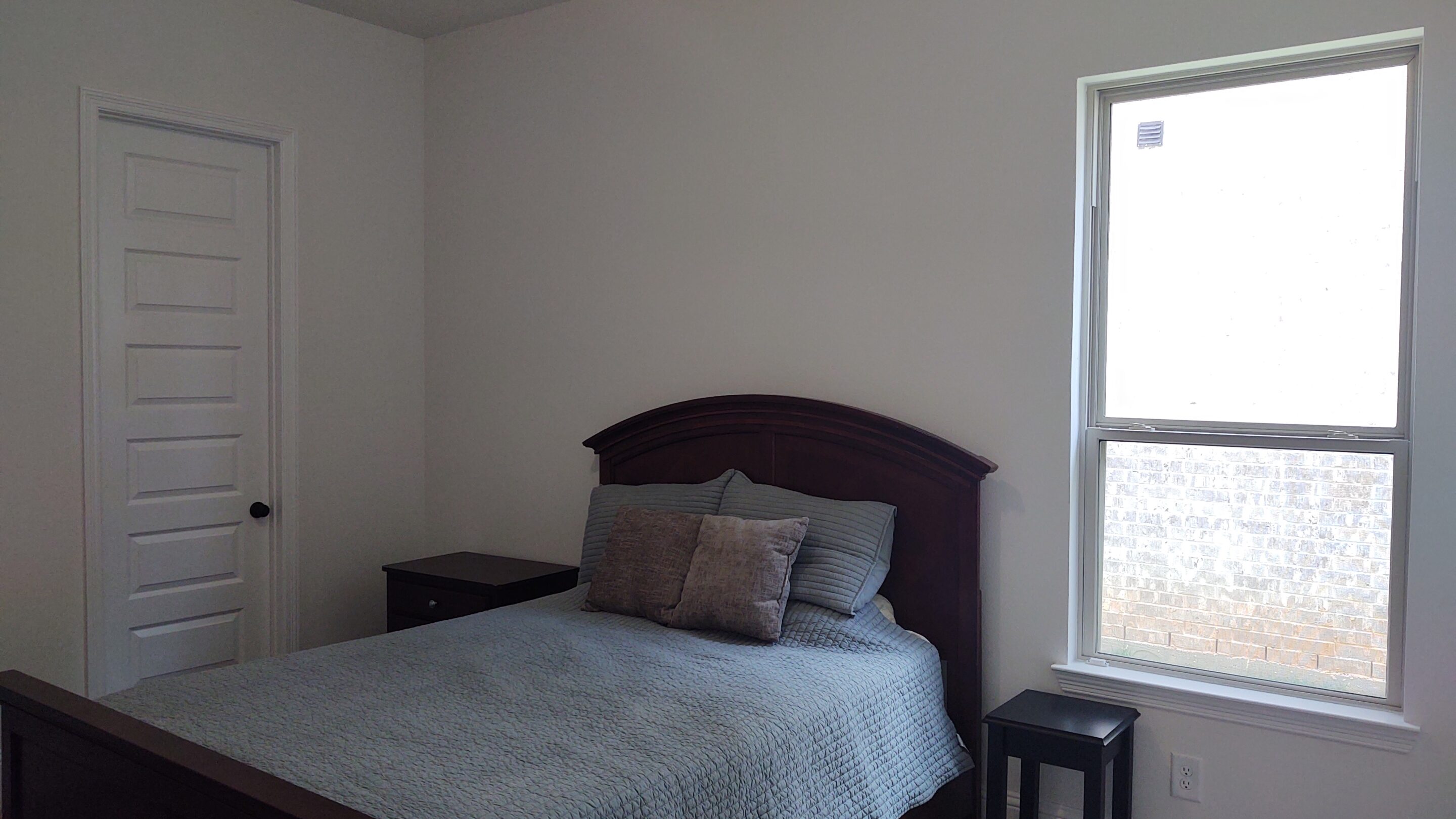
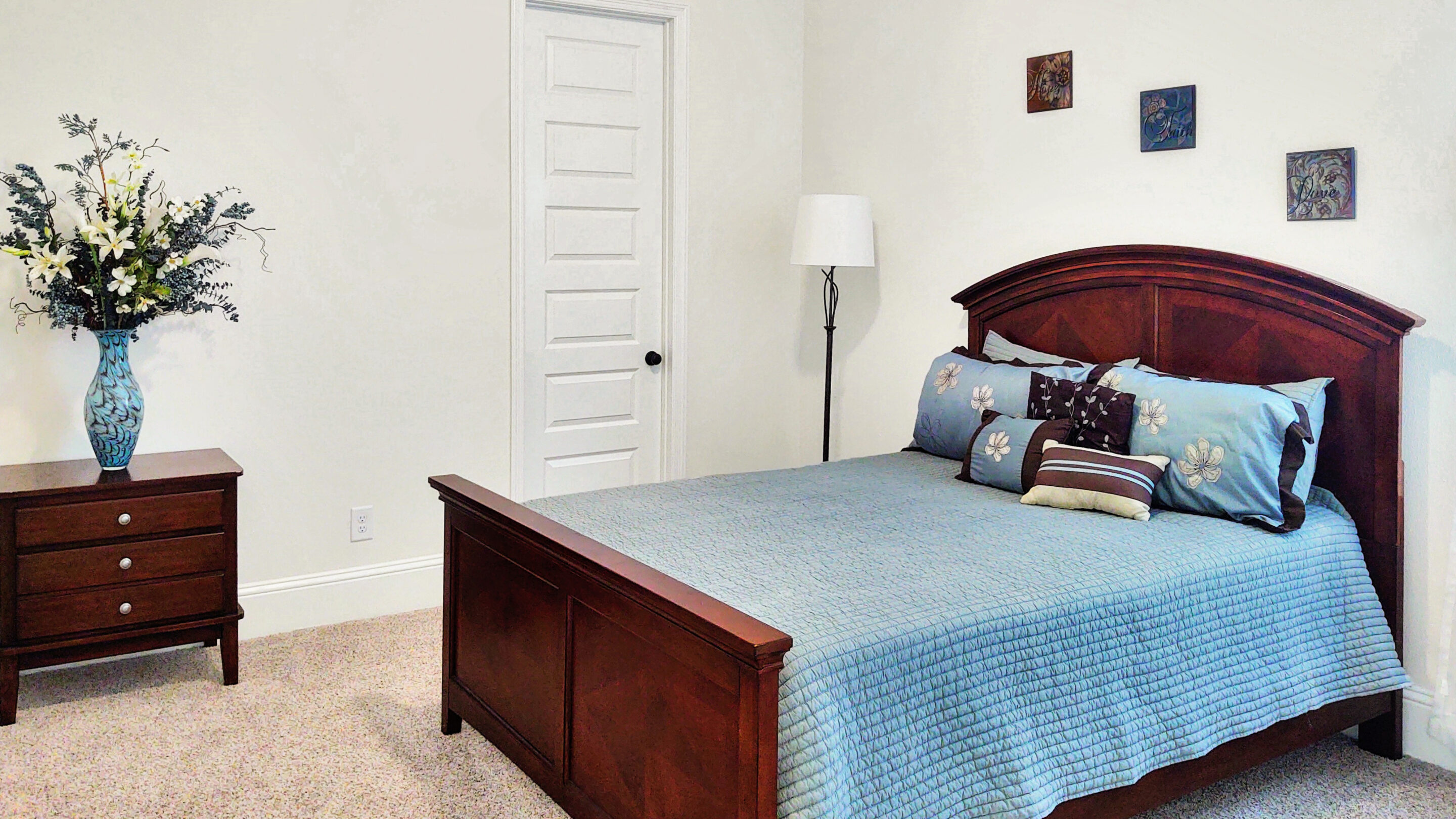
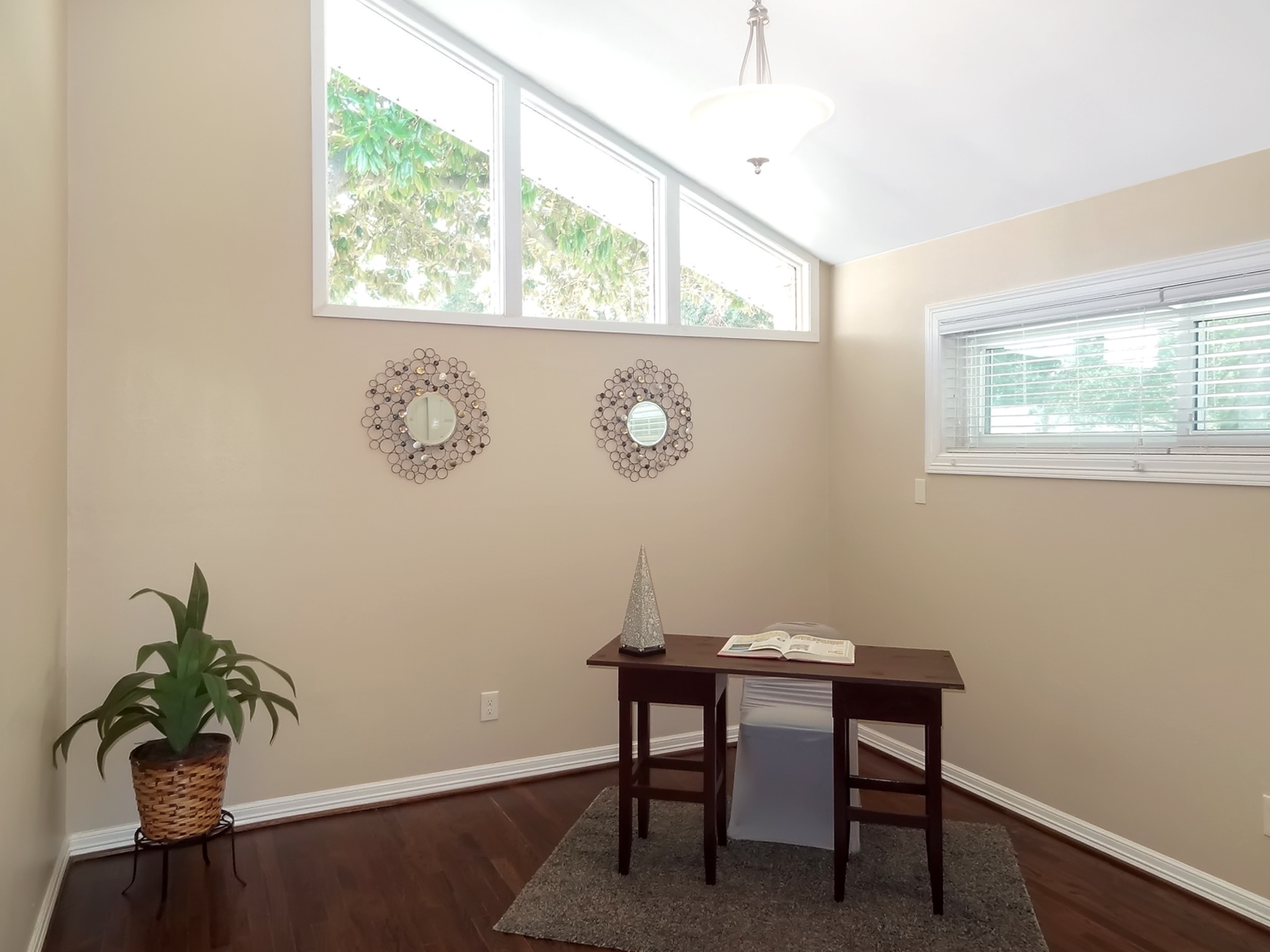
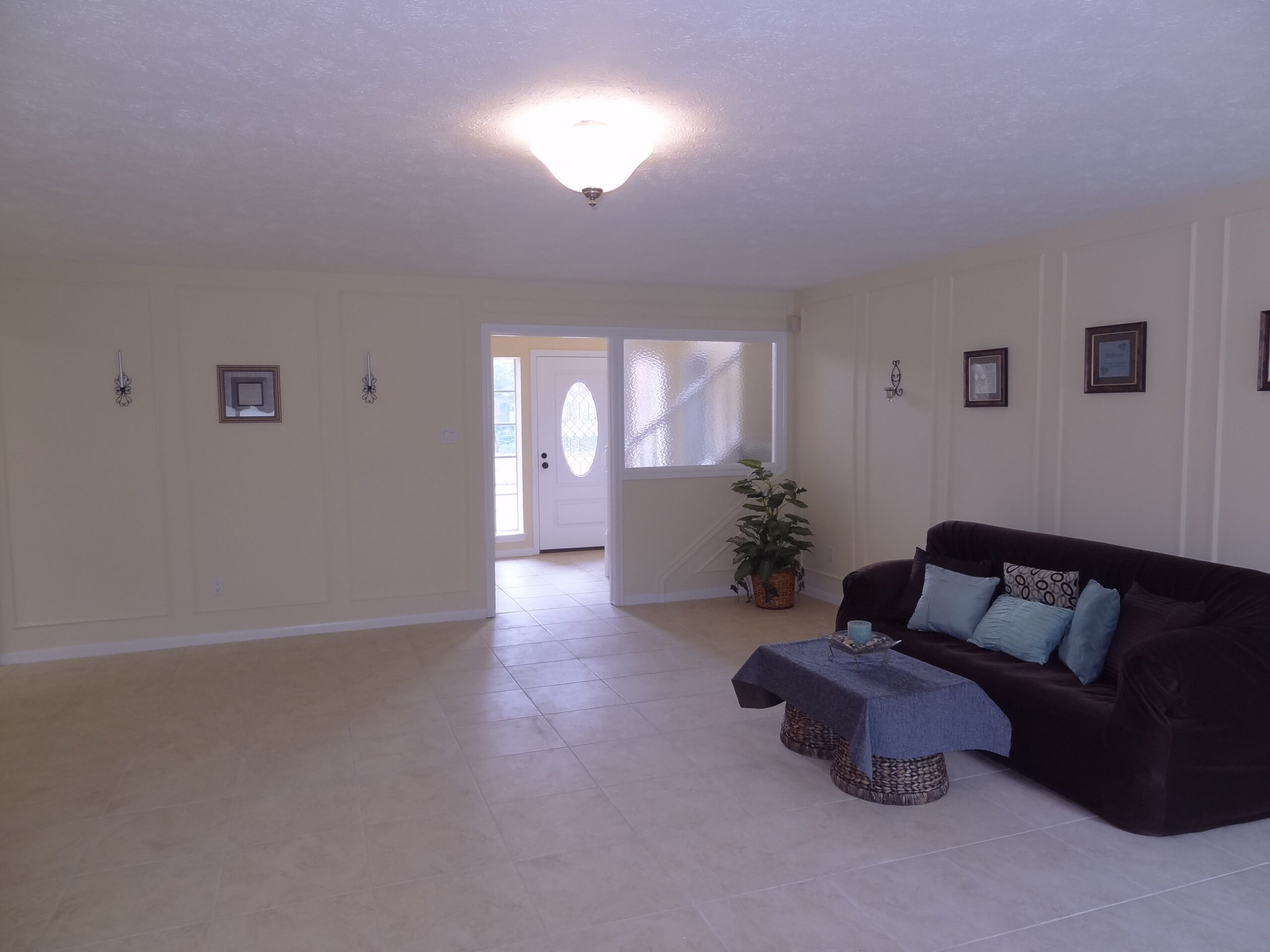
Here’s an example of a home staging project I did for a vacant home. I used to do my own photography, but now I hire a professional photographer for my listings.
Here’s another example of a home staging project I did for a vacant home several years ago. I used to do my own photography, but now I hire a professional photographer for my listings.
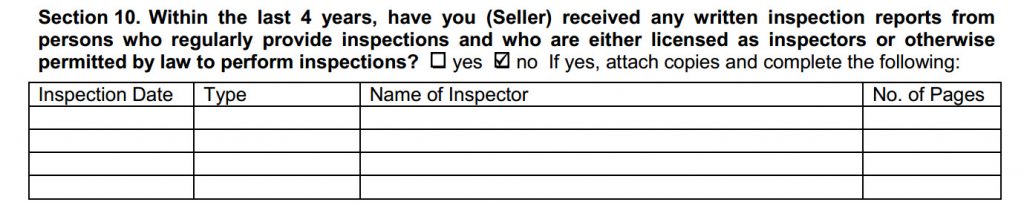
When you are selling your home, you may be tempted to focus more on your home’s appearance than its condition…both are very important to home buyers! In Texas, a home inspection report “sticks” with the home for four years. That means that if you get a contract on your home, and the Buyers do inspections, and then back of of the deal (“exercise their Option”) due to repair issues, you will have to attach that inspection report to your Seller’s Disclosure to inform all potential buyers about the issues with the home. (This is Texas law.)
This means that you want to prepare your home in advance, so that very few items are listed on the inspection report!
So do the following items when listing your home for sale, and especially a few weeks before an inspection. These are the most common things that will be listed on an inspection report in the Katy and Sugar Land area. These are also the types of things that “kill deals” and cause Buyers to “exercise their Option” to cancel the contract. Smart home owners side-step these issues by resolving them in advance of listing their home.
#1 – Get the HVAC System Serviced
The number one issue with buying and selling a home in Texas is the HVAC (heating, ventilation, air conditioning) system. Home inspectors will test the cool air blowing inside the home and compare that to the outside temperature to find the “differential.” Even if you THINK the system is working properly, it probably isn’t good enough for an inspection report.
Generally speaking, you want an air differential of 16-20 degrees. Home inspectors will also do other items to inspect the HVAC system but they will VERY OFTEN recommend that a “qualified HVAC professional check the system.” To head that off at the pass, you should contact your A/C company and have them check the system first. Make sure they fix any issues and then write the temperature differential on the receipt. Also make sure they check the heating elements and specifically write the condition of the heating elements on the receipt. (Home inspectors are not allowed or qualified to open the furnace to check the heating elements.) You need written proof of these items for most buyers.
One thing to understand…if the outside temperature is 65 degrees, minus a 16 degree differential, that equals 49 degrees. Most ACs will not work under 55 degrees. So you can’t properly inspect the cooling capacity of an HVAC system when the outside temperature is below 72 degrees.
Providing a Residential Service Contract (“home warranty”) may help you resolve concerns about HVAC systems, but not always. It’s best to have the system serviced, and provide WRITTEN PROOF, ahead of time. Send a copy of the receipt to the Buyer’s agent before the home inspection, so they can give it to the home inspector.
#2 – Walk the Perimeter and Repair Cracks in Brick Mortar Joints
Potential foundation issues will scare buyers off faster than most anything else when buying a home (read details). Since we live in an area with expansive clay soil (which is susceptible to our frequent floods and droughts) it is common for the brick and mortar around the exterior of a home to crack…especially at bay window and wall joints. Cracks do not, necessarily, mean there is a problem with the foundation. Most exterior cracks in the mortar, and interior cracks in the sheetrock, are indicative of typical “settling” in our area. However, most buyers do not understand that and will just move on to the next available home…passing yours by.
If you have any concerns about your foundation, don’t ignore them and hope they will go undetected. Call a reputable foundation company and have them give you an estimate. Most of the time, there is no issue, so having that information in writing is beneficial.
Make sure you properly seal up cracks in mortar to prevent water and pest intrusion. But never DIY these repairs with stuff you can buy at Home Depot!! Hire professionals so the repairs will be invisible. Also repair interior cracks in ceilings and sheetrock, but again, hire a professional so they will be done properly. These repairs are relatively inexpensive and well worth the price if it prevents buyers from avoiding your property.
If you have a swimming pool, even if you think it is working properly, have it serviced and especially make sure the pool heater (if any) has the pilot light lit so it can be tested during an inspection. Make sure your “pool guy” writes the condition of the equipment on a receipt and keep it to provide to buyers. Also make sure the pool pump is clearly labeled, all switches for lights and water falls are labeled, and clearly label the GFCI outlet.
#4 – Get the Sprinkler System Serviced
Most buyers want to ensure that the sprinkler system works properly…especially the backflow device (which keeps yard contaminants out of the homes main water supply). Make sure that your sprinkler control box is clearly labeled for “which zone is which.” Example: Zone 1 = Front flower beds. Also attach a copy of your sprinkler’s instruction manual in a clear, plastic paper protector and staple or thumbtack by the control panel.
#5 – Replace Burned Out Light Bulbs (or Fix the Light Fixture)
If an inspector turns on a light and nothing happens, they don’t know if the bulb is burned out or if they fixture doesn’t work…so it will go on the inspection report. It’s easy enough to walk your house, including porches and garage, and make sure every single light bulb works. I recommend you use “bright white” (not daylight and not soft white) with the highest wattage allowed for the outlet.
Beware of using energy efficient “pinkish” light bulbs that take several minutes to warm up. Usually the buyer is ready to leave by the time those lights bulbs warm up, so the house looks too dark.
#6 – Ensure All Sink and Tub Drains Work Properly
Go through your home and make sure none of the drains are clogged up. Slow drains will go on an inspection report. While you’re at it, if you have a whirlpool tub, fill it up and pour 2 cups of bleach into the water and run for a few minutes to clean the jets internally. If you do’t use the whirlpool regularly, you may be surprised with the “black gunk” that will appear in the water!
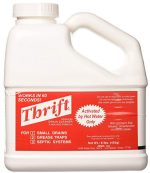
A plumber recommended Thrift Drain Cleaner (buy on Amazon) to me and it works great! I use it to maintain the drains in my own home.
#7 – Repair All Leaky Faucets and Underneath Sinks
Check all the faucets and underneath all the sinks in the home to make sure there are no leaks. Hire a handyman or plumber (more expensive) to fix or replace leaky faucets and sinks. Also repair previous water damage (if any).
#8 – Get the Electrical Panel (Breaker Box) Up to Code
Electricity scares most people and electric codes change year to year. Just to be safe, have a qualified electrician check your electrical box/panel and make sure it will pass an inspection. Make sure the breakers are properly labeled. Also make sure there is easy access to the box and there are no wasps nests growing in or around it. (Yes, I’ve seen this!)
#9 – Lower the Soil/Mulch Level Around the Foundation
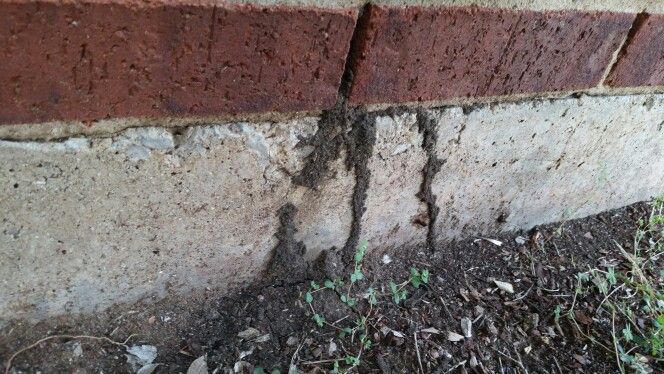
One of the most common items to go on an inspection report is that the soil/mulch line is too high around the foundation. Since termites are a problem in our area, and they build mud tubes along the foundation to get into the wood frame of the home, inspectors like to see 4 to 6 inches of foundation to ensure there are no termite tubes. If your soil or mulch is too high around the house, they can’t see the foundation and they will report it.
Hire your yard guys to rake back the soil and mulch from your foundation.
#10 – Fix Drainage and Gutter Issues
Home inspectors are very picky about possible drainage issues. Make sure your yard is properly graded to drain water within 24 hours. If you have spots that tend to “puddle” for more than a day, then have them filled-in or install a proper drain.
Also make sure your gutters are clear of debris. Home buyers don’t want to buy a home that needs a lot of attention like this and it’s easy enough for you to take care of before an inspection.
#11 – Repair and Paint Wood Rot & Caulk the Exterior Windows and Doors
Water is what typically damages a home. If you have any rotted wood around your home, have it replaced by a handyman. Also have a handyman or painter check every single exterior window and door of your home for separations and cracks and recaulk them as needed.
#12 – Repair Roof Leaks Properly and Repair Ceiling Damage As Well
No one wants to buy a house with a bad roof. Plus, if the roof is really bad, then the buyer may not be able to get home insurance, which means they will not be able to buy your home. (Lenders will not loan money to buy uninsurable homes.) So fix any known roof issues in advance and professionally repair interior damage (water spots on ceilings or walls).
#13 – Repair Broken Glass in Doors and Windows
No one wants to buy a home that has broken windows. Carefully walk your home and inspect each and every window and door and have all broken glass replaced. It’s usually relatively inexpensive to do this. Also make sure all doors and windows open and close and lock properly.
#14 – Label “Unusual” GFIC Outlets and Light Switches
A ground-fault circuit interrupter (GFCI) is the only protection device designed to protect people against electric shock from an electrical system. Most of the time, these outlets are obvious with Test and Reset buttons. However, you can connect a regular outlet to an outlet with a GFCI so that it is protected, but it will not be obvious to the inspector. So if you know you have some outlets like this, especially in the kitchen or bathrooms, then clearly label those outlets and specify the GFCI outlet they are tied to. This is something that inspectors can’t just “know” by looking at it, so they will mistakenly report this on an inspection report.
#15 – Ensure Accessibility to Attic Doors, Garage Doors, Sprinkler Panels, Etc.
A home inspector cannot inspect what they cannot get to and they will not move things to obtain access. So make sure that your garage is not so packed with stuff that the attic door (if any), breaker box, garage door openers, electrical breaker box, or sprinkler control panel is blocked. Make sure no car is in the garage, blocking an attic door as well.
#16 – Inspect the Stucco Exterior and Resolve All Issues
Many home owners love the look of stucco, but it is really a terrible substrate to use for homes in a moist and humid climate like Houston. If you have a home with stucco, make sure you maintain it properly (and annually) because moisture in walls can cause serious problems…including mold hazards. Before listing your stucco home, have it inspected by a professional stucco inspector and make all repairs in advance.
The highest repairs I have ever seen in my 10+ years as a real estate agent added up to $14,000 in stucco issues.
Checklist: Sixteen “Must Do” Items To Prepare Your Home for Inspections
by Sheila Cox, Five Star Real Estate Agent | Updated April 2026
Pricing a Katy home correctly is more complicated than simply comparing the list price to the sales price. Clients often ask me how much they should pay for a home, and I tell them, “It depends on how much it’s worth!” For example, if a house is listed at $450,000 and you get it at $400,000 that may seem like a good deal…but not if the market data says it’s only worth $350,000. (I’m using large numbers here to make the point.) Similarly, if a house is listed at $450,000 and you get it for $450,000, but the market data says it’s actually worth $500,000…then you got a good deal, even though you paid “full price.” See what I mean?
By the way…that new home specialist at the builder’s model home you like will tell you that the $440K model home was originally listed at $520K…sounds like a great deal, right? But they won’t tell you that the last five homes they sold, with that exact floorplan, had an average sales price of $400K. But I will! I’m looking out for you…not the builder.
Home Value Is Not About Price Per Square Foot
Pricing a Katy ome is complicated because real estate market data is changing every month…so home values are changing every month as well. In addition, there is not one price/sf price for an entire neighborhood. Smaller homes in the same neighborhood will typically have a higher price/sf than larger homes in the same neighborhood. Homes with swimming pools and water view lots are generally worth more in the same neighborhood than homes that don’t have those features. Three-car garage homes are worth more than two-car garage homes in the same neighborhood.
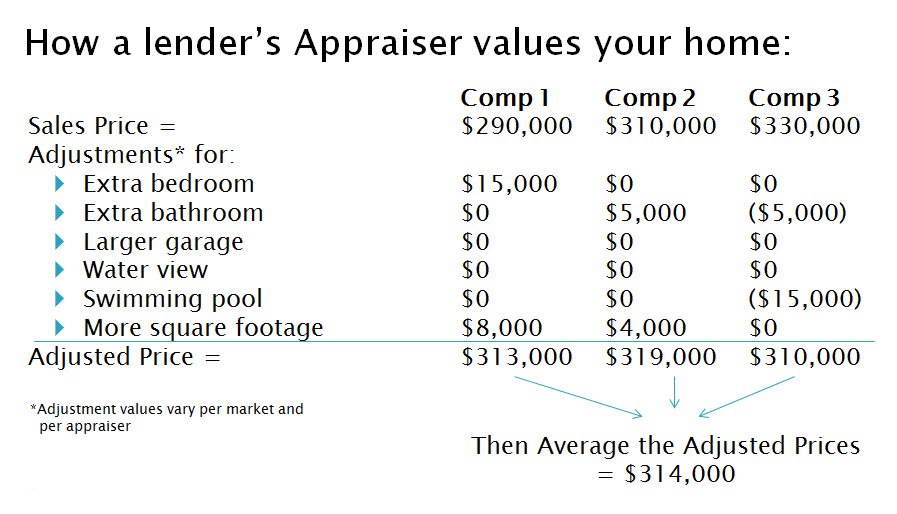
Pricing a home correctly is complicated…you can’t just work off of averages or price/sf. There is no “Kelly Blue Book” value for homes! When determining the value of a home, you should compare at least three to five recently Sold price (not asking prices) for homes that are comparable to the house you want. Comparable means the houses are all within the same size-range (+/- 10%sf), have a similar number of bathrooms, have similar garage sizes, have similar types of amenities and lot types, etc. Usually you will not find three to five homes that are exactly the same as the subject property, so adjustments must be made to the prices, and then the adjusted prices are averaged out. This gives you a good idea of a home’s current market value. See the example below.
By the way, cosmetic items such as granite counter tops, hardwood floors, updated light fixtures, special colors of paint…those items do not typically add value to a home. Appraisers do not make adjustments for most cosmetic items. They try to use Comps that match the home they are appraising. In other words, they don’t compare a “fixer upper” with a totally updated home. As much as possible, they compare “fixer uppers” to “fixer uppers.” So cosmetic adjustments are unnecessary.
New Construction Homes Cost More Than Comparable Resale Homes
New construction homes in a neighborhood make pricing a home correctly more challenging. Technically speaking, investing in a home is very different from investing in an automobile. Homes and real estate are generally “appreciating assets” while cars are generally “depreciating assets.” However, trust me when I tell you that no home buyer on the planet is going to pay the same price for a “used” one-year old home when they can buy a “fresh,” brand-new, never lived in home…where they get to choose all the finishes (paint colors, floors, counter tops, cabinets, etc.). Buyers like that “new home smell” just the same as they like that “new car smell.” And they are willing to pay a premium for the “new home smell” just like they are willing to pay a premium for the “new car smell.”
We all know a car loses value the minute you drive it off the car lot. Likewise, that a new construction home typically loses its value (at least in the short run) the minute that you move in. So do not compare new construction prices with a resale home prices when determining value.
And be prepared to sell your home for less than you paid for it if you bought it from a builder…at least until the builders move out of the neighborhood (and no new construction homes are available) or at least five years (or more) have passed since you bought it from the builder. It is almost impossible to compete on price with home builders when you are selling a resale home. They offer lots of “buyer incentives” to entice buyers to purchase…and they can offer a buyer something you can’t…a never-lived-in-home.
It can be hard to determine what new construction homes are selling for because builders do not always list them on the MLS. Since Texas is a non-disclose state, home builders can sell homes without ever reporting them to the MLS. This often conceals the fact that homes lose value after they are purchased by a builder.
I know that some home sellers think their home is “better than new” because they have done this and that to the home. Home sellers like to price a home based on new construction home prices. But just like a used car, a used home is not usually worth as much to a buyer as a new construction home.
Home Should Appraise for Sales Price
If you are like most home buyers, you are going to get a loan in order to buy a home. That means the lender’s appraiser is going to have a say in how much you can pay for a home. This is something that home buyers and sellers have to be reminded about. It really doesn’t matter if you are willing to pay $450,000 for a house if the lender’s appraiser says it’s only worth $420,000…unless you want to pay the $30,000 difference at Closing.
Remember that a lender is making an investment in you and your home when they loan you money to buy a house. They want to make sure the home is a good investment. They don’t want to invest more than the item is worth. Always keep this in mind when you are applying for a loan.
Always make sure you have a way to get out of the deal if the home doesn’t appraise for the sales price. That will give you leverage to renegotiate the price if the appraisal comes in too low. If you have a back-out addendum in place, and the appraisal comes in too low, then you have four options:
Get the Seller to come down in price to the appraised value
Meet the Seller somewhere in-between the sales price and the appraisal price (but you will have to pay your share of the difference at Closing)
Pay the difference between the sales price and the appraisal value at Closing…on top of your other down payment and Closing costs
Back out of the deal (but then you will not get back all the money you spend on inspections, appraisal, etc.)
Some people think they will be able to terminate a transaction if the appraisal comes in too low because they believe a lender will not approve the loan in that case. This is not, necessarily, true. If you have enough cash on hand to pay the difference, then the lender may still approve the loan.
Tax Appraised Values Do Not Equal Market Value
Pricing a home based on the “tax rolls” and tax appraised values does not work in Texas. Tax appraised values are usually not accurate for market value in this state. The following short video proves that the tax appraised value is usually (not always) lower than the market value.
Plus, Texas is a non-disclose state and only members of the MLS have actual sales data.
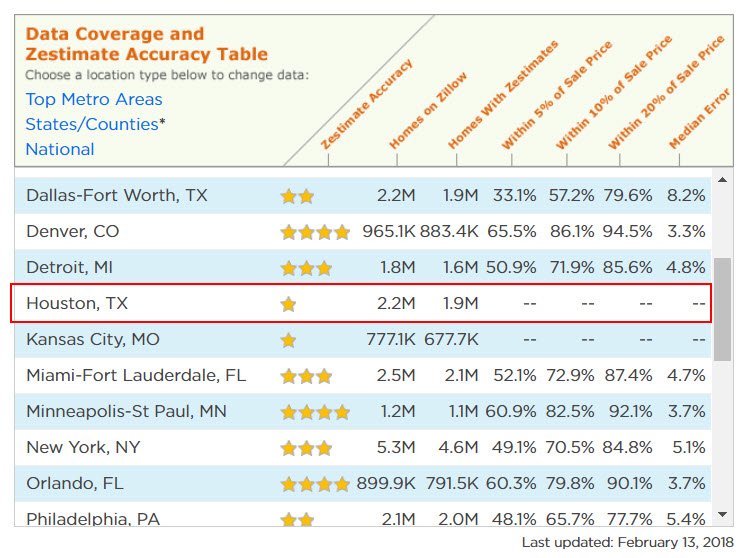
And even Zillow only gives themselves 1-star on their Zestimate’s accuracy (see here).
There is a method for doing a proper Comparative Market Analysis for a home that is similar to how a lender’s appraiser is going to determine a home’s value. Hire an experienced agent who knows what they are doing! (See My Sample CMA)
As your Buyer’s Agent, when you find a home you want to make an offer on, I do a complete CMA (Comparative Market Analysis) and provide you with the data that I have, to determine the realistic and accurate price for a home. This method is similar to how lender’s appraisers value a home. That way you don’t find yourself wasting a lot of time on a home that will not appraise for sales price.
Often times a home is listed at a price that is considerably more than the CMA value. For example, a home that just hit the market may be listed at $550,000 and the CMA, which is based on comparable homes SOLD in the past six months) says it is only worth $500,000. But you, the Buyer, really want the house. What do you do? Well…
Neither the Buyer’s Agent or the Listing Agent can make a seller accept your reasonable offer. And if the house just hit the market, then it’s possible that the seller hasn’t “come to their senses” yet. Sometimes it takes time for a home seller to see that their home isn’t worth what they want for it. If the house sits on the market for months, then sellers either decide to lower the price (hopefully) or they take the home off the market, because they find out they can’t get what they want for it at the current time. (So they will wait.)
I have seen it time and again where a Buyer’s Agent shows the Listing Agent their data for the $500,000 offer and it doesn’t matter…until months go by. Then, eventually, the Seller finally sells the home at the price you offered (or lower)…after letting it sit on the market for 6 months. It is often the case that only TIME can motivate a seller to accept a reasonable offer.
So what do you do if you really want a house that is overpriced?
Do you have time to wait? If so, give it a month or two and hope that another buyer doesn’t beat you to it. If you don’t have time to wait, then move on and find another home.
Pay the higher price. Sometimes it is worth paying more for a house to get what you want, when you want it. And besides…paying a higher price helps raise the prices in the neighborhood…thereby increasing the value of your investment.
Take a risk and offer the price the seller will accept while hoping the appraisal will come in low so you can renegotiate. Use the lender’s appraisal as your “checks and balances” for the price. This strategy can only work if you have the right to back out of the transaction if the appraisal comes in low.
Sometimes an appraisal comes in much higher than what a Buyer’s Agent thinks the house will appraise for. This may be because the market has changed in the 4-6 weeks between the time the agent did the CMA and the time the appraisal is done..and more homes sold in that time. Or sometimes it seems that appraisers choose odd “Comparables” to make the appraisal come in higher (or lower). You just never know what a lender’s appraiser will do when valuing a home.
Negotiating Tips for Buyers
Here are some tips to help with negotiations:
Don’t let yourself “fall in love” with a house, making detailed plans for remodeling and decorating, before you have an executed contract. If you are emotionally attached to the home, then it will be harder for you to walk away from an over-priced home.
Don’t expect to get a seller to go down substantially in price when the house has only been on the market for a few weeks. Be willing to pay a reasonable price instead of getting a “killer deal” on a house that just hit the market.
Don’t low-ball a house in a HOT market when you may get in a competitive situation with other buyers. Be willing to pay a reasonable price (or slightly more) because other buyers will be willing to do so.
There is a funny saying in real estate: “You can’t fix stupid.” That’s just an irreverent way of saying that your Buyer’s Agent can’t prevent other buyers from overpaying for a home. Cash buyers commonly pay way too much for a home because they don’t have a lender’s appraisal holding them back. And you don’t know what the other buyer’s circumstances and motivation are…maybe they are too desperate to be conservative about price.
Always consider your “next best alternative” when making pricing decisions. If you are desperate to get a home because you have to move in six weeks, and you have been looking for several months without finding anything else that you like, then be willing to pay more to get what you want. Likewise, if you are not being forced to move in a short-time frame, or you have seen lots of other homes that you like, then you can be “stricter” with the price you pay for a house.
Do not take the CMA value of a home and then subtract from it all the cosmetic changes (paint, flooring, landscaping, pool, etc.) that you want to make to the home. It doesn’t work that way. Cosmetic items do not, generally, effect the value/price of a home.
Remember that both CMAs and Appraisals are opinions of market value. If you have three different appraisers do an appraisal on the same home at the same time, you will probably end up with three, different values.
Always remember that the price you pay effects the prices in the neighborhood where you are buying and investing. Driving too hard a bargain on your future home can have a negative impact on your home’s value too.
How’s the Katy Real Estate Market?
Get the Report!
What’s Included
Ten-year trend of median sales prices by ZIP Code and neighborhood…so you have a baseline in determining a home value.
Ten-year trend of sales volume by ZIP Code and neighborhood…so you can see which are the most popular neighborhoods.
Ten-year trend of median Days on Market by ZIP Code and neighborhood…so you can see how long it takes to sell a home in each area.
List of the most popular neighborhoods in the Katy area…see what neighborhoods are HOT!
List of the neighborhoods by price (high to low) in the Katy area.
Detailed market data on the most popular Katy neighborhoods
As a homeowner in Texas, your Homestead Tax Exemption is a large exemption to reduce the amount of property taxes you pay. Applying for a Homestead Tax Exemption (more info) is a one-time activity in Texas that homeowners need to do the first year they buy a home…not something you do every year. The deadline is not until the first one-year anniversary of Closing on your home, however, you can do it now.
Your application must include a copy of your Texas Driver’s License or DPS Identification Card and the address on the driver’s license or identification card MUST be the same as the address on which you are filing an Application for Residence Homestead Exemption (because you can only get this exemption on ONE home you live in). Make an appointment to get your Texas driver’s license here.
—by Sheila Cox, Five Star Real Estate Agent | Updated April 2026—
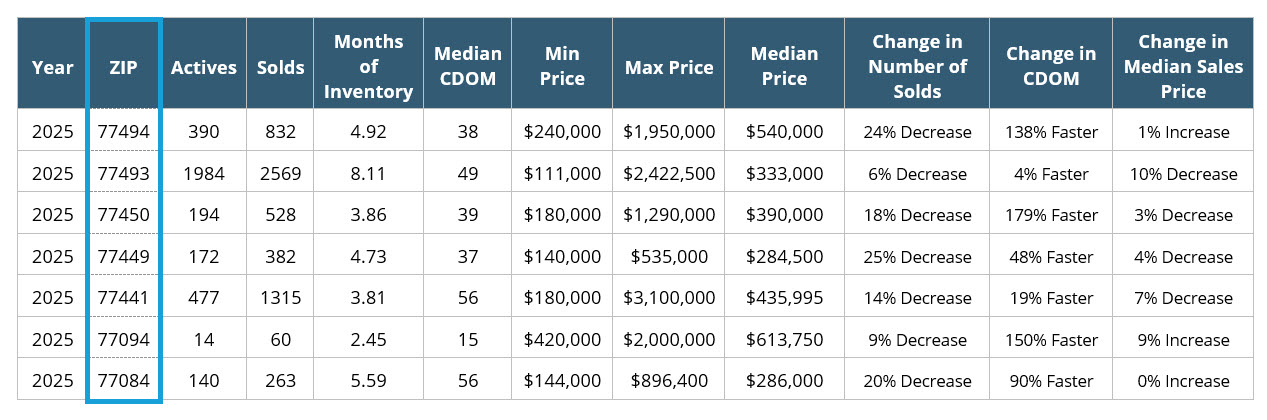
People always ask me, “How’s the Katy real estate market?” The table below shows the overall stats by Katy ZIP Code, in 2025Q3.
#image_title
Every Katy Neighborhood is Different
One of the biggest mistakes people make when looking at the Katy real estate market is assuming Katy behaves like one single, unified market. It doesn’t. Katy is a collection of very different neighborhoods, price points, school zones, housing ages, and buyer profiles, and each one responds differently to changing conditions. You can see this clearly when you look at inventory, pricing trends, and days on market across different ZIP codes. Some areas have months of inventory well below four months, meaning homes there still sell quickly and favor sellers who price correctly. Other areas are sitting well above six or even eight months of inventory, giving buyers far more leverage. Those differences dramatically affect pricing strategy, negotiation power, and timing.
CLICK TO DOWNLOAD MARKET DATA
Even within the same ZIP code, one neighborhood can be moving quickly while another just a few miles away struggles. Newer master-planned communities often attract buyers relocating from out of state, while older, more established neighborhoods may appeal to long-term residents or investors. School zoning, tax rates, HOA structures, and neighborhood amenities all influence demand in ways that broad market averages can’t capture.
For buyers, this means you can’t rely on general headlines about the Katy real estate market to guide your decisions. You might have strong negotiating power in one neighborhood while needing to act quickly in another. Understanding which areas still see competitive demand versus which areas offer more flexibility can save you money and frustration. That’s where I can help! 🙂
For sellers, neighborhood-level data is even more important. Pricing your home based on Katy-wide averages can lead to overpricing or underpricing, both of which cost you time and money. The most successful sellers in today’s market are those who price based on what’s happening in their specific neighborhood, not what’s happening across the entire city.
This is why hyperlocal data matters. Looking at recent sales, active competition, buyer behavior, and pricing trends at the neighborhood level allows you to make informed, confident decisions instead of guessing. In a market as diverse as Katy, success comes from understanding the details, not just the big picture.
Katy Real Estate Market: What You Need to Know Right Now
The Katy real estate market continues to evolve in 2025, and if you’re paying attention, you’ll notice a clear shift toward a more balanced, strategic market. Homes are still selling, buyers are still moving in, and prices are holding steady in many areas, but the pace, pricing power, and negotiation dynamics are no longer one-size-fits-all across Katy. Understanding what the numbers actually mean helps you make smarter decisions, whether you’re buying, selling, or simply watching the market.
This isn’t a market driven by panic or speculation. It’s driven by inventory levels, pricing accuracy, and how well a property matches current buyer expectations.
Inventory Levels Are Telling the Story
One of the most important indicators in the Katy real estate market is months of inventory, and right now, inventory varies widely depending on where you’re looking. Some parts of Katy are sitting just under four months of inventory, which still favors sellers who price correctly and prepare their homes well. Other areas are pushing past eight months of inventory, which clearly shifts leverage toward buyers. When inventory climbs above six months, buyers gain more choices, more negotiating power, and more time to make decisions.
Buyer Activity Has Slowed, But It Hasn’t Stopped
Across Katy, the number of homes sold in 2025 is down compared to the previous year. In most areas, sales declines range from single-digit drops to more noticeable decreases in the 20–25% range. That sounds dramatic at first, but it needs context. Fewer sales does not mean no demand. It means buyers are more selective. Higher interest rates, affordability considerations, and increased inventory have made buyers cautious, not absent. Homes that are well-priced and move-in ready are still selling. Homes that push pricing too far above market expectations are sitting. If you’re buying, this slower pace works in your favor. You have time to evaluate options, negotiate repairs or concessions, and avoid rushed decisions. If you’re selling, it’s no longer enough to “test the market.” Accuracy and presentation matter.
Homes Are Selling Faster Than You Might Expect
One of the more surprising trends in the Katy real estate market is how quickly homes are selling once they’re priced right. Median days on market have dropped significantly in several areas, with some showing homes selling more than 100% faster than last year. This tells you something important. The market isn’t slow, it’s intolerant of overpricing. When a home hits the market at the right price, buyers respond quickly. When it doesn’t, it lingers. From a seller’s perspective, the first few weeks on the market matter more than ever. From a buyer’s perspective, the best homes still require decisive action, even in a more balanced market.
Price Trends Are Mixed, Not Falling Across the Board
Median home prices in Katy are not moving in a single direction. Some areas are seeing modest price declines, others are holding steady, and a few segments are still experiencing slight price increases. This variation reflects affordability thresholds and buyer demand at different price points. Higher-priced areas with limited inventory continue to see strong pricing, especially where days on market are very low. More affordable areas, or areas with higher inventory levels, are seeing downward pressure on prices as buyers compare options more carefully. What matters for you is understanding your specific price range, not relying on headlines about the overall market. Katy does not behave like a single ZIP code, and broad averages can be misleading.
What This Market Means If You’re Buying
If you’re buying in the Katy real estate market right now, you’re in a position of relative strength. You have more inventory to choose from, fewer bidding wars, and better opportunities to negotiate than you did a few years ago. That doesn’t mean you should expect steep discounts across the board. Well-priced homes still sell quickly. However, you may be able to negotiate closing costs, repairs, or favorable terms, especially in areas with higher inventory levels. The key is being prepared. Pre-approval, realistic expectations, and understanding the micro-market you’re shopping in will give you an edge.
What This Market Means If You’re Selling
If you’re selling, success in the Katy real estate market comes down to strategy. Buyers are paying attention. They’re comparing homes carefully, watching days on market, and avoiding listings that feel overpriced or neglected. You’ll want to focus on pricing accuracy from day one, strong presentation, and realistic expectations about timing. Homes that launch well often sell quickly. Homes that don’t can struggle to regain momentum later. This is not a market where you can rely on appreciation alone to do the work for you. Preparation and pricing matter.
Why Local Expertise Matters More Than Ever
With conditions varying so much across Katy, generalized advice doesn’t work anymore. You need data-driven insights, local context, and a clear strategy based on your goals. Whether you’re buying your first home, relocating, or selling a property you’ve owned for years, understanding the Katy real estate market at a local level helps you make confident decisions instead of emotional ones. The market rewards preparation, patience, and realistic expectations. When you understand what the numbers are actually telling you, Katy becomes much easier to navigate.
Real Estate Terminology
Buyer’s Market vs. Seller’s Market
The real estate market is constantly changing. The way we determine the type of real estate market we’re in (Buyer’s Market vs. Seller’s Market) is based on the amount of Inventory (homes available for sale) currently available. Six months of inventory is usually considered “equilibrium” —neither a Seller’s or Buyer’s Market. A Buyer’s Market is considered to be 7 months or more of inventory. This is where the demand for homes is somewhat less than the supply of homes and when Buyers may have more control over house prices than Sellers. A Seller’s Market is considered to be 5 months or less of inventory. This is where the demand for homes is somewhat greater than the supply of homes and when Sellers may have more control over house prices than Buyers.
Months of Inventory
Months of Inventory refers to the number of months it would take to sell all of the currently listed homes on the market, with no new homes being added. This may also be called the “Absorption Rate” because it is the rate in which houses are “absorbed” in the current market. Generally speaking, if Inventory is greater than 6 months, then it is a “Buyers Market,” and if Inventory is less than 6 months, then it is a “Sellers Market.”
Months of Inventory =
# Active on the Market
(# Sold in Past 12 mths) / 12
Cumulative Days On Market
How long it takes to sell homes can be a good indicator for “how’s the market”? The longer it takes to sell homes, on average, the slower the market. So if the cumulative number of Days on Market is increasing, then the market may be slowing down, and if CDOM is decreasing, then the market may be speeding up.
“Days on Market” refers to the days a specific home listing has been on the MLS. If the real estate agent Terminates the listing and then relists it with a new MLS number, then the DOM resets. However, the Cumulative Days On Market should show the total Days on Market for that particular home, regardless of the number of time it is terminated and relisted by one or more real estate agents.
Keep in mind that areas with lower-priced homes will usually sell faster than luxury-priced areas, because the more affordable the home’s price, the larger the number of potential buyers, and the quicker it can sell.
Median Price
Median Price is not the same as the Average Price; it is the middle point for real estate prices. The Median Price is the price in the middle of all the sales prices for a certain time-period, with exactly half of the houses priced for less and half priced for more.
It is generally believed that the Median Price is the best indicator for market activity because it is less affected by abnormally low prices or high prices (which skew the Average Price).
Will Prior Foundation Repairs Effect a Home’s Resale Value?
In Texas, there is a saying that all houses here either have foundation repairs or will need them in the future. That’s because the soil in most parts of Texas is an “expansive soil” that significantly expands and contracts based on the level of moisture in it. And since Texas is known for either droughts or floods…our soil tends to expand and contract a lot.
That is why it is very important for homeowners to keep the soil around their home evenly watered. Water in the soil provides pressure to support the home. During a drought, the lack of moisture may cause a foundation to sag. Simply watering the soil can often push a slightly sagging foundation back up…no kidding!
Does having a prior foundation repair on a home effect the resale value? That’s a controversial question with no “scientific” data to prove one opinion or another. Some say that as long as the repair is done by a reputable foundation company and has a transferable lifetime warranty…no problem. It may even be considered a positive feature of the home, since the cost of the repair has been covered by a prior owner.
NOTE: If you need some brick or mortar repair in the Sugar Land area, contact JQ Brick at 713-253-5092…they do excellent work at very reasonable prices.
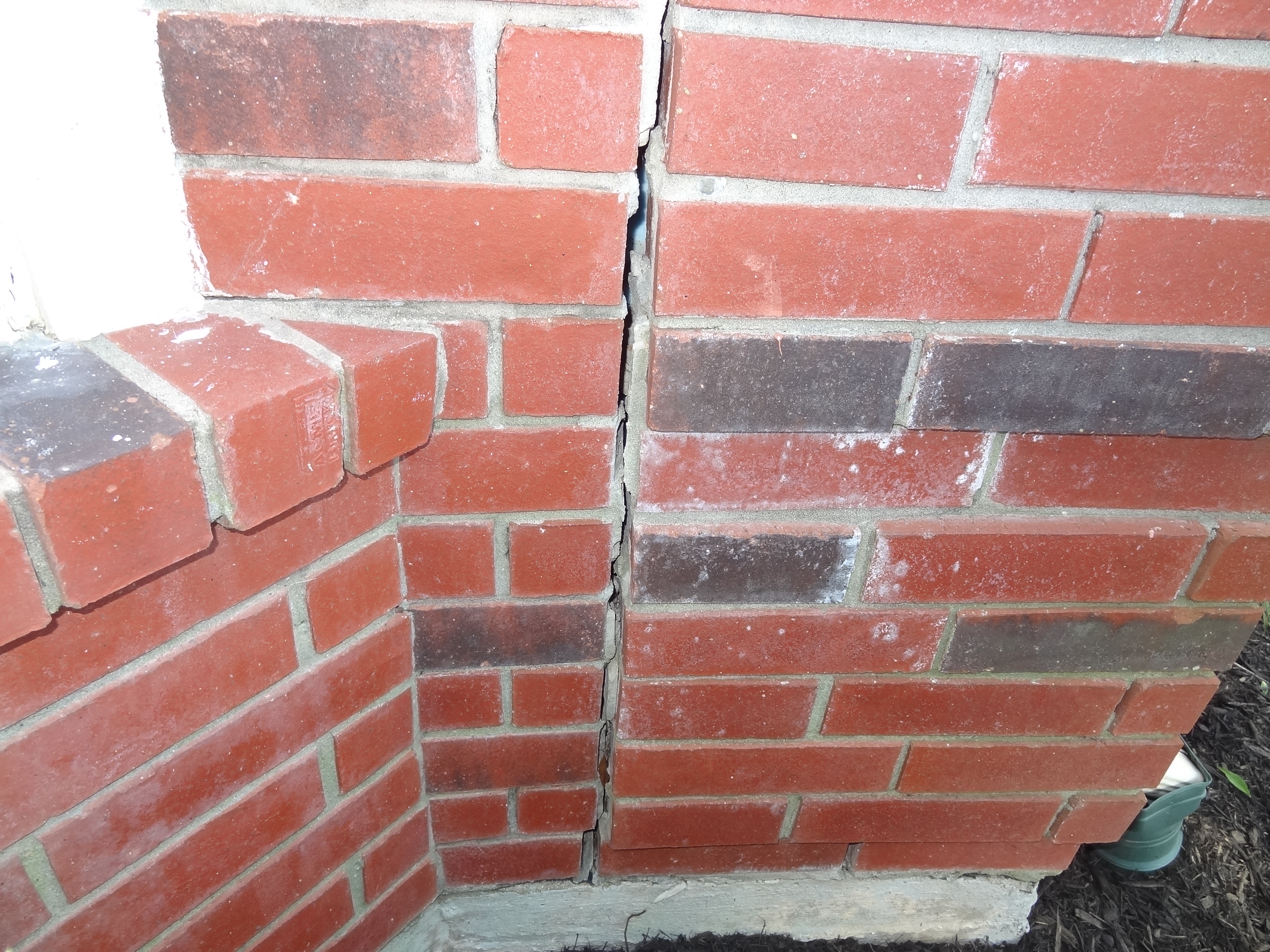
These kinds of cracks do not necessarily mean there are foundation issues…bricks and mortar crack very easily.
They do need to be resealed, however, with mortar (not caulk) to prevent water penetration into the side walls.
Call JQ Brick at 713-253-5092.
Others know that inexperienced home buyers may be scared of purchasing a home with prior foundation repairs…and will not even give such a home a second glance. So, by reducing the number of prospective buyers for a home this way, it could have a negative impact on the price per square foot that home can command. That would suggest that a home buyer should not pay a neighborhood’s top price/square foot for a home with prior foundation repairs…unless there are other special features that significantly override the foundation issues.
Before a home owner puts a brick home on the market to sell in the Katy TX area, a thorough inspection on the exterior of the home should be performed. All the walls should be checked for cracks along mortar lines and brick. The lintels above windows and doors should be checked for rust. Make sure that you look behind hard-to-see areas covered with bushes as well.
These kinds of cracks do not necessarily mean there are foundation issues…bricks and mortar crack very easily. They do need to be resealed, however, with mortar (not caulk) to prevent water penetration into the side walls. Call JQ Brick at 713-253-5092.
If you find any cracked brick or mortar, or rusted lintels, requiring brick repairs, then call a brick restoration company to have them repaired before you put the house on the market. If a potential home buyer sees these kinds of cracks, it may scare him away before he takes a serious look at the home. Or, if the cracks are found during an inspection, it can kill the deal. These brick repairs are relatively inexpensive (usually around $500 or less) and need to be done whether you sell or not…to prevent water penetration into the side walls.
Cracks in bricks and mortar may indicate foundation issues, but they definitely do not mean that the foundation definitely has problems. I’ve seen homes with cracks running the entire length of the home that did not require foundation repairs even after inspections by several foundation repair companies. However, most home buyers are not foundation experts and automatically think there are foundation problems when they see cracks in the walls…and move on to the next house to consider buying.
In Texas, there is a saying that all houses here either have foundation repairs or will need them in the future. That’s because the soil in most parts of Texas is an “expansive soil” that significantly expands and contracts based on the level of moisture in it. And since Texas is known for either droughts or floods…our soil tends to expand and contract a lot…causing the need for brick repairs on a regular basis.
That is why it is very important for homeowners to keep the soil around their home evenly watered. Water in the soil provides pressure to support the home. During a drought, the lack of moisture may cause a foundation to sag. Simply watering the soil can often push a slightly sagging foundation back up…no kidding!
When a REALTOR wants to show your home to a client, she will contact the Centralized Showing Service. They will, in turn, contact you to confirm the day and time. If the requested appointment is not a good time for you, offer an alternate time that is…but keep it as close to the requested time as possible.
Keep in mind that showing appointments are unpredictable. Most agents will set a window to show your home between, for example, 1:00 to 2:30 p.m. This means you should be out of the home by 12:55 and don’t return until 2:45. Due to the day’s showing schedule, the REALTOR and clients may not arrive at the home until 2:15 p.m.—which is why an appointment “window” is set.
Unfortunately, sometimes the REALTOR will have to cancel the appointment at the last minute…or sometimes they don’t show up at all. Remember that this is may be because the clients (potential Buyers) have either changed their mind or already decided on another home.
About 15 to 30 minutes before you need to leave your home for a showing appointment, do the following:
1.
Make sure the temperature of the house is comfortable: cool in summer and warm in winter.
2.
Many people are allergic to certain scents and deodorizers, so don’t spray the air or plug-in air fresheners.
3.
Open all the window coverings to let in light.
4.
For windows that show undesirable outdoor scenery, such as a dilapidated fence or a nearby structure that obstructs views, keep blinds partially closed.
5.
Turn on every light in the house, including closet lights.
6.
Put animals in crates in a safe, but out-of-the-way place such as a laundry room or garage. Some people are afraid of dogs and/or cats. Cover animal cages if possible…especially reptiles, snakes, and rodents.
7.
Turn off TV.
8.
If the house is wired for sound, leave classical music playing but very softly.
9.
Make sure you leave house brochures on the dining room table or another place pre-determined by your REALTOR.
10.
Leave the house. Don’t set the alarm unless you have left instructions with your REALTOR or the Centralized Showing Service.
NOTE: If you bump into the REALTOR and Buyer on the way out, be friendly and cordial, but do not stay.
After an appointment, I will follow-up with the showing agent to obtain feedback for you. This may take a few days, so please be patient. Generally I send weekly reports to keep you up-to-date.
The bottom line: No one knows an area better than a local, experienced real estate agent. Don’t gamble your biggest investment on automated Internet data.
It’s Not All About the ZIP Code…Or Shouldn’t Be
I love the Internet and I’m an information junkie, but I am constantly amazed at how WRONG the real estate info presented on the internet is for my area: Katy TX. Katy is a large city (population 250,000+) located in in Fort Bend County, just west of Houston TX. Like all cities of its size…some parts are very different than other parts…it is not completely homogeneous. Furthermore, it consists of multiple ZIP Codes: 77450, 77494, 77493, and 77449. And, Katy is adjacent to Houston, Fulshear, and Richmond as well. So you can live in the Katy area but technically have a Houston address.
What really “bugs” me about the data available on the Internet is that most websites use ZIP Codes to determine demographics and “city data.” But you can’t do that accurately in Katy since it has multiple ZIP Codes. And to complicate matters, Katy is divided into multiple master planned neighborhoods and each of those may be split into multiple subdivisions. For example, Cinco Ranch consists of over 50 subdivisions. So you can have multiple neighborhoods and subdivisions within the same ZIP Code, but let me assure you that the demographics and average income for homes in Avalon Seven Meadows is drastically different than those in Falcon Landing (two subdivisions in the same ZIP Code).
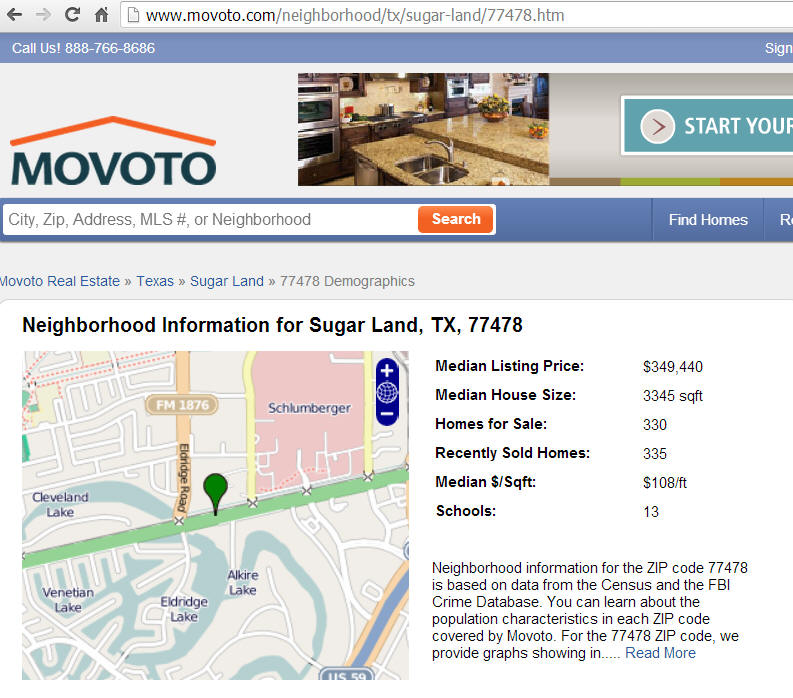
Here are some examples that “bug” me. I’m using information for the nearby Sugar Land TX area, but you get the idea…
At the time the above data was posted on the Internet, I checked the Multiple Listing Service (MLS) database which reported a median list price at $329,000…not $349,440 (as shown above). And besides that…I assure you that we have many subdivisions in Katy where you can purchase a home for much less than that price! Or much more! So what’s the point of this information? And the “median” for 77478 is probably not accurate for a specific home in a specific subdivision.
From MLS
NOTE: Home prices are a constantly moving target…even within the same subdivision. The averages, medians, and such change monthly…depending on current market activity. You have to evaluate the value of a home at the time you are making a purchase. (Which is one of the main services that a real estate agent should provide.) Home appraisals are professional opinions only and are typically only considered accurate for six months.
Neighborhoods Need to Be Properly Defined
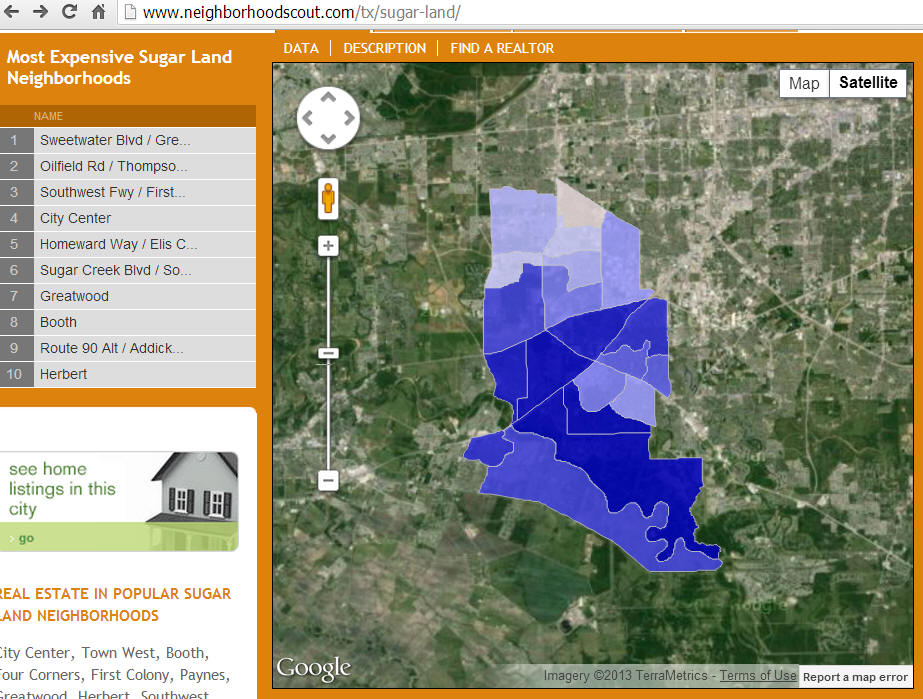
At least NeighborhoodScout is trying to look at the neighborhood level (see below)…but they fail miserably. The sections they have segmented are not actual Sugar Land neighborhoods…some sections contain multiple neighborhoods…so the data can’t be applicable for a specific home or subdivision. For example, if you click the area that is supposed to be for Telfair, you will see it includes part of First Colony and those subdivisions are zoned to different schools than Telfair. (And trust me when I tell you that schools are one of the most important variables in determining home values in our area!)
Inaccurate Data Misleads People
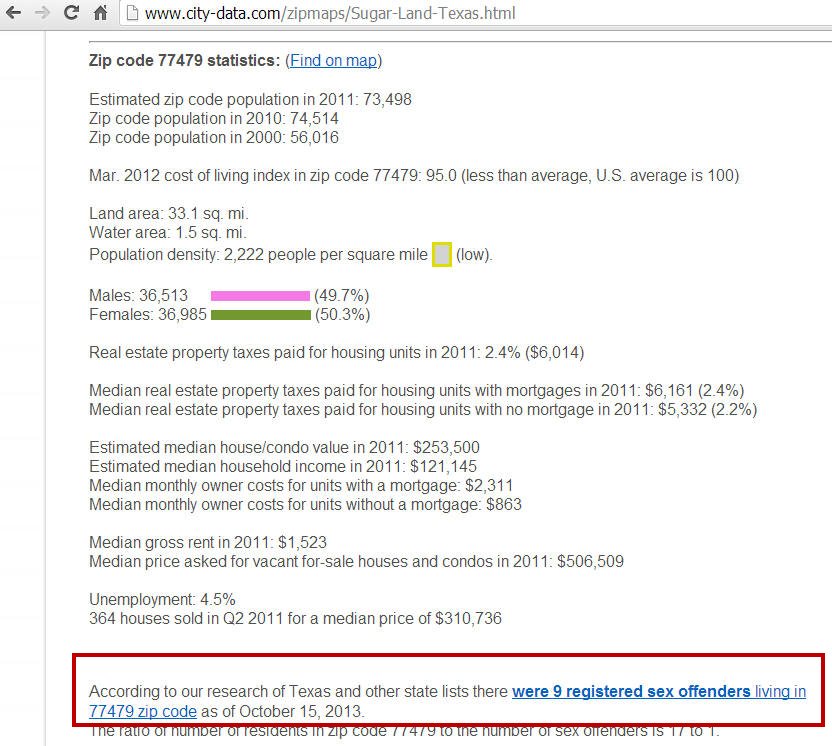
Here’s my least favorite source of data (city-data)…notice they report only 9 registered sex offenders in all of 77479. We wish!
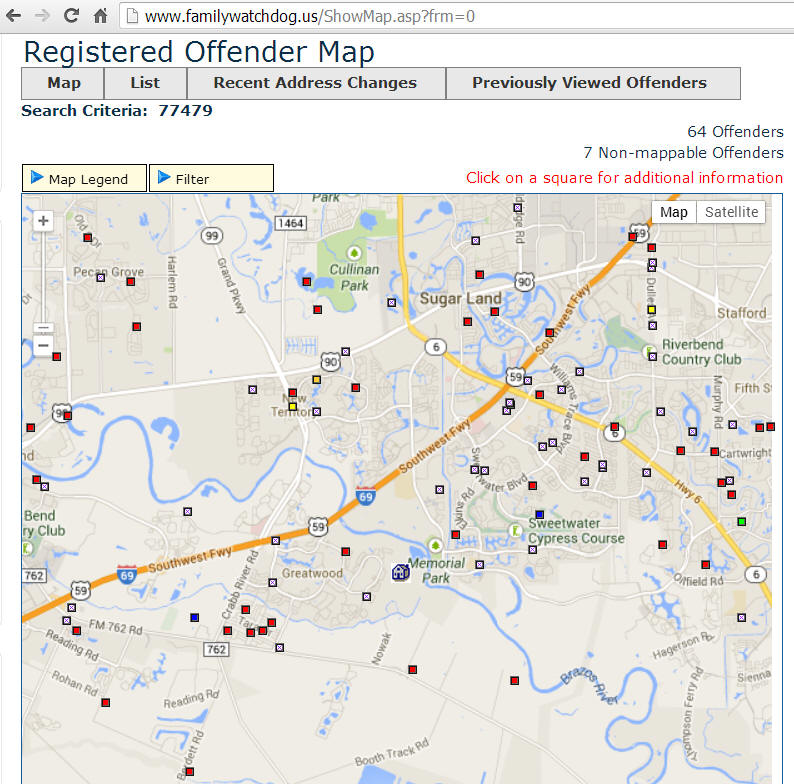
FamilyWatchDog reports and maps 64 (unfortunately)!
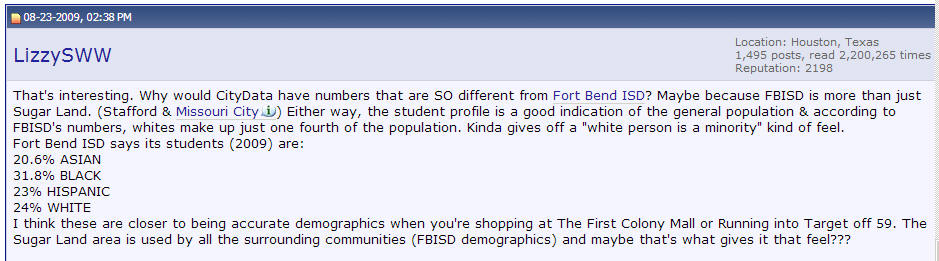
I REALLY don’t like most of the info on city-data because it reports information from any unknowledgeable “joe” who wants to put it up there. For example, I searched for “telfair sugar land demographics” on Google and the top entry was a city-data thread. In it, various and misleading demographics were reported…
Not accurate at all!
FBISD also consists of Houston addresses…not at all accurate stats for Sugar Land.
I think the City of Sugar Land has the best info on actual demographics for the city…they are getting it from the census data.
Each Neighborhood and Subdivision is Unique
The hard fact is that you can’t really get accurate census type data at the neighborhood or subdivision level. Relying on the data for an entire ZIP Code in our area may be very misleading when it comes to the neighbors you will eventually live next to. The best alternative is to look at the demographics for the Katy schools to which a home is zoned.
Only an Experienced Local Real Estate Agent Can Narrow and Focus Your Search
So if you are a home buyer in the Katy area, you really need the guided expertise of a local real estate agent you can trust to help you buy a home in the RIGHT neighborhood at the RIGHT price. No online searches available to the general public–including HAR.com, Trulia, Zillow, Homes.com–none of them will allow you to do the complicated and focused searches that a real estate agent can perform. Today (March 1, 2018) there are approximately 1291 active listings in Katy reported on the MLS. Do you want to sort through all of them or do you want to focus on the top 50 that most closely match your requirements?
Most Online Real Estate Pricing Data is Not Entirely Accurate and Should Not Be Relied Upon
Let me add that Texas is one of the few non-disclose states. That means that real estate data is not public information…so the online companies like Zillow and Trulia don’t have access to real data. They use tax appraisal values which are usually lower than actual home values. So don’t rely on them! And since online companies can’t get the real MLS data, they report erroneous information. Here’s an example…
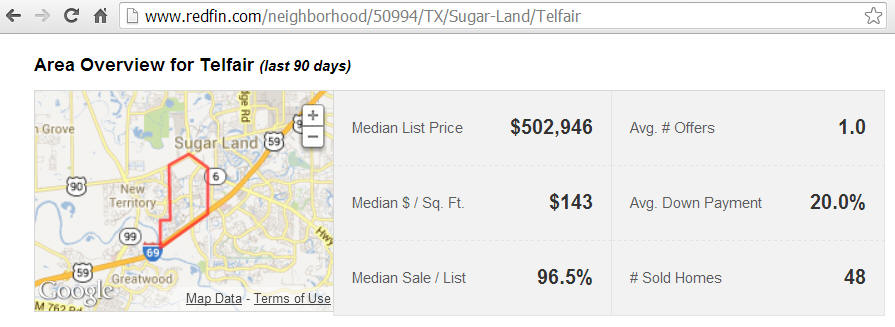
Here’s the data reported on Redfin on October 15, 2013…which says it is for the last 90 days and focused on one of our most popular neighborhoods: Telfair.
I ran the sales history on the MLS for the last 90 days, and got the following data.
The top box is for Active Listings and the bottom box is for Sold properties.
So let’s look at the differences…
Redfin Reported
MLS Reported
Median List Price
$502,946
$507,440
Median $/Sq Ft
$143
List = $143.68 but
Sold = $133.28!
Median Sale/List
96.5%
97%
Avg # Offers
1.0
No way to know!
Avg Down Payment
20%
No way to know!
# Sold Homes
48
54
My first complaint is that two reported variables are almost impossible to determine: Avg # Offers and Avg Down Payment.Agents do not report the number of offers on a home. They only have to report an offer when it is accepted and goes “Option Pending” or “Pending” (and sometimes they don’t even do that.) So that variable is completely unreliable and shouldn’t be reported at all.
The Avg Down Payment bothers me too. Agents are supposed to report that number at Closing (when a house sells), but you would have to look at every single transaction (54 over the past 90 days) to record those numbers. I don’t see how Redfin could automate that for every neighborhood…so I don’t trust that number either.
Notice the Median List Price is off by $4,500 and the # Sold Homes is off by 12.5 percent. Also, they report the Median $/SqFt for List Price only…but notice that the SOLD SalesPrice$/SqFt is $10.40 less! So if a buyer used the number Redfin reported to price a 3000sf home, that could have led to the buyer overpaying by $31,200!
NOTE: It really doesn’t matter what the median list price is for a neighborhood…only the sales price should be used to price a home you want to purchase.
And then that gets me into a price discussion which is too complicated to address here. But let me point out that this the median SalesPrice/SqFt and the house you may want to buy could be an above-average home or a below-average home. Do you want to pay the average price for a below-average home? Do you think a seller will accept an average price for an above-average home? The best way to get an accurate view of the value of a specific home at a certain time is to hire a professional appraiser or to engage a really good real estate agent. Not all real estate agents are good at pricing homes…you need a PRO!
Even Zillow Admits They Are Not That Accurate in the Houston Area
One of the questions that I’m frequently asked is, “Who pays the real estate commission in Texas for a real estate transaction?” That’s a good question! Here’s the answer…
Things Are Different in 2024!
There are BIG changes hitting the entire real estate industry as of August 2024, so make sure you watch my videos to understand those changes and how they will impact you.
RECOMMENDATION: Change the video Quality setting to 1080p. You can also change the Playback Speed.
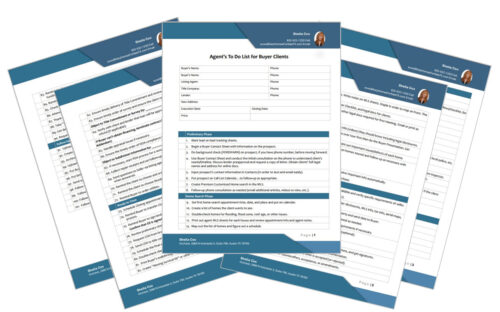
So how do I earn the sales commission? I have a very detailed “To Do List for Buyer Clients” that has over 100 tasks that I may perform for you…and only one task is “Show properties until one is found.” So even if I show you 30 houses, that only represents one of the line items on my To Do list! Trust me when I say that there is a lot more to my job than “just showing houses.” I’m looking out for you every step of the way and keeping my eye on the Listing Agent, the Seller, the builder (if applicable), the lender, the inspector, the title company…I’m always watching out for you because I’m your agent.
Now you need to understand one more important thing:
Want to know how to hire the best Katy real estate agent? See below!
NOTE: Many of these items are specific to Texas agents.
___ Did your agent give you the “Information About Brokerage Services” notice that is legally required by the Texas Real Estate Commission before showing you houses? Can your agent effectively explain it?
___ Did your agent provide all the other necessary disclosures, notices, and the Buyer’s Representation Agreement to you before showing you houses? Be careful! You don’t want to find out after-the-fact that your agent actually represents the Seller.
___ Can your agent effectively explain the HOA maintenance fees, MUD and LID taxes, compliance certificate requirements, amenities, property tax rates, school performance ratings, and other important information for the neighborhoods you are looking at?
___ Does your agent know how to provide you with an accurate CMA (price analysis) on a home before you make an offer? Is he or she committed to helping you get the right price or does the agent just want you to buy the highest priced home you can afford? (See “How to Price a Home Correctly“)
___ Does your agent point out possible defects of homes when you tour them or does your agent always seem to overlook the obvious problems of a home and try to convince you that they don’t matter? (Check my client satisfaction rating.)
___ Does your agent actually show you homes or does he or she expect you to drive the neighborhood on your own and then contact the listing agent directly to let you see the house? A dedicated agent wants to be with you every step of the way.
___ Has your agent set up a customized automatic home search for you that is pulled directly form the local MLS? Or are you still trying to find homes on your own using the limited online search Websites available in your area? These programs (such as Realtor.com, Zillow, Trulia, and Homes.com) can be outdated very quickly showing contract-pending homes as “active.”
___ Does your agent use an online paperwork system where you can e-sign documents instead of having to fax and scan them (which is sometimes challenging and time-consuming)? What if your spouse is still back home in another state or country? You need to be able to e-sign!
___ Does your agent work to negotiate a residential service contract (aka, home warranty) in the deal or provide one for you to protect you from too many future home repairs?
___ Does your agent have at least a 4.5 star client satisfaction rating with the local board of area Realtors? What’s your agent’s YELP rating, Homes.com endorsements, Angie’s List reviews, and so on?
___ Does your agent have 20 years experience? (Trick question.) IT DOESN’T NECESSARILY MATTER! There are terrible agents with 30+ years of experience who even have a broker’s license. And there are outstanding agents with only a couple of years experience. Time does not equal quality in this business. Time cannot guarantee attitude, dedication, integrity, intelligence, or commitment to customer service. Check their satisfaction rating...this is a free service for all members of the Houston Association of Realtors (HAR). If your agent hasn’t signed up, maybe they have something to hide.
“If you’re not sure whether you need a real estate agent or not, please take a look at Do I Need a Real Estate Agent to help you decide.”
RECOMMENDATION: Change video Quality setting to 1080p.
Does My Real Estate Agent Represent Me or the Seller?
When I bought my first house in the mid 1990s, Texas was kind of a “Buyer Beware” state. In fact, a home Buyer could spend weeks looking for a home with a real estate agent, telling her secret information (like how much you were willing to pay for a house), not knowing that everything you told that real estate agent would be told to the Seller because the real estate agent was actually representing the Seller–not you (the Buyer)!
Here’s what you need to know…
Things Are Different in 2024!
There are BIG changes hitting the entire real estate industry as of August 2024, so make sure you watch my videos to understand those changes and how they will impact you.
RECOMMENDATION: Change the video Quality setting to 1080p. You can also change the Playback Speed.
Agency Relationships in Texas
Another fact that you need to know is that Texas is a dual-agency state…meaning that a real estate broker (such as Keller Williams Signature) can represent both the Buyer (you) and the Seller (them) in a the same transaction. This is called “intermediary agency.” These visual aids will help you to understand…
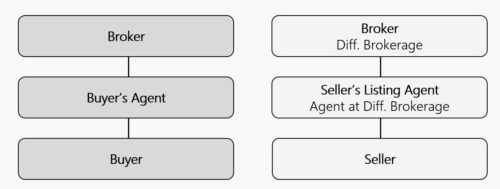
Typical Agency
In this case, you are represented by one broker while buying a house listed by another broker.
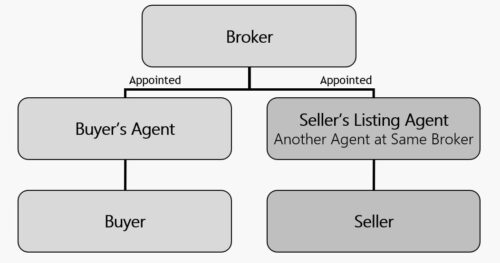
Intermediary Agency With Appointments
In this case, one broker is representing both you and the Seller…because the house that you are buying is listed with the same broker, but with a different agent. However, you have an appointed agent (Sheila Cox) and the Seller has an appointed agent (Unknown) and both agents have to maintain their fiduciary duties including confidentiality. So I am not allowed to share your private information with the other agent. This situation may occur frequently with large brokerages who have lots of listings.
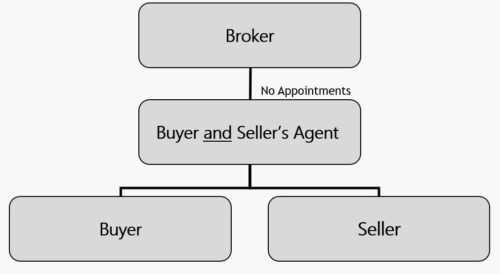
Intermediary Agency WithOUT Appointments
This situation may only occur if both the Seller and the Buyer agree to it in writing. In this situation, you are buying a house that I have listed for one of my other clients. I would be representing both you and the Seller, so my fiduciary responsibilities would be limited. Frankly, I don’t work these types of deals. If you wanted to buy one of my listings, then I would step back and find another real estate agent to be your appointed agent…so you would still have full representation.
Now you need to understand two more important things:
We use cookies to improve your experience on our site. By using our site, or submitting your email to request more information, you consent to Cookies and our Privacy Policy.
This website uses cookies
Websites store cookies to enhance functionality and personalise your experience. You can manage your preferences, but blocking some cookies may impact site performance and services.
Essential cookies enable basic functions and are necessary for the proper function of the website.
Name
Description
Duration
Cookie Preferences
This cookie is used to store the user's cookie consent preferences.
30 days
Statistics cookies collect information anonymously. This information helps us understand how visitors use our website.
Google Analytics is a powerful tool that tracks and analyzes website traffic for informed marketing decisions.
Used to monitor number of Google Analytics server requests when using Google Tag Manager
1 minute
_gac_
Contains information related to marketing campaigns of the user. These are shared with Google AdWords / Google Ads when the Google Ads and Google Analytics accounts are linked together.
90 days
__utma
ID used to identify users and sessions
2 years after last activity
__utmt
Used to monitor number of Google Analytics server requests
10 minutes
__utmb
Used to distinguish new sessions and visits. This cookie is set when the GA.js javascript library is loaded and there is no existing __utmb cookie. The cookie is updated every time data is sent to the Google Analytics server.
30 minutes after last activity
__utmc
Used only with old Urchin versions of Google Analytics and not with GA.js. Was used to distinguish between new sessions and visits at the end of a session.
End of session (browser)
__utmz
Contains information about the traffic source or campaign that directed user to the website. The cookie is set when the GA.js javascript is loaded and updated when data is sent to the Google Anaytics server
6 months after last activity
__utmv
Contains custom information set by the web developer via the _setCustomVar method in Google Analytics. This cookie is updated every time new data is sent to the Google Analytics server.
2 years after last activity
__utmx
Used to determine whether a user is included in an A / B or Multivariate test.
18 months
_ga
ID used to identify users
2 years
_gali
Used by Google Analytics to determine which links on a page are being clicked
30 seconds
_ga_
ID used to identify users
2 years
_gid
ID used to identify users for 24 hours after last activity
24 hours
Marketing cookies are used to follow visitors to websites. The intention is to show ads that are relevant and engaging to the individual user.
Facebook Pixel is a web analytics service that tracks and reports website traffic.



















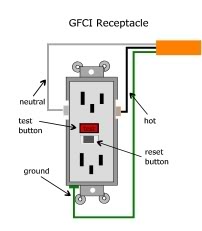 A ground-fault circuit interrupter (GFCI) is the only protection device designed to protect people against electric shock from an electrical system. Most of the time, these outlets are obvious with Test and Reset buttons. However, you can connect a regular outlet to an outlet with a GFCI so that it is protected, but it will not be obvious to the inspector. So if you know you have some outlets like this, especially in the kitchen or bathrooms, then clearly label those outlets and specify the GFCI outlet they are tied to. This is something that inspectors can’t just “know” by looking at it, so they will mistakenly report this on an inspection report.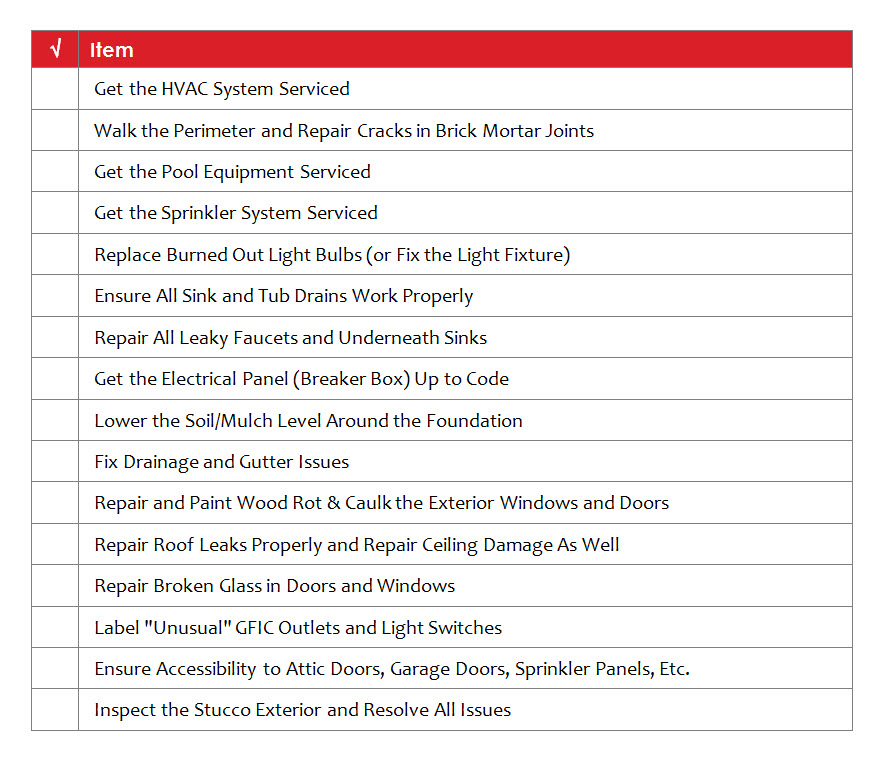

 What’s Included