—by Sheila Cox, Five Star Real Estate Agent | Updated April 2026—
Katy is so large that commute times may vary drastically depending on where you live in Katy…and where you are commuting. You can use Google Maps to estimate drive times from various locations.
Commute Times
The following tables shows the estimated Katye commute times to important places of interest. Times vary depending on route, traffic, wrecks, etc.
|
Place |
Miles Away |
Peak |
Off-Peak |
|
George Bush Intercontinental Airport |
44 |
55 mins |
44 mins |
|
Hobby Airport |
38 |
54 mins |
43 mins |
|
Texas Medical Center |
28 |
46 mins |
35 mins |
|
Downtown Houston |
30 |
42 mins |
32 mins |
|
Galleria |
23 |
38 mins |
26 mins |
|
Energy Corridor |
13 |
22 mins |
17 mins |
|
Kemah |
61 |
1 hr |
55 mins |
|
NASA |
55 |
62 mins |
50 mins |
|
Galveston |
79 |
1 hr 30 mins |
1 hr 20 mins |
*Peak Travel Time is general 7-9 a.m. and 4-6 p.m. Travel routes vary. LaCenterra address was used as the starting point.
The best way to estimate your commute time is to use Google Maps at the time you commute. Simply enter your work address and the address of the house you are interested in, and Google Maps will estimate your commute time. This time is based on the actual time you perform the search, so use it during your expected commute times.
Airport Access
Houston has two major airports, and both are accessible from Katy within about an hour depending on traffic.
George Bush Intercontinental Airport (IAH)
- Location: North Houston, near Humble.
- Distance from Katy: 45–55 miles (about 55 minutes to 1 hour 15 minutes).
- Access route: Typically, via Grand Parkway (99) north, connecting to the Hardy Toll Road or I-45.
- Use case: IAH is Houston’s largest airport, offering international flights and major domestic routes.
William P. Hobby Airport (HOU)
- Location: Southeast Houston, near Pasadena.
- Distance from Katy: 40–50 miles (about 55 minutes to 1 hour 20 minutes).
- Access route: Usually via I-10 east, then I-610 south, or Highway 59 to I-610.
- Use case: Hobby is smaller but convenient, serving primarily domestic flights (Southwest Airlines hub) and some international routes to Mexico and Latin America.
Tip: Always allow extra travel time when heading to airports, especially during rush hours. Morning flights can mean battling peak commuter traffic into Houston.
Major Highways and Roadways
Houston is famous (or infamous) for its highway system, and Katy sits right at the heart of several critical routes. Whether you’re commuting for work, heading into the city for dinner, or catching a flight, these highways define how you’ll move around.
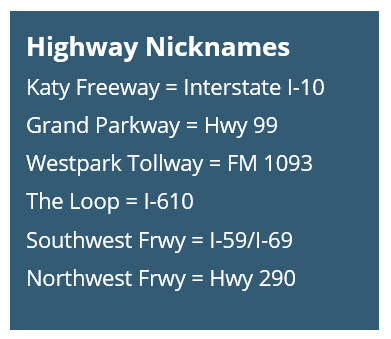
Interstate 10 (Katy Freeway)
Interstate 10, commonly known as the Katy Freeway, is the lifeline of the area. This eight-to-twelve-lane highway connects Katy directly to Downtown Houston and beyond. On the west side, it extends toward Sealy, Columbus, and eventually San Antonio; on the east side, it passes through Houston’s Energy Corridor, Galleria area, and straight into downtown.
I-10 is both a blessing and a challenge. On one hand, it makes Katy incredibly accessible. On the other, it’s one of the busiest freeways in the state. The good news is that the Katy Freeway underwent one of the largest freeway expansions in the country in the mid-2000s. Today, it includes managed lanes (toll lanes) that allow drivers to bypass the worst congestion if they’re willing to pay a fee. This makes commuting more predictable, especially during peak rush hours.
Grand Parkway (Highway 99)
The Grand Parkway, also known as Texas State Highway 99, is a massive outer loop that encircles much of the Houston metro area. In Katy, it intersects with I-10, creating a major junction that opens up commuting in multiple directions.
For residents, the Grand Parkway is essential. It connects Katy to other suburbs like Cypress, Sugar Land, Richmond, and The Woodlands. This makes it much easier to commute to job centers outside of Houston proper. For example, someone living in Katy can use Highway 99 to reach a corporate office in Sugar Land without ever dealing with downtown traffic.
The Grand Parkway also helps residents access shopping and entertainment outside their immediate area. With 99, you can get to places like First Colony Mall in Sugar Land or The Woodlands Mall to the north without needing to battle inner-city freeways.
Westpark Tollway
The Westpark Tollway is another important route, running east-west parallel to I-10 but further south. It begins just south of Katy and provides a direct route into Houston’s Westchase Business District and eventually toward the Galleria area.
For some commuters, the Westpark Tollway is a lifesaver. While it doesn’t extend all the way into Old Katy, it serves neighborhoods on the south side such as Cinco Ranch, Grand Lakes, and parts of Fulshear. If you live in these communities, you’ll often find the Tollway to be a faster alternative to I-10.
FM1463, FM 1093, and Local Connectors
Beyond the big highways, Katy is woven together by a network of farm-to-market roads and local connectors. Roads like FM1463, Fry Road, Mason Road, and FM 1093 play a major role in daily life. They connect neighborhoods to retail centers, schools, and job hubs. During rush hour, these local arteries can become just as busy as the freeways, but they’re critical for navigating the area.
Average Commute Times from Katy
If you’re relocating to Katy, one of the first lifestyle adjustments you’ll face is transportation. Katy offers a high quality of life, but like most Texas suburbs, it’s a car-centric community. Public transportation options are limited, and most errands, school drop-offs, and commutes will happen behind the wheel. Commute times are one of the biggest questions new residents have when considering a move to Katy. The truth is, commute times vary widely depending on where in Katy you live, what time you leave, and which job center you’re traveling to.
That said, Katy is well-positioned with direct access to Interstate 10 (I-10), the Grand Parkway (Highway 99), and the Westpark Tollway. These roads make it easy to reach Houston’s major job centers, shopping districts, and airports. The trade-off is dealing with traffic congestion, especially during rush hours.
Commute to the Energy Corridor
The Energy Corridor is one of Houston’s most important job centers, home to dozens of oil, gas, and engineering companies. It runs along I-10 between Highway 6 and Beltway 8.
- From Old Katy (north of I-10): 15–25 minutes without heavy traffic; up to 35–40 minutes during rush hour.
- From Cinco Ranch / south Katy: 20–30 minutes, depending on proximity to I-10 or the Westpark Tollway.
- Toll lane advantage: Using the I-10 managed lanes can shave 10–15 minutes off your drive during peak hours.
For many Katy residents, the Energy Corridor is close enough to feel almost like a local job hub. This is a major reason so many professionals choose Katy—it offers a suburban lifestyle without an overly long commute.
Commute to Downtown Houston
Downtown Houston is roughly 30 miles east of Katy along I-10. This is the commute that often worries newcomers the most, and for good reason.
- Morning commute (rush hour): 45–60 minutes is typical; on bad traffic days, it can stretch to 75–90 minutes.
- Off-peak hours: 30–40 minutes.
- Alternative routes: Some residents use the Park & Ride system (more on that below) to avoid driving entirely.
The commute to downtown is doable, but it requires planning. Many residents who work downtown adjust their hours to leave earlier in the morning and avoid the heaviest congestion.
Commute to the Galleria / Uptown
The Galleria area, another major business and shopping district, is located just inside the 610 Loop along I-610 at Highway 59.
- From Katy: 35–45 minutes with average traffic; closer to 60 minutes in heavy rush hour.
- Using the Westpark Tollway: This can be a faster option from south Katy, reducing the commute to 30–40 minutes.
Commute to Houston’s Medical Center
The Texas Medical Center, just south of Downtown Houston, is one of the largest medical complexes in the world.
- Average commute: 45–60 minutes by car, longer during peak times.
- Alternative: Some residents prefer Park & Ride options, which connect via bus routes into downtown and then light rail into the Medical Center.
Commute to Houston Airports
Katy residents also ask about access to airports. Houston has two major ones:
- George Bush Intercontinental Airport (IAH): Located on the north side of Houston, about 45–60 minutes from Katy via Highway 99 and Beltway 8 or the Hardy Toll Road.
- William P. Hobby Airport (HOU): Located Southeast of downtown, about 55–70 minutes from Katy, depending on traffic.
While neither airport is “close,” both are accessible within an hour to an hour and fifteen minutes, making business travel and vacations manageable.
Public Transportation and Park & Ride Options
Katy is so large that commute times may vary drastically depending on where you live in Katy…and where you are commuting. You can use Google Maps to estimate drive times from various locations. While Katy is primarily a car-dependent suburb, there are some public transit options for commuters who don’t want to deal with driving into Houston daily.
The METRO Park & Ride system has a large facility near the intersection of Grand Parkway and I-10. From here, buses run into Downtown Houston during peak commuting hours. Many residents find this option less stressful, as they can work, read, or relax during the ride.
Katy has two park and ride locations if you are commuting to Houston:
- 21669 Kingsland Blvd (Southeast Katy)
- 1030 W Grand Parkway (Central Katy)
Visit www.ridemetro.org for more information about other options such as ride matching, ride sharing, METRO lift, and the HOV system.
Destinations: Buses mainly serve Downtown, with connections to the Texas Medical Center and Greenway Plaza.
Schedule: Service is most frequent during peak morning and evening commute hours. Midday, late-night, or weekend service is limited.
Cost: Fares range from about $3–$5 per trip depending on distance.
This system is a lifesaver for residents who work downtown but don’t want to deal with the daily grind of Houston traffic or parking fees.
Limitations
- The Park & Ride doesn’t serve the Energy Corridor or Galleria directly, which are major job centers for Katy residents.
- There’s little intra-Katy transit. To get around Katy itself, you’ll still need a car.
- No light rail or subway systems exist in Katy or west Houston.
In short, the Park & Ride works well if you’re headed downtown, but otherwise, you’ll be driving.
Traffic Realities and Tips
Houston traffic has a reputation, and Katy is no exception. Rush hour typically stretches from 6:30–9:00 a.m. and 4:30–7:00 p.m., with the heaviest congestion on I-10. Fridays and rainy days are especially challenging.
 Here are some tips from seasoned Katy commuters:
- Leave early: A 15-minute difference in departure time can mean a 30-minute difference in arrival.
- Use toll roads strategically: The I-10 managed lanes and Westpark Tollway can save enormous time when traffic is at its worst.
- Work remotely when possible: Many employers now allow hybrid schedules, which can make commuting far more manageable.
- Plan errands around rush hour: Locals often avoid I-10 during peak times unless absolutely necessary.
Katy’s location is both its biggest draw and, for some, its biggest challenge. Yes, commuting into central Houston can be long, especially during peak hours. But the trade-off is significant: you get award-winning schools, safe neighborhoods, more house for your money, and a true sense of community.
For many families, that’s a trade they’re more than willing to make. With thoughtful planning—choosing the right neighborhood, leveraging toll roads, or using Park & Ride—Katy offers a very livable balance between suburban comfort and city accessibility.
When you move to Katy, you’ll quickly learn that location isn’t just about miles on a map—it’s about the lifestyle that comes with it. And for thousands of families each year, that lifestyle is exactly why they choose Katy as home.
Driving in Katy: The Basics
Transportation in Katy is about balance. Yes, you’ll need a car, and yes, you’ll face traffic. But the trade-off is access to excellent schools, neighborhoods, and community amenities. With I-10, 99, and the Westpark Tollway, you’re well-connected to Houston’s economic engine and airports.
If you plan ahead—budgeting for tolls, learning traffic patterns, and using Park & Ride when it makes sense—you’ll find commuting manageable. And once you’re settled, most of your daily needs will be just minutes away, reducing the stress of long drives.
Katy may not have the mass transit options of big cities, but it offers accessibility, convenience, and choice—all of which make it one of the most livable suburbs in Texas.
Car Culture in Houston/Katy
If you’re used to living in a city with subways or robust bus systems, Katy will feel very different. Almost every household here owns at least one car, and most own two or more. The community is spread out, and while neighborhoods are walkable within themselves, getting from one part of Katy to another usually requires driving.
Parking, fortunately, is rarely a problem. Most homes have two-car garages and driveways, and retail centers have ample free parking. Gas stations are plentiful, and fuel prices in Texas tend to be lower than the national average thanks to proximity to refineries.
How Toll Roads Work in Katy
If you’re new to Texas, toll roads may be confusing at first. Here’s what you need to know:
- Toll tags are essential. Cash booths are disappearing, and many tollways (like Westpark) don’t accept cash at all. Most residents use EZ TAGs (Harris County Toll Road Authority) or TxTags. Both work across most toll roads in Texas.
- Pay by mail is expensive. If you don’t have a tag, cameras will read your license plate and bill you by mail—often at higher rates plus fees.
- Variable pricing. Some toll lanes (like I-10’s managed lanes) change rates depending on time of day and congestion.
- Budgeting for tolls. Daily commuters can spend $100–$200+ per month on tolls. Factor this into your budget if you’ll rely heavily on toll roads.
Pro tip: If you’re house hunting, consider how far your commute is and whether it requires daily toll road use. Sometimes paying slightly more for a home closer to work saves money in the long run by reducing toll and fuel costs.
Tips for Navigating Katy Traffic
Houston traffic is notorious, and Katy is no exception. But with the right strategies, you can reduce frustration and save time.
- Know the Rush Hours
- Morning rush: 6:30 – 9:00 a.m.
- Evening rush: 4:30 – 7:00 p.m.
- Fridays and rainy days are especially congested.
If your work schedule allows, shifting your hours by even 30 minutes can dramatically change your commute experience.
- Use Traffic Apps
Apps like Waze and Google Maps are essential. Locals often check them before leaving home, since traffic conditions change quickly due to accidents or weather.
- Be Strategic with Toll Roads
Sometimes the extra cost of tolls is worth it. For example, using I-10’s managed lanes can save 15–20 minutes on a downtown commute. But if traffic is light, you can stick to the free lanes.
- Carpooling
If you have coworkers or neighbors heading the same direction, carpooling not only saves money on tolls and fuel but also allows you to use HOV lanes for faster travel.
- Consider Park & Ride
If you work downtown, the Park & Ride is almost always less stressful than driving yourself. The cost of bus fares is often less than parking fees downtown.
- Prepare for Weather
Houston’s weather can wreak havoc on traffic. Heavy rains may cause flooding in low-lying areas, and accidents are more common. Always check conditions before heading out and avoid flood-prone streets during storms.
- Think Local
When running errands, choose shopping centers and services close to home to minimize time in the car. Katy has grown enough that you rarely need to drive into Houston unless you’re commuting for work or seeking specialized entertainment.
Need Help Buying or Selling a Home in Katy?
Buying or selling a home is a major financial decision. You deserve an experienced local Realtor who knows the Katy-area neighborhoods, schools, property taxes, flood risks, market conditions, and all the little details that can make a BIG difference in your decision.
I’ve been helping Katy-area home buyers and sellers since 2009, and I’ve been recognized as a Five Star Real Estate Agent every year since 2010. More importantly, I’ll give you my frank opinion, point out things you may not know to investigate, and look out for YOUR best interests throughout the entire transaction.

Sheila Cox, Five Star Real Estate Agent since 2010 and creator of this entire website (KatyHomesForSaleTX.com) so you have proof she’s a local expert. 🙂


Why Work With Sheila?I’m not going to sell you on a house or neighborhood just because it’s beautiful, popular, or new. My job is to help you make a smart real estate decision. That means looking beyond the listing photos and helping you evaluate things like school zoning, flood risk, property taxes, resale considerations, neighborhood differences, inspections, repairs, contract deadlines, and the dozens of other details that can affect your purchase or sale. Sometimes the most valuable thing I can tell you is, “I wouldn’t buy this house.” Please read the list of my value-added services for home buyers |
Free Guides & Reports – What to Know Before You Buy
Use my free guides and reports to learn more about Katy neighborhoods, schools, new construction, market conditions, home buying, and other things you should understand before making a move.



Client Reviews of Sheila
Want to know what it’s like to work with me? Here’s what my past clients have to say.
READ REVIEWS