—by Sheila Cox, Five Star Real Estate Agent | Updated April 2026—
Katy TX Property Taxes–Unfortunately, property taxes in Texas are among the highest in the country. But before you panic, just remember that we don’t have a state income tax in Texas…so one sort of offsets the other. I tell my out-of-state clients to find out the state income taxes they paid last year and add that to their property taxes, and then compare that number to the property taxes here.
Each Katy subdivision (and there are over 200!) has different property tax rates…and they can change from year to year. Subdivisions in our newest neighborhoods, like Firethorne and Tamarron, tend to have the highest property tax rates (3.2 to 3.6) and subdivisions in our older neighborhoods, like Kelliwood or Nottingham Country, tend to have the lowest tax rates (2.2 to 2.8).
Older homes within the same neighborhood
may have lower tax rates than newer homes in newer sections.
The tax rate in a subdivision tends to go down over time. That doesn’t mean your taxes go down over time, because the home value is probably increasing, but your tax rate will probably decline with time.
One thing I like to point out though…our newer homes tend to be much more energy-efficient than our older homes; so you will save money in energy costs when you buy a newer home. That may help partially offset the higher taxes.
There are tax benefits and other benefits in owning your own home (which can make up for the high Katy property taxes). Please read The Benefits of Home Ownership to learn more.
Something else you need to know…the tax appraised value on a home does not usually equally the market value of the home in Texas. If a home is older, it’s tax appraised value may be significantly lower than it’s market value. So don’t use those numbers when calculating a sales price!
⇒ See How to Price a Home Correctly
You can read more about Texas property taxes so you are well-informed.
What is a MUD?
In most parts of Fort Bend County, neighborhood infrastructure is provided through a Municipal Utility District, commonly called a MUD. A MUD is a special-purpose local government entity created under Texas law to finance, build, and maintain essential utilities for a specific area—usually a residential community.
When a new subdivision is developed, the developer often forms a MUD to fund infrastructure such as water lines, sewer systems, drainage facilities, and sometimes roads, parks, or recreational amenities. Instead of the developer paying the full cost upfront, the MUD issues bonds to build these improvements. Those bonds are then repaid over time through property taxes collected from homeowners within the district.
For homeowners, this means that your property tax bill will typically include a separate MUD tax rate in addition to county, school district, and other local taxes. The MUD uses those tax revenues to repay infrastructure bonds and operate the district’s utilities. With a MUD you will have a monthly bill that covers your water, sewer, and trash service. In addition to that, your property taxes will include a portion that goes to the MUD. So they do add to your property tax bill.
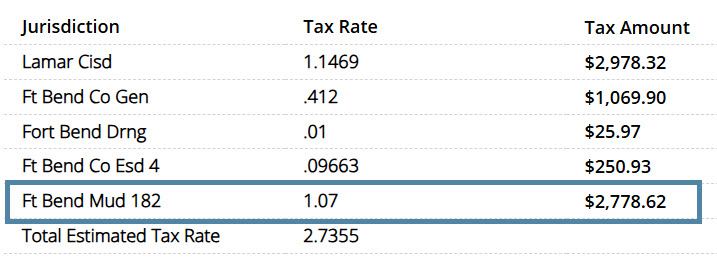
A MUD is governed by a board of directors, usually elected by residents who live within the district. This board makes decisions about budgets, tax rates, and ongoing infrastructure maintenance.
MUDs are very common in fast-growing suburban areas like Fort Bend County because they allow new communities to develop without requiring existing taxpayers in nearby cities to fund the infrastructure. There are PROs and CONs of having MUDs to provide utilities, but regardless of our opinions on them, you will be hard-pressed to find many neighborhoods in this area that are not assigned to a MUD.
Homestead Exemption
As a homeowner in Texas, your Homestead Tax Exemption is a large exemption to reduce the amount of Katy TX property taxes you pay. Applying for a Homestead Tax Exemption (mor
The deadline is not until the first one-year anniversary of Closing on your home.
Your application must include a copy of your new Texas Driver’s License or DPS Identification Card and the address on the driver’s license or identification card MUST be the same as the address on which you are filing an Application for Residence Homestead Exemption (because you can only get this exemption on ONE home you live in). Make an appointment to get your Texas driver’s license here.
Download the form to fill out and send in or you can eFILE it by clicking here.
You can get the appraisal district’s name and number here: Fort Bend County Appraisal District
If you have questions, please call the Fort Bend Tax Assessor-Collector Office at 281-341-3710 or go to: https://www.fbcad.org/
Need Help Buying or Selling a Home in Katy?
Buying or selling a home is a major financial decision. You deserve an experienced local Realtor who knows the Katy-area neighborhoods, schools, property taxes, flood risks, market conditions, and all the little details that can make a BIG difference in your decision.
I’ve been helping Katy-area home buyers and sellers since 2009, and I’ve been recognized as a Five Star Real Estate Agent every year since 2010. More importantly, I’ll give you my frank opinion, point out things you may not know to investigate, and look out for YOUR best interests throughout the entire transaction.

Sheila Cox, Five Star Real Estate Agent since 2010 and creator of this entire website (KatyHomesForSaleTX.com) so you have proof she’s a local expert. 🙂


Why Work With Sheila?I’m not going to sell you on a house or neighborhood just because it’s beautiful, popular, or new. My job is to help you make a smart real estate decision. That means looking beyond the listing photos and helping you evaluate things like school zoning, flood risk, property taxes, resale considerations, neighborhood differences, inspections, repairs, contract deadlines, and the dozens of other details that can affect your purchase or sale. Sometimes the most valuable thing I can tell you is, “I wouldn’t buy this house.” Please read the list of my value-added services for home buyers |
Free Guides & Reports – What to Know Before You Buy
Use my free guides and reports to learn more about Katy neighborhoods, schools, new construction, market conditions, home buying, and other things you should understand before making a move.


Client Reviews of Sheila
Want to know what it’s like to work with me? Here’s what my past clients have to say.
READ REVIEWS