Katy TX FAQs—If you’re thinking about moving to Katy or Fulshear, buying a home here, or simply trying to understand how the area works, you probably have a lot of questions. I hear many of the same questions from buyers every week, especially from people relocating to the Houston area.
The answers below are based on my firsthand experience helping people buy and sell homes throughout Katy and Fulshear for more than 17 years, as well as my experience living in the Katy area for more than 20 years. I’ll give you the practical answer first, then point you to a more detailed resource when you want to dig deeper.
Tip: Click any question below to open the answer.
Moving to Katy TX
Is Katy a good place to live?
For many people, yes. Katy is especially popular with buyers who want highly rated schools, master-planned communities, neighborhood amenities, newer homes, and convenient access to the Energy Corridor and other west Houston employment centers. You also get a wide range of neighborhoods, from older areas with mature trees to large new-construction communities.
That said, Katy is not one single lifestyle. Southwest Katy, Southeast Katy, Northwest Katy, and Northeast Katy can feel very different from one another. Commute time, school zoning, property taxes, flood risk, home age, and neighborhood amenities can vary significantly depending on where you buy.
If you are relocating, start with my Katy Relocation Guide and read my detailed page about living in Katy TX.
What should you know before moving to Katy?
The first thing I think you should know is that “Katy” is much larger than the incorporated City of Katy. Most people who say they live in Katy actually live in Greater Katy, which stretches across parts of Harris, Fort Bend, and Waller counties. That matters because tax rates, school zoning, utilities, flood considerations, and even commute routes can change from one neighborhood to another.
You should also understand that choosing the right neighborhood usually matters more than choosing a ZIP code. Two homes only a few miles apart may have very different school assignments, tax rates, commute times, and resale demand.
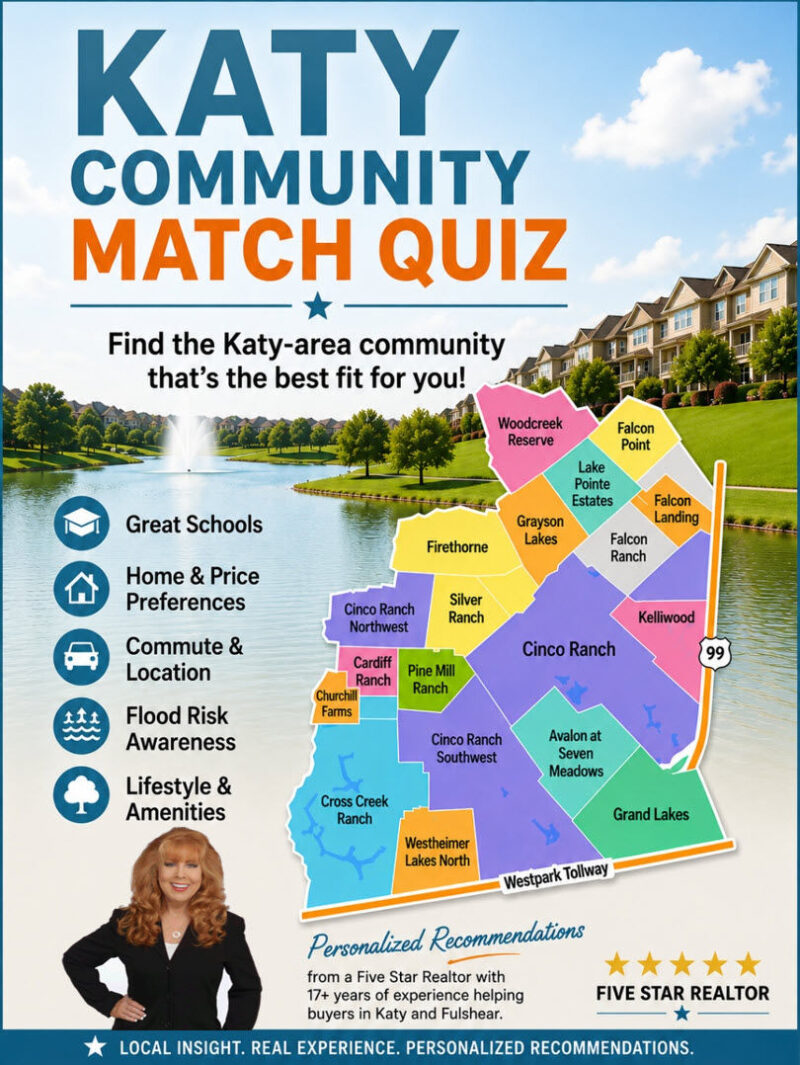
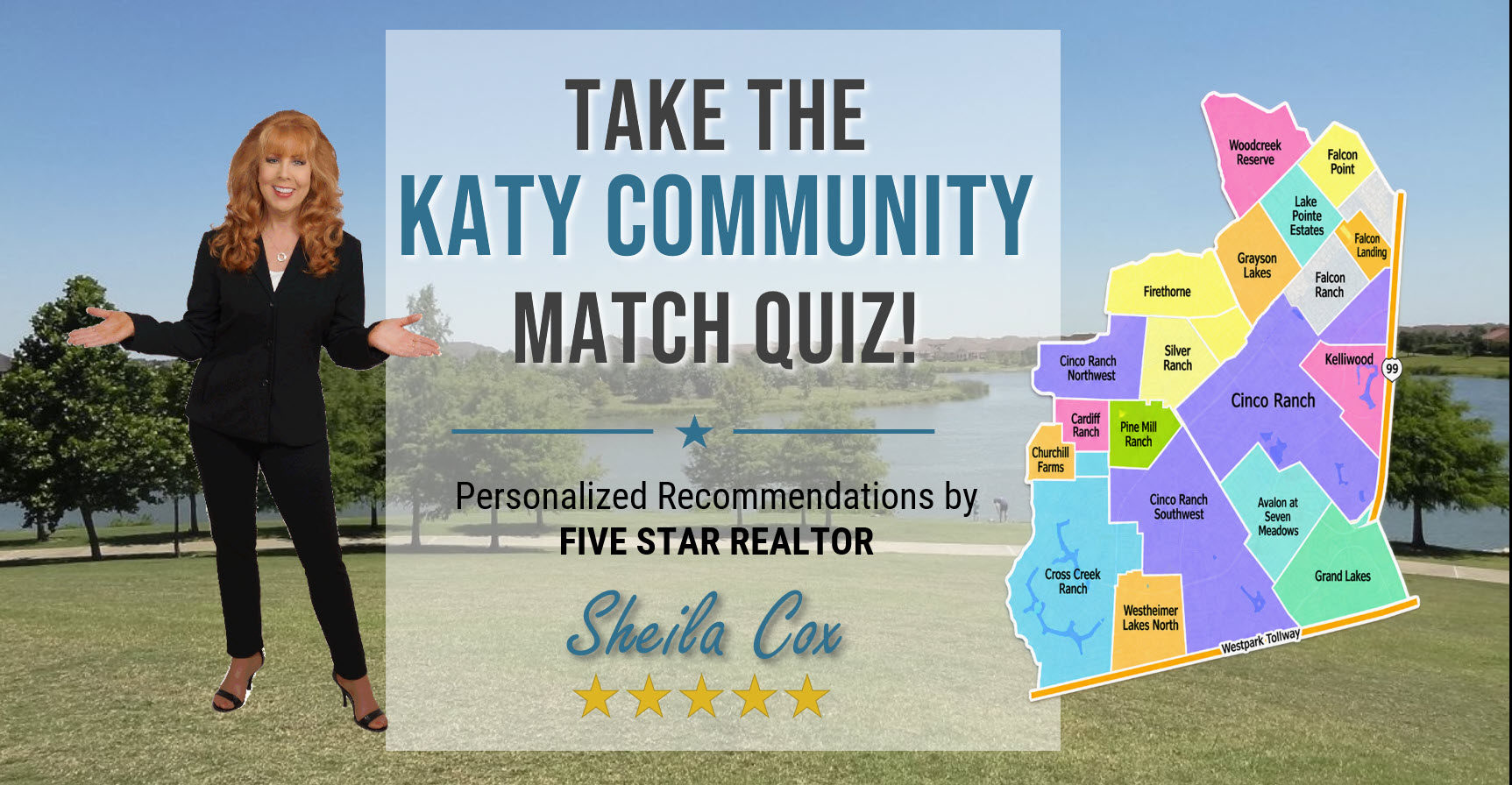
Before you begin touring homes, I recommend narrowing down the areas that fit your lifestyle first. Take my Katy Community Match Quiz to get my personalized recommendations based on YOUR criteria.
Is Katy or Fulshear better?
Neither one is automatically “better.” The right choice depends on what matters most to you. Katy generally gives you more established shopping, restaurants, medical facilities, employment access, and a wider range of neighborhoods and home ages. Fulshear tends to appeal to buyers who want newer construction, newer master-planned communities, and in some cases larger lots or a more suburban-to-rural feel.
The biggest trade-off with Fulshear is location. It is farther west, so your commute may be longer depending on where you work, and some residents still drive into Katy for major shopping, dining, and services.
If you are comparing the two, look at your commute, school preferences, tax rates, and desired home age before deciding. You can explore my Fulshear neighborhoods page along with my Katy neighborhood information. Or, better yet, take my Katy Community Match Quiz to get personalized recommendations based on YOUR criteria.
What does it cost to live in Katy?
In my experience, your cost of living in Katy depends heavily on the home and neighborhood you choose. The mortgage payment is only one part of the picture. Property taxes can vary substantially between neighborhoods and even between sections of the same master-planned community. You may also have HOA fees, MUD taxes, homeowner’s insurance, flood insurance, utilities, and commuting costs.
Newer neighborhoods can sometimes have higher tax rates because of MUD or infrastructure-related taxes, while older established neighborhoods may have lower rates. Larger homes, pools, oversized lots, and long commutes can also increase your monthly expenses.
When I help buyers compare homes, I recommend looking at the estimated total monthly ownership cost instead of comparing list prices alone. My Katy Relocation Guide can help you understand these local differences before you buy.
How difficult is commuting from Katy?
It depends almost entirely on where you work, what time you travel, and which side of Katy you choose. Katy is located west of Houston, so it is especially convenient for people working in the Energy Corridor and other west Houston employment areas. Downtown, the Texas Medical Center, and some northern or southern job centers can involve much longer drives.
I always recommend checking commute times during your actual expected rush hour, not on a Sunday afternoon when traffic is light. Your route may involve I-10, Grand Parkway, Westpark Tollway, or local roads, and the best neighborhood for you can change dramatically based on that route.
See my detailed Katy commute times and traffic guide before deciding which part of Katy makes the most sense.
What are the advantages and disadvantages of living in Katy?
I’ve lived in the area over 20 years, and I believe Katy offers the most advantages: strong schools in many areas, attractive master-planned communities, plenty of neighborhood amenities, a large selection of homes, good access to west Houston, and extensive shopping, dining, medical, and recreational options. You can also choose among established neighborhoods, luxury communities, and new construction.
The disadvantages are mostly the flip side of growth. Traffic can be frustrating, property taxes can be high, newer neighborhoods may have higher tax rates, summers are hot and humid, and flood risk must be evaluated carefully. Rapid growth also means school boundaries, roads, and surrounding development can change.
That is why I don’t recommend choosing a home based only on photos or an online ranking. Start with your daily lifestyle and priorities, then compare neighborhoods. My Katy Relocation Guide will help you weigh the trade-offs.
Katy Neighborhoods
What are the best neighborhoods in Katy?
The “best” Katy neighborhood depends on what you want. A neighborhood that is perfect for someone who wants mature trees and a short commute may not be the best choice for someone who wants brand-new construction and resort-style amenities.
Some buyers prioritize highly rated schools. Others care more about lower property taxes, larger lots, newer homes, walkability to amenities, or proximity to I-10. I also look at long-term resale demand, flood considerations, HOA quality, and how well the neighborhood fits your price range.
Instead of relying on a generic Top 10 list, use my Best Katy Communities page as a starting point, then compare individual communities through my Katy neighborhoods information. Or, better yet, take my Katy Community Match Quiz to get personalized recommendations based on YOUR criteria.
Which part of Katy is best for you?
I usually recommend thinking about Katy in four broad areas: Southwest, Southeast, Northwest, and Northeast. Each has a different mix of home ages, prices, schools, tax rates, commute routes, and new construction.
Southwest Katy is popular with buyers who want established master-planned communities and highly regarded schools. Southeast Katy includes many established neighborhoods and can provide excellent access toward Houston. Northwest Katy has experienced tremendous new-construction growth, while Northeast Katy generally offers older and often more affordable housing.
Your best area depends on your budget, commute, school preferences, desired home age, and tolerance for higher tax rates. Start with my Katy homes by area page so you can compare the four parts side by side. Or, better yet, take my Katy Community Match Quiz to get personalized recommendations based on YOUR criteria.
What is the difference between Southwest and Northwest Katy?
Southwest Katy and Northwest Katy are two of the fastest ways to understand how different the Katy market can be. Southwest Katy, generally south of I-10 and west of Grand Parkway, includes many established master-planned communities, mature landscaping, and some of Katy’s most sought-after school zones.
Northwest Katy, north of I-10 and west of Grand Parkway, has seen tremendous growth in newer master-planned communities and new construction. You may get a newer home and modern amenities there, but you should pay close attention to tax rates, school maturity, infrastructure growth, and flood zones in some locations.
Neither area is automatically better. It comes down to what you value. You can compare both areas through my Katy homes by area guide.
Which Katy neighborhoods have new construction?
You will find new construction throughout the Katy and Fulshear area, but the largest concentration is generally in the growth corridors to the west and northwest. Communities such as Sunterra, Grange, Katy Court, and other newer developments continue to add homes, while Fulshear also has substantial new construction.
When comparing new neighborhoods, don’t look only at the model homes and builder incentives. I recommend comparing total tax rates, future development plans, school zoning, flood maps, HOA fees, commute routes, and the builder’s reputation. A lower purchase price can be offset by a higher tax rate.
You can browse current options on my Katy new homes for sale page, and read my article on new construction versus resale.
Which neighborhoods have mature trees?
If mature trees are high on your wish list, focus primarily on established Katy neighborhoods rather than brand-new communities. Older areas in Southeast Katy, parts of Southwest Katy, and established sections of communities such as Cinco Ranch and Grand Lakes have had decades for landscaping to mature.
New-construction neighborhoods can be beautiful, but the trees are usually young and it may take many years before the streets have the shaded, established look you see in older communities. This is one of those lifestyle differences that is difficult to judge from listing photos alone.
When you tell me you want mature trees, I usually narrow your search by neighborhood age before worrying about individual houses. Browse my Katy neighborhoods pages to compare established and newer communities.
Which neighborhoods have lower property taxes?
In general, older established neighborhoods may have lower tax rates than brand-new master-planned communities because some of the infrastructure-related debt has already been paid down. However, you cannot assume that every older neighborhood has low taxes or every newer neighborhood has high taxes.
Tax rates can vary by MUD, school district, county, emergency services district, and other taxing entities. They can even vary between subdivisions inside the same master-planned community. That is why I check the specific property instead of quoting one tax rate for an entire neighborhood.
If lower taxes are important to your budget, tell your Realtor before you begin touring homes so tax rates can be part of the search criteria. My neighborhood pages also include local tax information where available.
Which Katy neighborhoods are closest to Houston?
Generally, neighborhoods on the east and southeast sides of Greater Katy are closer to Houston, especially communities near I-10, Fry Road, Mason Road, and the eastern side of Grand Parkway. If your job is in the Energy Corridor, these locations may significantly reduce your commute compared with communities farther west.
But “closest” is not always the same as “fastest.” A neighborhood may be geographically closer while having a slower route to the freeway. Your exact work location and travel time matter more than mileage alone.
I recommend testing the commute from the actual neighborhood during your normal work hours. My Katy commute guide explains the major routes and realistic travel considerations.

Katy Homes for Sale
How much do homes cost in Katy?
Katy has a very wide range of home prices, so there is no single useful “average” that tells you what you will actually spend. Prices vary by neighborhood, school zone, home age, lot size, condition, amenities, and location. Entry-level homes and older homes may be available at much lower prices than homes in luxury communities or newer master-planned neighborhoods.
Instead of asking only, “What is the average Katy home price?” I recommend deciding what monthly payment and total ownership cost fit your budget, then seeing which neighborhoods offer the best match.
You can browse current listings organized by price, neighborhood, area, school, and home type on my Katy Homes for Sale page.
Is Katy currently a buyer’s or seller’s market?
Katy is too large and diverse to label the entire area as one buyer’s or seller’s market. Market conditions can be very different by neighborhood and price range. One community may have low inventory and multiple buyers competing for well-priced homes, while another may have months of available inventory and give buyers much more negotiating leverage.
This is why broad Houston or Katy headlines can be misleading. When I evaluate the market for a buyer or seller, I look at active competition, recent sales, days on market, price reductions, and months of inventory for the specific neighborhood and price range.
For current data, see my Katy Real Estate Market Report, which breaks the market down beyond the citywide averages.
Should you buy new construction or a resale home?
Both can be excellent choices, but they offer different advantages. New construction gives you a never-lived-in home, current design trends, newer systems, and often attractive builder incentives. Resale homes may offer better locations, mature landscaping, established school zones, proven neighborhood resale history, and potentially lower property tax rates.
One mistake I see buyers make is comparing only the purchase price. A new home with a higher tax rate can cost more per month than a slightly more expensive resale home. You should also compare lot size, included upgrades, builder warranties, HOA fees, and future development around the neighborhood.
My detailed guide to buying new versus resale in Katy walks you through the trade-offs.
How competitive is the Katy housing market?
Competition varies dramatically by neighborhood, price range, home condition, and time of year. A beautifully updated home in a popular school zone may attract strong interest very quickly, while an overpriced home in a neighborhood with more inventory may sit for weeks or months.
For buyers, the important question is not whether “Katy” is competitive. It is whether the homes you want are competitive. I look at recent comparable sales, current inventory, days on market, and seller behavior before recommending how aggressively you should structure an offer.
You can monitor current conditions through my Katy Market Report. If you are actively buying, my VIP Buyer Services explain how I help you evaluate each property and negotiation individually.
What can you buy in Katy at different price points?
Your buying power in Katy changes significantly by area. At the same price point, you might choose between an older, larger home in an established neighborhood, a smaller new-construction home in a newer community, or a home with better schools but fewer upgrades. The trade-offs are very local.
This is why I like to show relocating buyers several different neighborhoods early in the process. Once you see what the same budget buys in Southwest, Northwest, Southeast, or Northeast Katy, your priorities usually become much clearer.
My Katy Homes for Sale page lets you browse listings by price and other criteria, which is a useful way to understand your options before scheduling tours.
How should you search for homes before relocating?
Start by narrowing the area before falling in love with individual houses. When you are relocating, it is easy to save dozens of attractive listings that are scattered across Katy without realizing they have completely different commutes, schools, tax rates, or flood considerations.
I recommend deciding on your commute tolerance, budget, school preferences, desired home age, and must-have neighborhood features first. Then build a home search around the areas that fit those criteria. That keeps you from wasting time on homes that look great online but do not fit your real-life needs.
Use my Katy Relocation Guide to understand the area, then browse my Katy Homes for Sale page or request a customized search.
Katy Schools
How are Katy schools rated?
Katy ISD has many highly rated schools, but you should not assume every school in the district has the same rating. Katy ISD is a very large and growing district, so school performance varies by campus. That is normal for a district with dozens of elementary, junior high, and high schools.
When buyers tell me schools are important, I recommend evaluating the specific schools assigned to a home rather than relying only on the school district name. You should also look beyond a single rating website and consider state accountability data, programs, course offerings, and what matters to your family.
My Katy schools information and free Katy Schools Report can help you compare local schools more carefully.
How do you verify a home’s school zoning?
Always verify school zoning directly with the school district before making a purchase decision. Real estate websites, old listing information, and even neighborhood marketing materials can become outdated when boundaries change.
For Katy ISD homes, use the district’s official school assignment tools with the property’s exact address. This is especially important in fast-growing areas where new schools open and attendance boundaries may be adjusted.
I also check school zoning while helping buyers evaluate homes, but I still recommend that you independently verify the assignment before closing because school districts control those boundaries. My Katy Schools page explains more about how school zoning works in this area.
Can Katy school boundaries change?
Yes. School boundaries can and do change, especially in rapidly growing areas. When a new school opens, the district may redraw attendance zones to balance enrollment. That means a home assigned to one school today is not guaranteed to remain assigned to that school forever.
This is particularly important when you are buying in a new-construction area where population growth is happening quickly. I never recommend buying a house based solely on the assumption that a particular school assignment will remain permanent.
You should verify current zoning with the district and review any announced rezoning plans before buying. My free Katy Schools Report and Katy Schools page provide additional context about local schools and ratings.
Does every home with a Katy address attend Katy ISD?
No. A Katy mailing address does not automatically mean the property is zoned to Katy ISD. Greater Katy extends across a large area, and mailing addresses do not always match school-district boundaries.
This is one of the reasons I tell relocating buyers not to rely on the city name shown in an online listing. You need to verify the exact school district and the exact campus assignments for the property address.
The same issue can occur in communities near Fulshear, where different sections of a large development may be assigned to different school districts. Before buying, verify directly with the appropriate district. My Katy Schools page will help you understand the local school landscape.
How do schools affect Katy home values?
School reputation can have a significant effect on buyer demand and resale value in Katy. Homes zoned to highly sought-after schools often attract more buyers, even from people who do not currently have school-aged children, because many buyers believe strong schools support long-term neighborhood demand.
However, school ratings are not the only factor affecting value. Location, home condition, tax rate, neighborhood amenities, flood risk, lot characteristics, and market supply all matter too. A highly rated school does not automatically make every home a good investment.
When I analyze value, I compare homes within the same neighborhood and school environment whenever possible. My Katy Market Report and school resources can help you see how these factors work together.
Taxes and Homeownership Costs
How high are Katy property taxes?
Katy property taxes can be high compared with many parts of the country, but there is no single Katy tax rate. Your total rate depends on the specific taxing entities that apply to the property, including the school district, county, MUD or other special districts, and sometimes additional local entities.
This is why two similarly priced homes can have noticeably different monthly payments. Newer communities may have higher tax rates because infrastructure is still being financed, while some established neighborhoods may have lower rates.
When comparing homes, always calculate the actual estimated taxes for the specific property instead of using a citywide assumption. I also recommend checking the current appraisal and exemptions because those can affect what the seller is paying versus what you may pay after purchase.
What is a MUD tax?
A MUD is a Municipal Utility District. In many Houston-area communities, a MUD helps finance and provide infrastructure such as water, sewer, drainage, and related services in areas that were developed outside a city’s traditional utility system.
The MUD may levy a property tax to repay bonds and fund operations. That tax becomes one part of your total property tax rate. In some established districts the MUD tax can decline as debt is paid down, while newer communities may have higher rates.
MUDs are extremely common in the Katy area, so having one is not automatically a negative. What matters is understanding the total tax rate and how it affects your monthly ownership cost. Always compare the actual tax rates of the specific homes you are considering.
Why do tax rates vary among Katy neighborhoods?
Tax rates vary because different properties can be served by different taxing entities. Even within the same general Katy area, homes may fall into different counties, MUDs, emergency service districts, or other special districts. Newer neighborhoods may also carry infrastructure-related taxes that established areas no longer have at the same level.
Large master-planned communities can be especially confusing because separate sections may have different MUDs and therefore different total tax rates. That means you should not assume the tax rate shown for one home applies to every home in the neighborhood.
When you are comparing two houses, ask for the exact current tax rate for each property and calculate the estimated annual tax using a realistic purchase-price assumption.
How much are Katy HOA fees?
HOA fees vary widely by neighborhood. A community with basic common-area maintenance may charge relatively modest annual dues, while a large master-planned community with multiple pools, fitness facilities, lakes, trails, staffed amenities, or gated sections may charge considerably more.
Some properties can also be subject to more than one association or additional fees depending on the section. HOA dues can change, so do not rely on an old online listing when you are making a buying decision.
I recommend reviewing the current HOA information, transfer fees, deed restrictions, and any additional assessments during your due-diligence period. My individual Katy neighborhood guides include HOA and amenity information where available.
What other expenses should you consider before buying?
In addition to your mortgage, property taxes, and HOA fees, budget for homeowner’s insurance, possible flood insurance, utilities, maintenance, repairs, lawn care, pest control, and commuting costs. If the home has a pool, expect additional maintenance and utility expenses.
New homes need maintenance too, even if major systems are covered by warranties. Older homes may require more immediate replacement of roofs, HVAC systems, water heaters, or other components. Your home inspection can help identify likely short-term costs.
For relocating buyers, I also recommend thinking about toll-road expenses because many Katy commuters use Grand Parkway or Westpark Tollway. The true cost of a home is the total monthly and annual lifestyle cost, not just the purchase price.
Flooding and Due Diligence
Did Katy flood during Hurricane Harvey?
Yes, some parts of Katy flooded during Hurricane Harvey in 2017, but the impact was not uniform across the area. Homes near the Addicks and Barker Reservoirs, natural bayous, creeks, and certain lower-lying locations experienced some of the most serious problems. Many Katy neighborhoods did not have homes flood, even during that historic storm.
That distinction matters because national news coverage can make it sound as though the entire Katy area flooded. It did not. At the same time, you should never assume that a home is low-risk simply because it did not flood during Harvey.
My free Katy Flood Report explains Harvey, local flood zones, and the due diligence I recommend before you buy.
Which parts of Katy have higher flood risk?
Higher-risk locations are generally associated with mapped floodplains, bayous, creeks, drainage channels, reservoirs, and other natural or engineered water features. Some new-construction neighborhoods also contain sections in 100-year or 500-year flood zones, so “new” does not automatically mean lower flood risk.
I do not recommend labeling an entire ZIP code or large neighborhood as safe or unsafe. Flood risk can change from one section or even one street to another. You need to evaluate the exact property.
Before buying, review official flood maps, the Seller’s Disclosure, prior flood history when available, and the home’s relationship to nearby drainage features. My Katy Flood Report includes maps and explains what I watch for when helping buyers.
How can you check a home’s flood zone?
Start with official FEMA flood maps and local flood-control resources, then evaluate the exact property address rather than relying on a generalized neighborhood rating. You should also review the Seller’s Disclosure for reported flood history and ask questions if anything is unclear.
I recommend using more than one source because online real estate websites sometimes simplify flood information into a single score that does not tell you everything you need to know. The home’s elevation, nearby drainage, bayous, reservoirs, and historical conditions may all provide useful context.
My Katy Flood Report explains the maps and shows you how I approach flood due diligence with buyers before they make a decision.
Do you need flood insurance in Katy?
Whether flood insurance is required depends on the property, flood zone, and lender requirements. A lender may require flood insurance for a home in certain higher-risk flood zones. Homes outside those zones may not have the same lender requirement.
However, “not required” does not mean “no risk.” Flooding can occur outside mapped high-risk zones, especially during extreme weather. Because Katy is part of the Gulf Coast region, I generally encourage buyers to investigate flood-insurance options even when coverage is not required.
You should discuss the specific property with your insurance professional and obtain a quote before your option period ends. My free Katy Flood Report gives you additional local context.
Is Flood Zone X completely risk-free?
No. Flood Zone X generally indicates lower mapped flood risk than the Special Flood Hazard Areas, but it does not mean a property has zero chance of flooding. Flood maps are risk-management tools, not guarantees.
Storm intensity, drainage conditions, development patterns, blocked drainage, and other factors can create flooding outside mapped high-risk zones. Hurricane Harvey also demonstrated why historical experience alone should not be treated as a guarantee of future conditions.
When I help a buyer evaluate a home, I look at the flood map as one part of the due-diligence process rather than the only answer. Read my Katy Flood Report for a more complete explanation of local flood risk.
What other neighborhood risks should you investigate?
Flood risk is only one part of neighborhood due diligence. You should also investigate future development, nearby roads, utility corridors, drainage features, tax rates, HOA restrictions, school zoning, crime data, noise sources, and anything else that could affect your quality of life or resale value.
For new-construction communities, I pay special attention to what has not been built yet. Vacant land near the home may eventually become apartments, retail, schools, roads, or other development. You should never assume today’s view or traffic pattern will remain unchanged.
My neighborhood guides are designed to help you evaluate more than pretty photos and amenities. Start with my Katy neighborhoods information and then verify anything especially important to you independently.
Lifestyle and Commuting
How long is the commute from Katy to Houston?
There is no single answer because Houston is enormous. A commute from Katy to the Energy Corridor may be relatively manageable, while a drive to Downtown, the Galleria, the Texas Medical Center, or another side of the metro area can take considerably longer, especially during rush hour.
Your Katy neighborhood also matters. Living five or ten miles farther west can add meaningful time to your daily drive. Toll roads such as Westpark Tollway or Grand Parkway may help in some cases, but they add cost.
Before choosing a neighborhood, test the route in Google Maps during the actual time you expect to commute. My Katy commute times page gives you realistic examples and explains the major routes.
What is there to do in Katy?
Katy has plenty to do, especially if you enjoy restaurants, shopping, parks, sports, family activities, and community events. LaCenterra at Cinco Ranch is one of the best-known dining and shopping destinations, and the area also has parks, trails, golf, entertainment venues, youth sports, and easy access to Houston attractions.
Many master-planned communities have their own pools, playgrounds, lakes, trails, fitness facilities, and resident events, so your neighborhood can become an important part of your lifestyle.
If you are relocating, I recommend spending a day exploring the area before you tour homes. My Things To Do in Katy information and self-guided Katy tour can help you get a feel for the community.
What is the difference between the City of Katy and Greater Katy?
The incorporated City of Katy is relatively small. Greater Katy is the much larger suburban area that people commonly mean when they say they live in Katy. Greater Katy spans portions of Harris, Fort Bend, and Waller counties and includes many large master-planned communities outside the official city limits.
This distinction is important because your mailing address may say Katy while your property taxes, utilities, school district, and local services are provided by other entities. It also explains why there can be such enormous differences between neighborhoods that all have a Katy address.
My Katy TX guide explains the geography in more detail and will help you understand how the area is organized before you begin a home search.
Is Katy walkable?
Overall, Katy is a suburban, car-oriented area rather than a highly walkable city. Most residents drive to work, shopping, restaurants, and schools. However, many individual master-planned communities are very walkable internally because they include miles of trails, parks, lakes, and neighborhood amenities.
Some areas also place homes closer to shopping and dining than others. If walkability is important to you, define what you mean by it. Walking for recreation inside the neighborhood is much easier to find than being able to walk from home to groceries, restaurants, and work.
Tell your Realtor that walkability matters before you start searching, because it can help narrow your neighborhood choices considerably. My Katy neighborhood guides describe amenities and locations in detail.
What is daily life in Katy really like?
For most residents, daily life in Katy feels suburban and convenient. You have grocery stores, restaurants, medical care, shopping, schools, and neighborhood amenities close by, while still being connected to the much larger Houston metro area.
The trade-offs are traffic, hot summers, and the realities of living in a rapidly growing region. Your experience also depends heavily on your neighborhood. Living in an established community with mature trees feels different from living in a new community where homes, schools, and retail are still being built.
If you are relocating, I strongly recommend spending time here before choosing a house. Drive your potential commute, visit grocery stores and restaurants, and tour neighborhoods at different times of day. My Katy Relocation Guide will help you plan what to evaluate.
Katy Real Estate Market
Are Katy home prices increasing or decreasing?
It depends on the specific neighborhood, price range, and time period you are measuring. Katy does not behave like one single real estate market. Some neighborhoods may be appreciating while others are flat or experiencing more price reductions because of higher inventory or competition from new construction.
That is why I do not rely on one citywide percentage when advising a buyer or seller. I look at recent comparable sales, active listings, price reductions, days on market, and inventory within the specific neighborhood.
If you want current information, use my Katy Real Estate Market Report. It is designed to show you what is happening at a much more useful local level than broad Houston headlines.
How long does it take to sell a home in Katy?
It can range from days to months depending on the neighborhood, price, condition, competition, and how accurately the home is priced. Well-prepared homes in strong-demand areas can sell quickly, while overpriced properties may sit on the market and require multiple price reductions.
I pay close attention to the median days on market for the specific neighborhood and price range, but even that number needs context. A unique luxury home behaves very differently from a typical mid-priced resale home.
If you are thinking about selling, the best estimate comes from analyzing your direct competition and recent comparable sales. My Katy Market Report provides current local context, and you can also request a professional analysis of your home’s value.
What are months of inventory?
Months of inventory is a way to estimate how long it would take to sell the current supply of homes if no new listings came on the market, based on the current sales pace. It is one of the tools Realtors use to judge the balance between supply and demand.
Lower inventory generally gives sellers more leverage because buyers have fewer choices. Higher inventory usually gives buyers more options and can create stronger negotiating opportunities. But the number only becomes truly useful when you calculate it for the specific neighborhood and price range.
A Katy-wide inventory number can hide major differences between communities. My Katy Real Estate Market Report explains local market statistics and why neighborhood-level data matters.
Which Katy neighborhoods have maintained their value?
Neighborhoods with consistent buyer demand, attractive amenities, desirable locations, established resale history, and strong school reputations often show more resilience over time. But no neighborhood is guaranteed to appreciate, and performance changes with market conditions.
I also look at how much direct competition a neighborhood faces. An established community with limited new supply can behave differently from a newer area where builders continue releasing hundreds of homes and offering incentives that compete with resale sellers.
If long-term value is important to you, don’t rely only on a neighborhood’s reputation. Review actual sales history and current market conditions. My Katy Market Report and individual neighborhood pages can help you evaluate those patterns.
When is the best time to buy or sell in Katy?
There is no perfect month that works for everyone. Spring and early summer often bring more buyers and more listings because families prefer to move around the school calendar. That can help sellers, but it can also mean buyers have more competition.
Fall and winter may have fewer listings, but motivated sellers can sometimes be more flexible. Interest rates, inventory, builder incentives, your personal timeline, and the specific neighborhood can matter much more than the season.
If you are buying, the best time is usually when your finances and life circumstances are ready and you can find the right home at a price you are comfortable with. If you are selling, I recommend looking at your neighborhood’s current competition before choosing a date. See my Katy Market Report for current conditions.
Still Have Questions About Katy?
If you’re trying to decide where to live in Katy or Fulshear, you don’t have to figure everything out from online rankings and listing websites. I can help you compare neighborhoods based on your commute, budget, school preferences, property taxes, flood concerns, home style, and the way you actually want to live.
Start with my Katy Relocation Guide, explore Katy Homes for Sale, or contact me when you’re ready for help.
Need Help Buying or Selling a Home in Katy?
Buying or selling a home is a major financial decision. You deserve an experienced local Realtor who knows the Katy-area neighborhoods, schools, property taxes, flood risks, market conditions, and all the little details that can make a BIG difference in your decision.
I’ve been helping Katy-area home buyers and sellers since 2009, and I’ve been recognized as a Five Star Real Estate Agent every year since 2010. More importantly, I’ll give you my frank opinion, point out things you may not know to investigate, and look out for YOUR best interests throughout the entire transaction.

Sheila Cox, Five Star Real Estate Agent since 2010 and creator of this entire website (KatyHomesForSaleTX.com) so you have proof she’s a local expert. 🙂


Why Work With Sheila?I’m not going to sell you on a house or neighborhood just because it’s beautiful, popular, or new. My job is to help you make a smart real estate decision. That means looking beyond the listing photos and helping you evaluate things like school zoning, flood risk, property taxes, resale considerations, neighborhood differences, inspections, repairs, contract deadlines, and the dozens of other details that can affect your purchase or sale. Sometimes the most valuable thing I can tell you is, “I wouldn’t buy this house.” Please read the list of my value-added services for home buyers |
Free Guides & Reports – What to Know Before You Buy
Use my free guides and reports to learn more about Katy neighborhoods, schools, new construction, market conditions, home buying, and other things you should understand before making a move.

Client Reviews of Sheila
Want to know what it’s like to work with me? Here’s what my past clients have to say.
READ REVIEWS